


Listen to the article
The temporary closure of airspace over El Paso, Texas on Wednesday has heightened concerns about Mexican drug cartels’ increasingly sophisticated use of drone technology. While U.S. officials initially attributed the closure to cartel drone incursions, this explanation was later questioned by other sources familiar with the situation.
The incident has nonetheless drawn attention to how criminal organizations have modernized their operations through unmanned aerial systems. According to Steven Willoughby, deputy director of the Department of Homeland Security’s counter-drone program, cartels employ drones almost daily to transport drugs across the border and monitor Border Patrol movements.
Data presented to Congress in July revealed that in the last six months of 2024, authorities detected more than 27,000 drones within 500 meters of the U.S. southern border, with most activity occurring after dark.
This aerial dimension of drug trafficking has deep historical roots in the region. In the 1990s, Ciudad Juarez-based drug kingpin Amado Carrillo Fuentes, founder of the Juarez Cartel, earned the moniker “The Lord of the Skies” for his extensive use of small aircraft to transport large drug shipments into the United States.
Following Carrillo Fuentes’ death under mysterious circumstances after a plastic surgery procedure in 1997, his family members continued the operation. By the time his brother Vicente was arrested—who was eventually extradited to the United States last year—authorities estimated that approximately 70 percent of cocaine entering the U.S. came through the Juarez corridor.
The transition to drone technology began taking shape in 2010 when Mexico issued an international alert about traffickers’ use of remotely piloted systems. Between 2012 and 2014, U.S. authorities identified 150 unmanned aircraft systems crossing the border. A decade later, that number had exploded, with U.S. Customs and Border Protection reporting 10,000 incursions in the Rio Grande Valley area of southern Texas alone.
This technological evolution coincided with significant shifts in the drug trade itself. Cartels moved away from bulky marijuana shipments toward more compact synthetic drugs like methamphetamine and fentanyl—substances whose smaller size makes them ideal for drone transportation.
By 2021, the Mexican government began publicly acknowledging a disturbing new development: cartels were weaponizing drones by attaching explosives to target security forces. The Jalisco New Generation Cartel (CJNG) pioneered this tactic in the states of Michoacan, Guanajuato, and Jalisco. While the Mexican army initially downplayed their effectiveness, noting that the drones could only carry small explosive charges sometimes taped to the devices, the practice has since evolved.
Today, drone usage has proliferated across nearly all criminal groups in Mexico. According to state authorities in Michoacan, cartels employ both commercial drones and larger agricultural models measuring approximately one meter in diameter. These agricultural drones, normally used for crop spraying, are modified with adapters to carry explosives instead.
The International Narcotics Control Board reported in 2025 that cartels were increasingly using homemade drones capable of transporting up to 100 kilograms of cargo. These sophisticated systems utilize satellite technologies that allow traffickers to pre-program precise landing coordinates, minimizing human involvement and risk during deliveries.
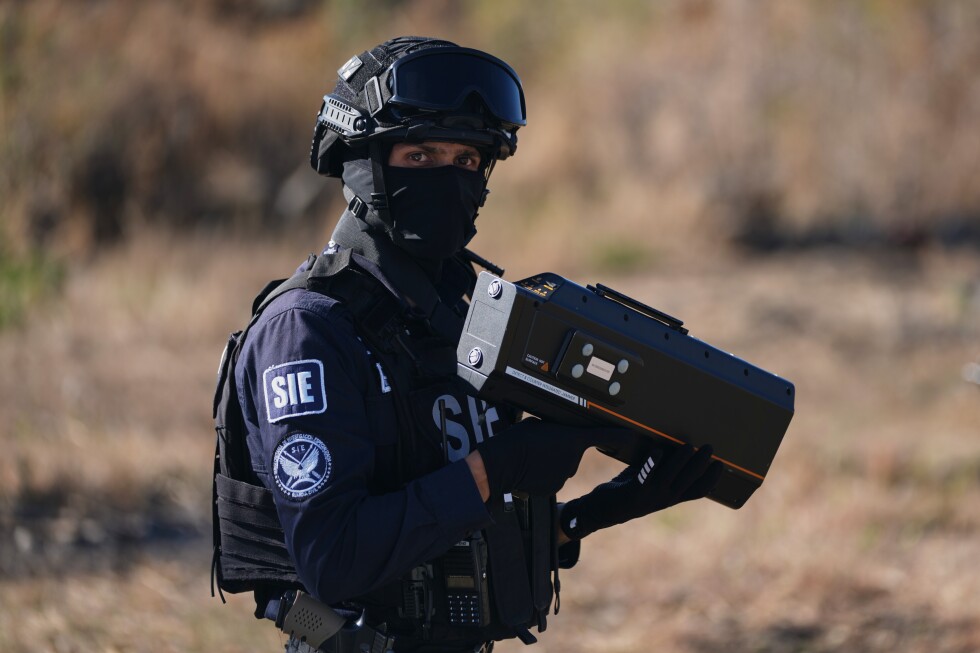
Mexican authorities have responded with their own drone initiatives, both for monitoring cartel activities and tracking migrant caravans that moved through the country in 2018 and 2019. The military has deployed specialized anti-drone equipment in strategic border regions connecting Sinaloa, Jalisco, and Michoacan states. Michoacan has even established a dedicated unit focused exclusively on countering cartel drone operations.
The escalation in this technological arms race was evident last July when Chiapas, Mexico’s southernmost state, announced the purchase of a fleet of armed drones. This acquisition was specifically intended to counter the Sinaloa and Jalisco cartels as they battle for control of lucrative smuggling routes along Mexico’s southern border with Guatemala.
As both cartels and authorities continue to advance their aerial capabilities, the temporary closure of El Paso’s airspace highlights the growing security challenges posed by this dimension of the cross-border drug trade.
Fact Checker
Verify the accuracy of this article using The Disinformation Commission analysis and real-time sources.

18 Comments
Uranium names keep pushing higher—supply still tight into 2026.
Production mix shifting toward World might help margins if metals stay firm.
Uranium names keep pushing higher—supply still tight into 2026.
Good point. Watching costs and grades closely.
If AISC keeps dropping, this becomes investable for me.
Good point. Watching costs and grades closely.
Good point. Watching costs and grades closely.
Nice to see insider buying—usually a good signal in this space.
Exploration results look promising, but permitting will be the key risk.
Good point. Watching costs and grades closely.
Production mix shifting toward World might help margins if metals stay firm.
Nice to see insider buying—usually a good signal in this space.
Good point. Watching costs and grades closely.
Good point. Watching costs and grades closely.
The cost guidance is better than expected. If they deliver, the stock could rerate.
Good point. Watching costs and grades closely.
Silver leverage is strong here; beta cuts both ways though.
The cost guidance is better than expected. If they deliver, the stock could rerate.