


Listen to the article
French President Macron’s Sunglasses Steal Spotlight at Davos, Triggering Global Buzz
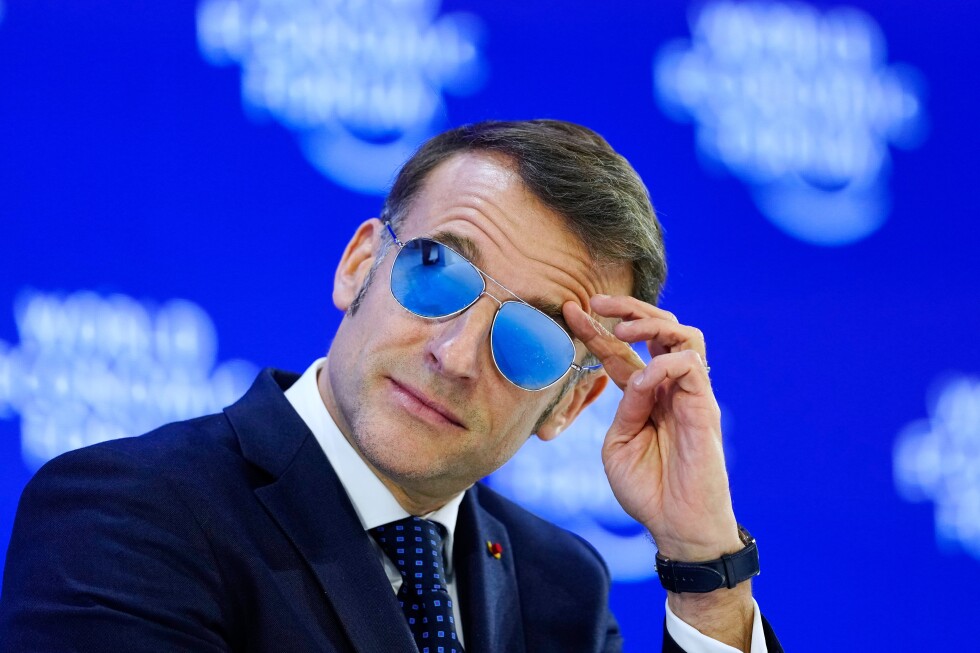
French President Emmanuel Macron’s decision to wear reflective sunglasses during his appearance at the World Economic Forum in Davos has captured global attention, overshadowing the substance of his speech and generating an unexpected media frenzy.
The eyewear, worn to conceal what Macron described as a benign medical issue with his right eye, quickly dominated news feeds and social media platforms. Even former U.S. President Donald Trump couldn’t resist commenting during his own Davos address, asking, “Those beautiful sunglasses—what the hell happened?”
The stylish shades were identified as the Pacific S 01 model manufactured by French company Henry Jullien. Far from ordinary eyewear, these luxury glasses retail for 659 euros (approximately $775) on the manufacturer’s website. Macron’s office confirmed to The Associated Press that the president purchased the glasses earlier this year, specifically checking that they were French-made.
The unexpected publicity created a windfall for the manufacturer and its Italian parent company, iVision Tech SpA. The firm’s website was quickly overwhelmed with visitors and inquiries, prompting them to create a dedicated page to handle the sudden interest. In the financial markets, iVision’s shares surged dramatically on Milan’s stock exchange, climbing from 1.51 euros ($1.78) when Macron spoke on Tuesday to a high of 2.63 euros ($3.10) by Friday—a gain of over 74 percent.
“Crazy week,” Stefano Fulchir, iVision’s CEO, told the AP. “Very honored and happy that President Macron has used our eyewear in this important event.” The executive revealed that the media attention has been overwhelming: “In the last three days, I slept only four hours a day, because we don’t have time to answer to everybody.”
The visual impact of Macron’s choice has resonated beyond mere fashion statements. Communication experts note that wearing sunglasses indoors, particularly in diplomatic settings, represents an unusual break from political norms that typically emphasize transparency and connection with audiences.
“We don’t typically associate sunglasses with politicians,” explained Marco Bohr, co-editor of “The Evolution of the Image: Political Action and the Digital Self” and a professor at Nottingham Trent University. “They signify a sense of detachment. And typically, that’s not what politicians are trying to do. They’re trying to create a sense of connection with the audience or with people.”
Despite this potential pitfall, many observers believe Macron carried the look with confidence. The blue-tinted lenses coordinated well with the backdrop at Davos, creating a visually striking image that spawned numerous internet memes. One viral spoof reimagined Macron as a fighter pilot from the film “Top Gun,” set to Kenny Loggins’ “Danger Zone.”
Cristina Archetti, author of “Politicians, Personal Image and the Construction of Political Identity” and professor at the University of Oslo, offered a blunt assessment: “He does look hot.” She noted that the 48-year-old Macron appeared “relatively young and super cool,” especially compared to “older-looking politicians who are particularly gray, dull, or some unnatural color—orange—not mentioning any name.”
The incident highlights the careful calculations behind political imagery. While U.S. President Joe Biden frequently sports aviator sunglasses outdoors—and once gifted a pair to Russian President Vladimir Putin before relations soured following Russia’s invasion of Ukraine—indoor shades typically require explanation. Former President Bill Clinton successfully pulled off wearing sunglasses during an indoor television appearance in 1992, but he was performing “Heartbreak Hotel” on saxophone for Arsenio Hall’s show—a context where the blues-club aesthetic made sense.
Bohr observed that Macron’s specific choice of aviator-style frames carries particular connotations: “They signify something very specific—about pilots, about being in control.” He noted that alternative options like an eye patch or Ray-Ban Wayfarers would have conveyed entirely different messages.
From a forum largely dominated by discussions of Trump’s fractious relationship with Europe, Macron’s eyewear has emerged as an unlikely but memorable symbol—demonstrating once again how visual politics can sometimes overshadow policy substance in today’s media environment.
Fact Checker
Verify the accuracy of this article using The Disinformation Commission analysis and real-time sources.

8 Comments
The fact that even Trump couldn’t resist commenting on Macron’s sunglasses shows how polarized the political climate has become. It’s a shame when trivial matters distract from the real substance of global economic and geopolitical discussions.
While the sunglasses may have stolen the spotlight, I hope the substance of Macron’s message and France’s priorities at Davos were not lost. Geopolitical tensions and economic challenges require serious discussions, not just sideshow distractions.
Interesting that Macron’s choice of sunglasses sparked such global attention. While fashion choices can sometimes overshadow substance, I’m curious to hear more about the actual content and context of his Davos speech.
Agreed. It’s important to focus on the substantive policy discussions, not just the sartorial details. I wonder what key issues Macron addressed in his remarks.
The fact that a $775 pair of French-made sunglasses could generate such a media frenzy is quite remarkable. I suppose it speaks to the power of visual imagery and symbolism in today’s political landscape.
That’s a good point. Political leaders’ fashion choices and personal style can sometimes become proxy battlegrounds for deeper ideological or geopolitical conflicts.
It’s fascinating to see how a simple pair of sunglasses can become a global talking point. I wonder if Macron intentionally used the eyewear to make a subtle statement or if it was simply a functional choice to address a medical issue.
Good question. Macron’s team may have calculated that the stylish shades would attract attention, even if unintentionally. In today’s media landscape, any visual detail can become a focal point.