


Listen to the article
In a significant departure from traditional U.S. diplomatic practice, President Donald Trump has emerged as an unprecedented power broker in foreign elections, openly endorsing candidates and attempting to sway political outcomes across multiple continents.
From Hungary to Argentina and Honduras, the Trump administration has broken with longstanding norms of non-interference in other nations’ electoral processes, instead wielding endorsements, financial leverage, and personal relationships to influence political outcomes abroad.
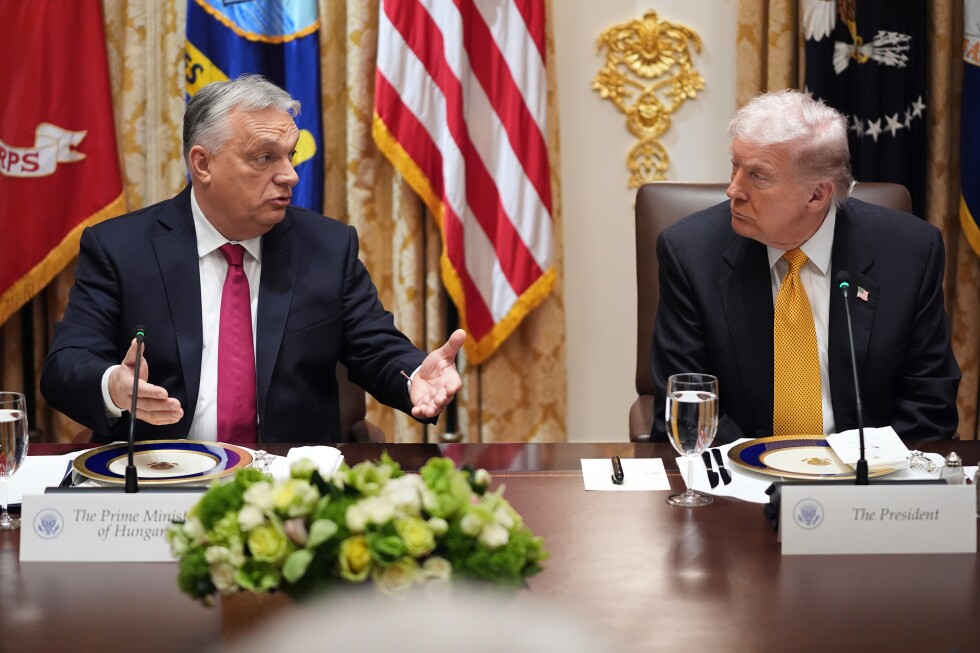
In Hungary, where Prime Minister Viktor Orbán faces voters this Sunday in his bid for a fifth term, Trump’s support has been particularly visible. “I love Hungary and I love that Viktor,” Trump declared this week, as Vice President JD Vance put him on speakerphone during a campaign rally with over 1,000 Orbán supporters in Budapest. Trump later posted on Truth Social: “Hungary: GET OUT AND VOTE FOR VIKTOR ORBÁN,” and promised to “use the full Economic Might of the United States” to help Hungary’s economy if needed.
Orbán, who was the first European leader to back Trump during his 2016 presidential run, has maintained close ties with the former president even during Trump’s time out of office. The relationship has included visits to Trump’s Florida residence and Orbán’s continued endorsement of Trump’s 2024 reelection bid.
Secretary of State Marco Rubio, who previously expressed concerns about “democratic erosion” under Orbán, has since endorsed the Hungarian leader, highlighting the “very, very close personal relationship and working relationship” between Trump and Orbán.
Trump has been equally forthright in other regions. In Argentina, his administration arranged a $20 billion currency swap line to stabilize financial markets, but Trump subsequently threatened to withdraw this support if election results didn’t favor his preferred outcome. “If he loses, we are not going to be generous with Argentina. OK?” Trump told a reporter while hosting Argentine President Javier Milei, known for his chainsaw-wielding demonstrations of budget-cutting zeal, at the White House.
Similarly, in Honduras, Trump not only endorsed conservative candidate Nasry Asfura but warned that “the United States will not be throwing good money after bad” if Asfura lost. He also pardoned former Honduran President Juan Orlando Hernandez for U.S. drug trafficking convictions, timing the announcement to influence voters.
The Conservative Political Action Conference (CPAC) has become a platform for promoting Trump’s foreign political allies. At a CPAC gathering in Warsaw last year, then-Homeland Security Secretary Kristi Noem urged Polish voters to support conservative candidate Karol Nawrocki, suggesting that U.S. military presence in Poland could depend on the election outcome. Nawrocki subsequently won.
The White House defends this approach as a sign of transparency. “President Trump is a great American statesman who will speak or work with anyone, and he makes no secret about those he likes or supports,” said White House spokeswoman Anna Kelly. “Many individuals who align with President Trump’s ideology are getting elected to top offices around the world because everyone wants to replicate his immeasurable success on behalf of the American people.”
Critics, however, argue that Trump’s overt interference diminishes diplomatic relationships and reduces foreign policy tools to political instruments. “The impact of that is to really cheapen a relationship,” said David Pressman, who served as U.S. ambassador to Hungary during the Biden administration. Pressman noted that Hungarian positions on key issues such as Ukraine appeared “infused through a political U.S. rubric,” rather than representing sovereign foreign policy.
While past U.S. administrations have certainly influenced foreign politics—from the CIA-engineered 1954 coup in Guatemala to President Bill Clinton’s support for Boris Yeltsin’s parliamentary dissolution in Russia in 1993—Trump’s explicit political engagement abroad is unprecedented in its openness and scale, according to James Lindsay, a distinguished senior fellow at the Council on Foreign Relations.
Senator Tim Kaine (D-Va.) linked Trump’s approach to what the administration termed the “Trump Corollary to the Monroe Doctrine” in its national security strategy. Kaine, who worked as a missionary in Honduras during a period of covert U.S. involvement in Latin America, called this “poison language” for the region. “America has been deeply involved in regime support, opposition and regime change in the Americas for centuries, and it is not a legacy that we should be proud of,” he stated.
As Hungary’s election approaches this Sunday, the world will be watching to see whether Trump’s influence can deliver a victory for Orbán, who had been trailing in independent polls. The outcome could provide the most significant test yet of Trump’s growing ambition to shape political landscapes far beyond America’s borders.
Fact Checker
Verify the accuracy of this article using The Disinformation Commission analysis and real-time sources.

6 Comments
The article raises important questions about the boundaries of U.S. influence in foreign elections. It’s a delicate balance between promoting democratic values and respecting national sovereignty.
This is certainly an unconventional approach to diplomacy. While Trump’s direct endorsements are unorthodox, it raises interesting questions about the role of the U.S. in foreign elections and the balance of global influence.
This is a fascinating development in global politics. Trump’s unorthodox approach could have far-reaching consequences, both intended and unintended, for U.S. standing and relationships around the world.
Trump seems determined to flex his political muscle abroad, even if it departs from established diplomatic norms. Regardless of one’s views, this is a significant shift in U.S. foreign policy worth following closely.
I’m curious to see how Trump’s interventions play out in Hungary and elsewhere. It’s a complex geopolitical situation with valid arguments on multiple sides.
Agreed, the dynamics are nuanced. It will be interesting to see if these high-profile endorsements have a meaningful impact on election results.