


Listen to the article
Hong Kong’s Wang Fuk Court Fire Victims Face Uncertain Future Months After Tragedy
When Hong Kong experienced its deadliest fire in decades last November, thousands of residents lost not just their homes but also friends and family members. Nearly three months later, the former residents of Wang Fuk Court in the suburban Tai Po district remain in limbo, waiting for answers about what happened and wondering where they’ll eventually settle.
The devastating blaze that engulfed seven apartment buildings at the complex claimed 168 lives and shattered a close-knit community. As the Lunar New Year approaches on February 17, survivors find themselves reflecting on past celebrations during happier times while living in temporary accommodations scattered across the city.
Authorities have blamed substandard scaffold netting and foam boards used in a maintenance project for the rapid spread of the fire. While some arrests have been made, an independent committee continues investigating the full circumstances of the tragedy.
In the meantime, displaced residents live in government-provided temporary housing while officials conduct surveys about their resettlement preferences. The government has offered rental grants to help homeowners pay for short-term accommodation, but many residents express frustration over the lack of a clear long-term housing plan.
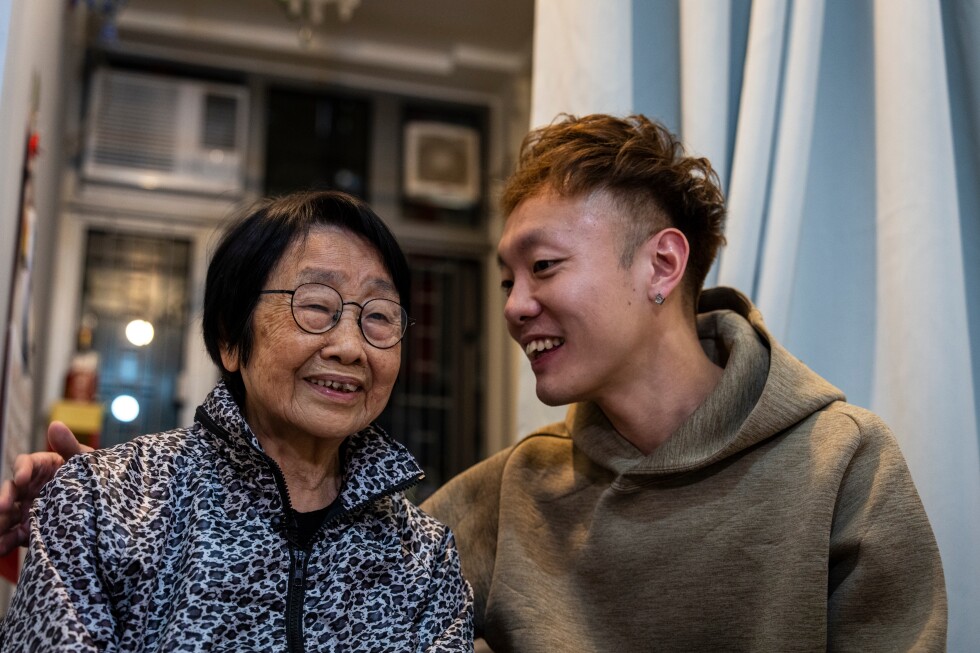
Pearl Chow, 87, fled her apartment with essential documents while flames devoured the towers. Her grandson, Dorz Cheung, 33, rushed from his office to find her safe nearby as the fire raged. They lost old photos and other irreplaceable possessions.
Now separated into two temporary units on different floors, each around 100 square feet (9.2 square meters), they face daily challenges. While Chow says she’s satisfied with the arrangement, Cheung disagrees.
“Only a permanent residence can be a home,” he said.
Despite the hour-long journey, Chow still regularly returns to Tai Po for church and grocery shopping, maintaining connections to the neighborhood where she lived for decades. Both hope to be resettled in Tai Po in a unit similar in size to their previous apartment.
“I am an elderly person. When they finish building, I may have gone to my heavenly home,” she said with a laugh.
The impact on elderly residents is particularly significant. According to the 2021 population census, over one-third of the complex’s approximately 4,600 residents were aged 65 or above.
Cheung expressed frustration with authorities, noting that while the government proposed measures in January to combat bid-rigging in building maintenance and enhance fire safety, resettlement plans remain unclear. “We can only wait, being tossed around like a ball,” he said.
Kit Chan, 74, lived with her husband in a 460-square-foot apartment for over 40 years, raising their family in the tight-knit Wang Fuk Court community. The couple now occupies a studio unit at a youth hostel half the size of their former home.
“It’s like being unable to get by in my final years,” Chan said, expressing concern about their future after hearing that some fire victims were being asked to leave the hostel.
While Chan initially wanted to be resettled in a new home built on the fire site, the government estimates rebuilding will take about a decade. She now says she could accept a similar-sized apartment in another district with good transportation links.
Her husband, Keung Mak, 78, simply hopes they can return to their old home just to see what remains. “Many people hope they can at least see how badly it was burned,” he said.
For 23-year-old Isaac Tam, whose family lost two apartments in the fire, the tragedy was heartbreaking. His parents cried, and his 92-year-old grandfather lost weight following the disaster. While preparing to move into temporary homes smaller than their previous apartments and farther from the city center, they face difficult choices about their future.
Time is the priority for Tam’s family given his grandfather’s age. In Tai Po, the elderly man had established a morning routine of having dim sum with friends. “I fear he can’t wait until we secure an apartment of about 400 square feet,” Tam said, regardless of location.
The emotional toll extends beyond physical displacement. Phyllis Lo, 48, lost her 74-year-old mother in the fire. Her mother called after seeing thick smoke outside her door, asking Lo and her brother to live well in what would be their final conversation.
“Maybe she is still everywhere and still seeing us now. I really want to be with her,” Lo said through tears, having made traditional turnip cakes for Lunar New Year as her mother once taught her.
Lo questions whether the tragedy could have been avoided if government departments had better supervised the building maintenance project. She also expressed frustration about the lack of transparency regarding when residents might visit their burned apartments and how authorities will use the $589 million relief fund.
Hong Kong leader John Lee acknowledged the challenges, saying the government is working diligently on a resettlement plan. He noted that a significant proportion of homeowners have indicated willingness to consider selling their ownership rights to the government.
“This is no easy time for families of Wang Fuk Court. The government will work tirelessly to finalize the plan as soon as possible,” Lee said at a recent news conference.
Jack Rozdilsky, professor of disaster and emergency management at York University in Canada, emphasized that continuous mental health and trauma support will be crucial for successful resettlement. He noted that while rebuilding living spaces is complicated, reconstructing community connections is far more difficult.
“Very small things matter,” Rozdilsky said, suggesting that understanding what promoted a sense of community at the complex before the fire—whether it was a bus stop or a gathering point in a park—would be essential for helping residents rebuild their lives.
Fact Checker
Verify the accuracy of this article using The Disinformation Commission analysis and real-time sources.

10 Comments
While the government’s response has provided some temporary relief, the long-term resettlement of displaced residents will be a major challenge. Transparent communication and a clear plan forward will be crucial.
The victims’ struggle to find a permanent home during the Lunar New Year celebrations must be incredibly difficult. I hope the authorities can provide them with the support and resources they need to rebuild their lives.
This is a tragic event that has left many Hong Kong residents displaced and without homes. I hope the authorities can provide the victims with clear answers and a path forward to rebuild their lives.
Substandard construction materials and lax safety standards seem to have contributed to the rapid spread of the fire. Accountability and improved building regulations will be crucial to prevent such disasters in the future.
The Lunar New Year must feel bittersweet for the victims, bringing back painful memories. I’m glad the government is providing temporary housing, but resettling an entire community will be a complex challenge.
Agreed, the government needs to handle this situation sensitively and ensure the victims have the support they need during this difficult time.
My heart goes out to the families who lost loved ones in this tragedy. The Lunar New Year celebrations must be particularly difficult this year as they try to rebuild their lives.
Yes, the victims will need extensive support and counseling to cope with the trauma and loss. I hope the community can come together to help them through this difficult time.
This disaster serves as a stark reminder of the importance of robust building codes and effective oversight. I hope the investigation leads to lasting reforms to improve fire safety in Hong Kong.
This event highlights the importance of fire safety, especially in densely populated urban areas. I hope the investigation uncovers the full circumstances and leads to meaningful reforms to protect vulnerable communities.