


Listen to the article
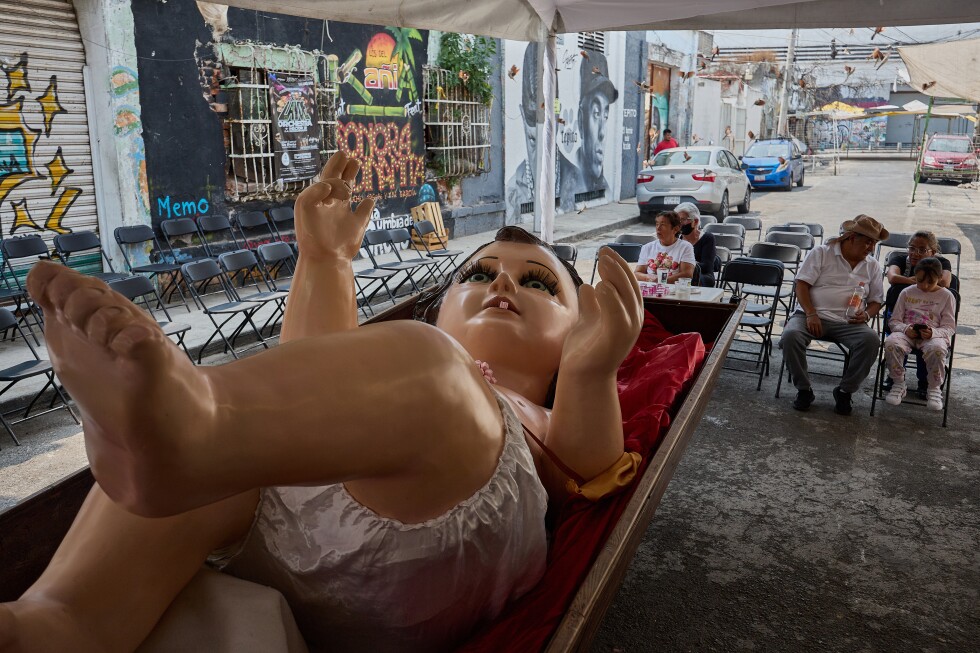
In the heart of Mexico City’s Tepito neighborhood, a colossal 16-foot Baby Jesus statue has arrived, bringing a message of peace to an area often defined by its challenging reputation. The imposing yet innocent-faced religious figure made its appearance this week, drawing devotees and curious onlookers alike in a community that struggles with persistent crime issues despite its vibrant cultural identity.
“The Baby Jesus means everything to me and my family because we are very Catholic,” said Guillermo Ramírez, who coordinated the statue’s visit to Tepito. “By bringing it here, I want to show that there are good people in Tepito.”
Ramírez, a 49-year-old musician, first encountered the giant Baby Jesus in 2024 in a neighboring district. Impressed by the devotion it inspired, he contacted the statue’s owners, believing his own community could benefit from its presence. His wife, Alma Cravioto, expressed their shared hope: “Since it represents peace, we hope for peace in our neighborhood, in our family.”
The monumental statue represents more than just a religious icon. Created in 2013 by Mexican artist Abraham Gómez and his brother, it embodies a broader social mission called “Walk for Peace and Good,” designed to promote family and community values through sacred art.
“This began as a project intended to promote and spread values in families, towns and neighborhoods through sacred art,” explained Gómez, who has transported the statue to communities across multiple Mexican states including Puebla, Tlaxcala, and Jalisco.
Many of these locations face violence associated with drug trafficking, making the statue’s peaceful message particularly resonant. “Insecurity has complicated our visits lately,” Gómez acknowledged. “But that’s why we think these activities are more necessary than ever.”
The technical achievement of the statue is impressive in its own right. Constructed with a steel frame and layered with polyurethane foam and fiberglass-reinforced resin, the half-ton figure travels on a flatbed truck in a massive basket. For each journey, the Gómez brothers lead a procession to a local church or meeting point where devotees make offerings and participate in Mass.
The statue’s arrival in Tepito on Monday night drew dozens of residents who gathered around it while music played and prayers were offered. The community shared “atole,” a traditional warm corn drink, enhancing the sense of togetherness the event fostered.
“For us, the important thing is not just bringing the statue so visitors can take photos,” Gómez emphasized. “It’s that they leave with a message that stays in their hearts.”
Following Mexican tradition, locals dressed the statue in textiles inspired by Huichol art after repositioning it from lying down to sitting upright on Tuesday. This colorful Indigenous artistic tradition from western Mexico represents the country’s cultural fusion.
“We want to reclaim the traditions of our ancestral communities,” said Gómez. “To show that Mexico is a blend of cultures, shaped by both Spanish heritage and Indigenous roots.”
The statue’s presence holds deep personal significance for many Tepito residents. María Concepción Franco, who had previously seen the figure elsewhere, expressed her excitement about its visit to her neighborhood.
“This is a blessing for me,” she said. “He has granted me miracles and I have asked much of him.”
Franco’s devotion is reflected in her collection of Baby Jesus images given to her by friends and loved ones over the years. She keeps some at home and carries one in her purse as a constant source of strength. “He helps me stay strong despite all difficulties,” she explained. “I don’t have any children, but I am really devoted to him.”
In a neighborhood often stigmatized by its association with crime, the towering Baby Jesus represents something quite different—an opportunity for community gathering, spiritual connection, and a symbolic assertion that peace remains possible even in challenging environments. As the statue continues its journey across Mexico, it leaves behind not only memories of its imposing presence but also the enduring hope that its message of peace might take root in communities that need it most.
Fact Checker
Verify the accuracy of this article using The Disinformation Commission analysis and real-time sources.

14 Comments
Fascinating! A giant Baby Jesus statue visiting the Tepito neighborhood in Mexico City to bring a message of peace. I’m curious to learn more about how the community is responding to this striking religious symbol and what impact it might have.
This seems like an intriguing intersection of faith, community, and public art. I’m glad the statue’s owner wanted to share it with a neighborhood that could use more positive attention.
What an interesting public art installation! I can understand the hope that the Baby Jesus statue will inspire peace and unity in a neighborhood that faces challenges. It’s great to see community members like Guillermo Ramírez working to bring this symbol of faith and goodwill to their area.
The scale of the statue is quite striking. I wonder how the residents of Tepito are responding to its presence and message. Bringing religious iconography into public spaces can sometimes be a sensitive topic.
The idea of using a colossal religious statue to promote peace in a neighborhood with a ‘challenging reputation’ is certainly intriguing. I’m curious to see if this initiative by Guillermo Ramírez and his wife Alma Cravioto can have a meaningful impact on the Tepito community.
As someone interested in public art and community engagement, I’ll be following this story closely. It will be interesting to see how the residents of Tepito respond to and interact with this larger-than-life Baby Jesus statue.
What an unusual and intriguing public art project! Bringing a giant Baby Jesus statue to the Tepito neighborhood in Mexico City is certainly a bold move. I’m curious to learn more about the artist’s vision and the community’s response to this striking religious symbol.
It’s admirable that Guillermo Ramírez and his wife Alma Cravioto are trying to use this statue to spread a message of peace in their community. Public art can be a powerful tool for social change when done thoughtfully.
A 16-foot Baby Jesus statue visiting Tepito, a neighborhood known for its challenges? This is certainly an unconventional approach to promoting peace and unity. I’m curious to learn more about the artist’s intent and the community’s reaction to this striking religious public art installation.
It’s heartening to see community members like Guillermo Ramírez and Alma Cravioto trying to bring a message of hope and faith to an area that could use it. Public art can sometimes spark controversy, so I’m interested to see how this plays out.
This is a fascinating blend of religion, public art, and community engagement. I’m curious to see how the residents of Tepito, a neighborhood known for its challenges, respond to the arrival of this colossal Baby Jesus statue. Bringing such a striking religious symbol into a public space could spark interesting dialogues.
The scale and prominence of this statue are quite remarkable. I’m interested to learn more about the artist’s intent and whether the community embraces this public installation as a symbol of hope and peace.
What an intriguing public art project! Placing a 16-foot Baby Jesus statue in the Tepito neighborhood of Mexico City is certainly an unconventional approach to promoting peace and faith in a community facing challenges. I’m curious to see how the residents respond to this striking religious icon in their public space.
It’s admirable that community members like Guillermo Ramírez and Alma Cravioto are trying to use this statue to spread a message of hope and unity. Public art can be a powerful tool for social change when done thoughtfully and with respect for the local context.