


Listen to the article
Gaza Hospital Dispute Erupts as Doctors Without Borders Suspends Operations
A rare public disagreement between two prominent healthcare organizations has emerged in Gaza, as Nasser Hospital officials criticized Doctors Without Borders’ decision to suspend operations at the facility over security concerns. The dispute centers around the presence of armed personnel at one of Gaza’s few remaining functional large hospitals.
Doctors Without Borders, known internationally as Médecins Sans Frontières (MSF), announced Saturday that it had suspended non-critical medical operations at Nasser Hospital in January due to what it described as “serious” security breaches. The organization cited “a pattern of unacceptable acts including the presence of armed men, intimidation, arbitrary arrests of patients and a recent situation of suspicion of movement of weapons.”
Nasser Hospital officials pushed back strongly against these claims on Sunday, calling the allegations “factually incorrect, irresponsible and pose a serious risk to a protected civilian medical facility.” Hospital administrators explained that the armed individuals were actually civilian police officers deployed specifically to protect patients and staff following attacks on the facility by “masked, armed men and militias” in recent months.
The dispute unfolds against the backdrop of an increasingly fragile ceasefire between Israel and Hamas. Palestinian health officials report that at least 602 Palestinians have died from Israeli fire since the U.S.-brokered truce took effect on October 10. In the past 24 hours alone, at least 11 Palestinians were killed in various incidents across Gaza.
Nasser Hospital, located in the southern city of Khan Younis, has been a critical medical hub throughout the conflict. It treats hundreds of wounded patients daily and has played a significant role in the prisoner exchanges between Israel and Hamas under the ceasefire agreement.
The Israeli military has claimed, without providing evidence, that Nasser Hospital serves as “a headquarters and military post for senior Hamas officials.” Throughout the more than two-year conflict, Israel has frequently targeted hospitals, including Nasser, alleging that Hamas operates within or around medical facilities. Some Israeli hostages released from Gaza have reported being held captive for periods of time in hospitals, including Nasser.
Hamas maintains control in areas of Gaza not under Israeli occupation, including the region where Nasser Hospital is situated. However, the war has led to the emergence of numerous other armed groups, including some reportedly backed by Israel’s military in territories under Israeli control.
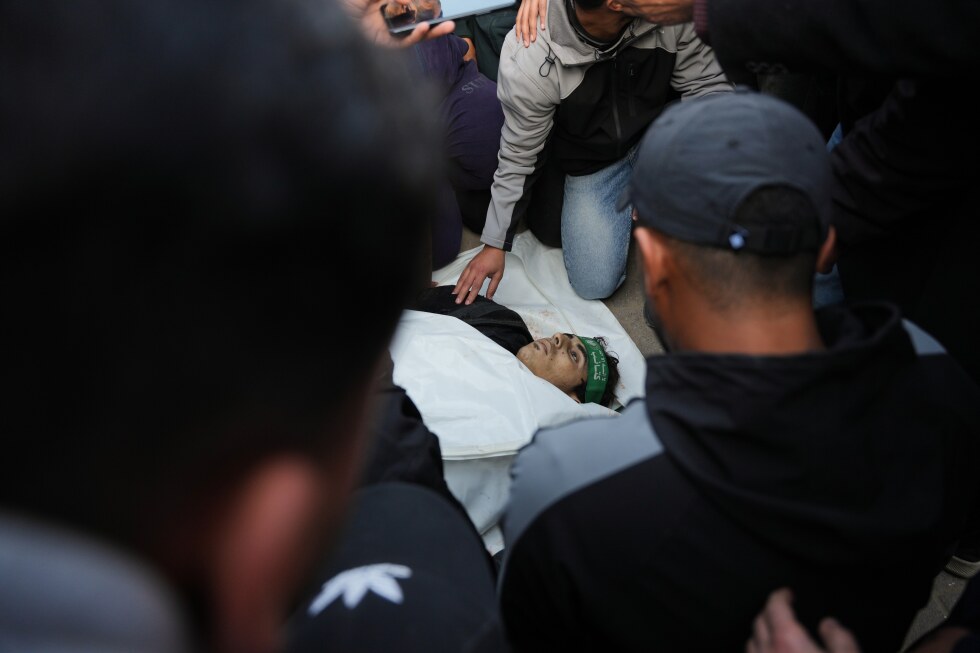
The ceasefire agreement has not completely halted violence. Israeli forces continue to conduct airstrikes and fire on Palestinians near military-controlled zones. On Sunday, five men in their 20s were killed in eastern Khan Younis near the “Yellow Line” that separates Israeli-controlled areas from the rest of Gaza. According to Associated Press footage, at least two of the deceased wore headbands identifying them as members of Hamas’ military wing, the Qassam Brigades.
In northern Gaza, a drone strike in the Jabaliya refugee camp killed five people, while a separate drone strike in Gaza City resulted in one fatality, according to Shifa Hospital. The Israeli military stated it had conducted multiple strikes in response to ceasefire violations, including against militants attempting to hide in debris or cross the Yellow Line while armed.
Meanwhile, in Israel, tensions flared in the ultra-Orthodox city of Bnei Brak, where two female Israeli soldiers had to be rescued from riots. Video footage showed the soldiers being hurried away by police as thousands of ultra-Orthodox men pursued them. The unrest stems from growing anger within the ultra-Orthodox community over potential laws that would require them to serve in the military, from which they have traditionally been exempt.
At least 22 people were arrested during the protests as demonstrators set police motorcycles ablaze, attacked officers, and overturned a police vehicle. Prime Minister Benjamin Netanyahu condemned the attack on the soldiers but attributed the violence to an “extremist minority.”
The exemption of approximately 1.3 million ultra-Orthodox Jews from mandatory military service has reopened deep divisions within Israeli society, particularly as the war in Gaza continues.
Fact Checker
Verify the accuracy of this article using The Disinformation Commission analysis and real-time sources.

11 Comments
This is a concerning development that could have serious consequences for healthcare access in Gaza. I hope the parties can swiftly reach an agreement that upholds patient safety while preserving critical medical services.
The claims and counter-claims here point to a complex dynamic that needs to be resolved through open dialogue and good-faith efforts on both sides. The people of Gaza should not be caught in the middle of this dispute.
Absolutely. The priority has to be ensuring uninterrupted medical care for the vulnerable populations in Gaza. I hope the parties can work together to find a compromise that addresses legitimate security concerns without jeopardizing essential healthcare access.
This is a complex situation with valid concerns on both sides. Security challenges in conflict zones can create difficult dilemmas for medical providers. I hope the parties can find a constructive resolution that prioritizes patient safety and access to care.
Agreed, balancing security and healthcare access is always tricky in these environments. Transparent communication between the organizations will be key to finding the right compromise.
This is a sensitive situation that requires careful navigation. While security concerns are understandable, preserving access to healthcare must be the overriding imperative. I hope a mutually agreeable solution can be found soon.
Security challenges in conflict zones are never easy to navigate, but preserving access to healthcare should be the top priority here. I hope Nasser Hospital and Doctors Without Borders can find a mutually acceptable solution through open dialogue.
Agreed. Both organizations need to approach this issue constructively and with the best interests of Gaza’s residents in mind. Finding the right balance between security and healthcare access will be crucial.
This is a concerning situation that highlights the difficult trade-offs faced by medical providers in conflict zones. I hope the parties can work together to resolve the security issues while ensuring uninterrupted care for patients in Gaza.
Doctors Without Borders’ decision to suspend services is concerning, as Nasser Hospital is a critical facility serving vulnerable populations in Gaza. I hope the parties can resolve this dispute quickly to ensure uninterrupted care for patients.
Absolutely, maintaining essential medical services should be the top priority here. Both sides need to work together constructively to address the security issues while minimizing disruptions to patient care.