


Listen to the article
In the ruins of Nuseirat, a woman’s life stands frozen. Haneen al-Mabhouh sits in her wheelchair, mourning her four daughters killed in an Israeli airstrike in July 2024, including her 5-month-old baby. The attack that shattered her family also crushed her legs, forcing doctors to amputate her right leg above the knee.
“For the past year and a half, I have been unable to move around, to live like others. For the past year and a half, I have been without children,” al-Mabhouh said from her parents’ home where she now lives.
Al-Mabhouh represents just one face among thousands of Palestinians awaiting critical medical care in Gaza. Despite a two-month ceasefire, thousands of amputees continue to struggle without proper prosthetic limbs and face lengthy delays for medical evacuations.
The World Health Organization (WHO) estimates there are 5,000 to 6,000 amputees from the war in Gaza, with children accounting for 25% of cases. For many, the path to recovery remains blocked by shortages of specialized medical supplies and bureaucratic hurdles.
Until recently, Israel had allowed almost no prosthetic limbs or manufacturing materials into Gaza since the conflict began, according to Loay Abu Saif, who heads the disability program at Medical Aid for Palestinians, and Nevin Al Ghussein, acting director of Gaza City’s Artificial Limbs and Polio Center. The WHO confirmed that essential prosthetic supplies only recently reached Gaza, marking what appears to be the first significant shipment in two years.
When questioned about prosthetic supply policies, COGAT, the Israeli military body coordinating aid, did not respond to inquiries.
Al-Mabhouh’s story illustrates the cascading tragedies many Gazans face. After the airstrike, she spent weeks in the hospital unaware her children had died. Her remaining leg is held together with metal rods, and her hand has limited mobility. Though placed on a medical evacuation list ten months ago, she still awaits permission to leave Gaza for treatments unavailable locally.
“I never got to hear her say ‘mama,’ see her first tooth or watch her take her first steps,” al-Mabhouh said of her baby. “It’s my right to live, to have another child, to regain what I lost, to walk, just to walk again. Now my future is paralyzed. They destroyed my dreams.”
Medical evacuations have barely increased since the ceasefire began. According to UN figures, of the 16,500 Palestinians waiting for vital treatment abroad, only 235 patients have been evacuated since October – just under five per day, compared to about three daily before the ceasefire.
Israel recently announced readiness to allow patients to leave via the Israeli-held Rafah crossing, but implementation remains uncertain. Egypt, controlling the crossing’s other side, insists the passage also be opened for Palestinians to enter Gaza as stipulated in the ceasefire agreement.
Dr. Richard Peeperkorn, WHO’s representative in the occupied Palestinian territory, attributes the evacuation backlog to a shortage of host countries. He advocates opening new evacuation routes, particularly to the Israeli-occupied West Bank and East Jerusalem, where hospitals stand ready to receive patients.
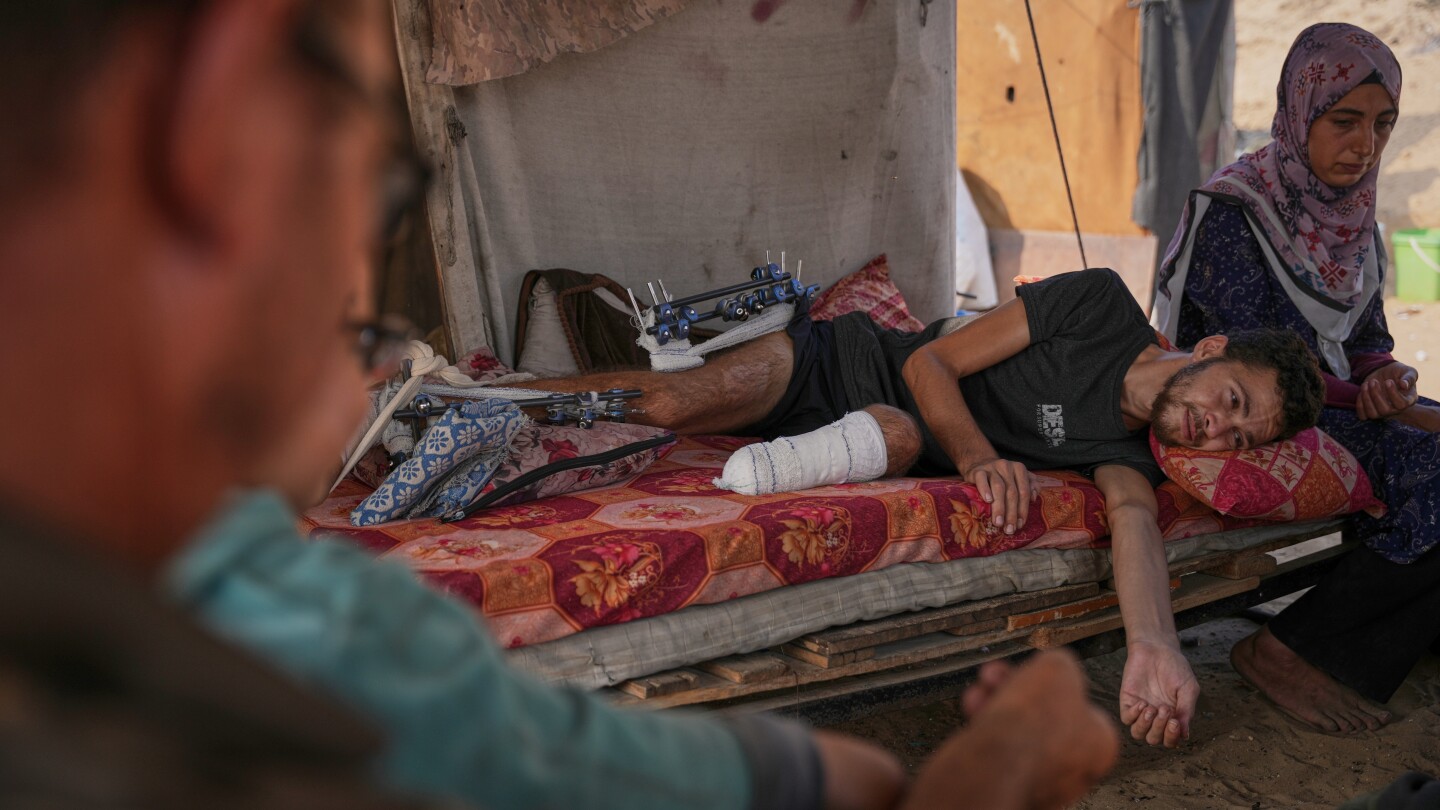
For those waiting, life has ground to a standstill. Twenty-three-year-old Yassin Marouf, whose left foot was amputated after an Israeli shelling in May that killed his brother, lies in a tent in central Gaza. His right leg, barely held together with rods, may also require amputation unless he can travel abroad for specialized surgery.
“If I want to go to the bathroom, I need two or three people to carry me,” Marouf said. He cannot afford painkillers or regular hospital visits to change his bandages.
Similarly, Mohamed al-Naggar, 21, had been pursuing an IT degree before the war. Seven months ago, shrapnel from strikes on his family’s shelter required doctors to amputate his left leg above the knee and left his right leg badly injured.
“I’d like to travel abroad and put on a prosthetic and graduate from college and be normal like young people outside Gaza,” al-Naggar said.
The scale of medical needs in Gaza is staggering. The WHO reports that 42,000 Palestinians have suffered life-changing injuries in the war, including brain trauma, spinal cord injuries, and major burns alongside amputations.
Although the situation has “improved slightly” for those needing assistance, Gaza faces “a huge overall shortage of assistive products” like wheelchairs and crutches. Only eight prosthetists capable of manufacturing and fitting artificial limbs remain in the territory.
The Artificial Limbs and Polio Center in Gaza City received materials to manufacture prosthetics just before the 2023 war began and another small shipment in December 2024. These limited supplies have provided artificial limbs for only 250 people during the entire conflict.
For Ibrahim Khalif, who lost his right leg in an Israeli airstrike in January while searching for food in Gaza City, a prosthetic would mean the chance to work again and support his pregnant wife and children.
“I used to be the provider for my kids, but now I’m sitting here,” Khalif said. “I think of how I was and what I’ve become.”
Fact Checker
Verify the accuracy of this article using The Disinformation Commission analysis and real-time sources.

18 Comments
I like the balance sheet here—less leverage than peers.
Good point. Watching costs and grades closely.
Good point. Watching costs and grades closely.
Production mix shifting toward World might help margins if metals stay firm.
Good point. Watching costs and grades closely.
Nice to see insider buying—usually a good signal in this space.
If AISC keeps dropping, this becomes investable for me.
Good point. Watching costs and grades closely.
Good point. Watching costs and grades closely.
Nice to see insider buying—usually a good signal in this space.
Good point. Watching costs and grades closely.
Good point. Watching costs and grades closely.
The cost guidance is better than expected. If they deliver, the stock could rerate.
Interesting update on Gaza amputees struggle to rebuild lives as the enclave faces shortages of prosthetic limbs. Curious how the grades will trend next quarter.
Good point. Watching costs and grades closely.
Good point. Watching costs and grades closely.
Nice to see insider buying—usually a good signal in this space.
Good point. Watching costs and grades closely.