


Listen to the article
Giant Tortoises Return to Galapagos Island After 150-Year Absence
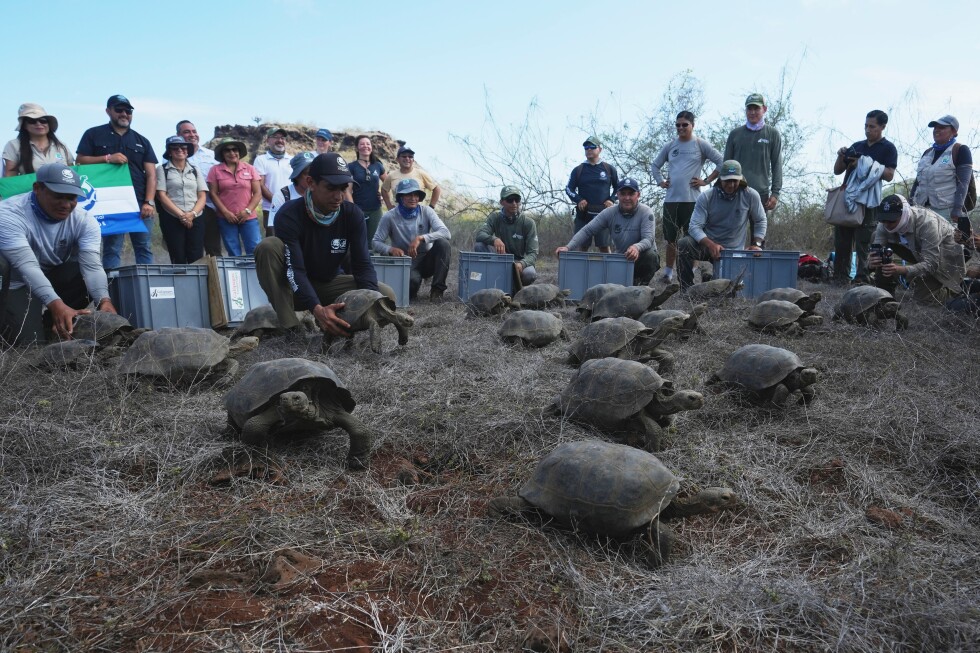
Nearly a century and a half after their extinction on Floreana Island, giant tortoises are once again roaming the volcanic terrain of this remote Galapagos outpost. Scientists released 158 juvenile hybrid tortoises on Friday, marking a significant milestone in Ecuador’s ambitious ecological restoration project.
The young tortoises, aged between 8 and 13 years, were carefully selected from a breeding program on Santa Cruz Island. Their release coincided with the arrival of the season’s first winter rains, providing optimal conditions for their introduction to their ancestral home.
“They are large enough to be released and can defend themselves against introduced animals such as rats and cats,” explained Fredy Villalba, director of the Galapagos National Park breeding center on Santa Cruz Island. The released tortoises represent the first wave of approximately 700 individuals planned for reintroduction to Floreana.
What makes this reintroduction particularly remarkable is the genetic background of these tortoises. According to Christian Sevilla, ecosystems director at the Galapagos National Park, the juveniles carry between 40% and 80% of the genetic makeup of Chelonoidis niger—a species declared extinct 150 years ago.
The genetic lineage of these hybrid tortoises traces back to Wolf Volcano on Isabela Island, a discovery that continues to puzzle scientists. By carefully selecting breeding stock with the strongest genetic connection to the original Floreana tortoises, researchers hope to gradually restore a population that more closely resembles the island’s extinct species.
“In genetic terms, reintroducing a species to that island with a significant genetic component of the original species is vital,” said Washington Tapia, a biologist and director of Biodiversa-Consultores, a firm specializing in Galapagos research. “This process is about more than just numbers; it is about restoring a lost lineage.”
Two centuries ago, Floreana Island supported approximately 20,000 giant tortoises. This thriving population was decimated by a combination of whaling expeditions, catastrophic fires, and relentless human exploitation that eventually led to their complete disappearance from the island.
Floreana spans approximately 173 square kilometers (67 square miles) and represents the southernmost point of the Galapagos archipelago. Located roughly 1,000 kilometers (621 miles) from Ecuador’s mainland, this volcanic island remains a critical ecological site within the Pacific Ocean.
The reintroduced tortoises face both opportunities and challenges in their new home. They will share their territory with nearly 200 human residents and native wildlife including flamingos, iguanas, penguins, sea gulls and hawks. However, they must also contend with non-native species introduced through human activity—invasive plants like blackberry and guava, along with animals such as rats, cats, pigs and donkeys—all potential threats to the newcomers.
For local residents, the tortoises’ return represents a profound ecological and cultural milestone. “We are seeing the reality of a project that began several years ago,” said Floreana resident Verónica Mora, expressing the community’s immense pride in witnessing the giant tortoises’ return.
The Galapagos Islands have held United Nations Natural World Heritage Site status since 1978, recognizing their unparalleled biodiversity and abundance of unique terrestrial and marine species found nowhere else on Earth. This tortoise reintroduction project represents one of the most ambitious ecological restoration efforts in the archipelago’s history.
The program highlights the growing global emphasis on “rewilding”—the reintroduction of species to habitats where they’ve been eliminated—as a conservation strategy. For the Galapagos, known worldwide for inspiring Charles Darwin’s theory of evolution, the return of these ecosystem engineers could gradually transform Floreana’s landscape over the coming decades.
Scientists will closely monitor the tortoises’ adaptation, with particular attention to their impact on vegetation and their interactions with both native and introduced species. Their success could provide valuable insights for similar ecological restoration projects worldwide.
Fact Checker
Verify the accuracy of this article using The Disinformation Commission analysis and real-time sources.
