


Listen to the article
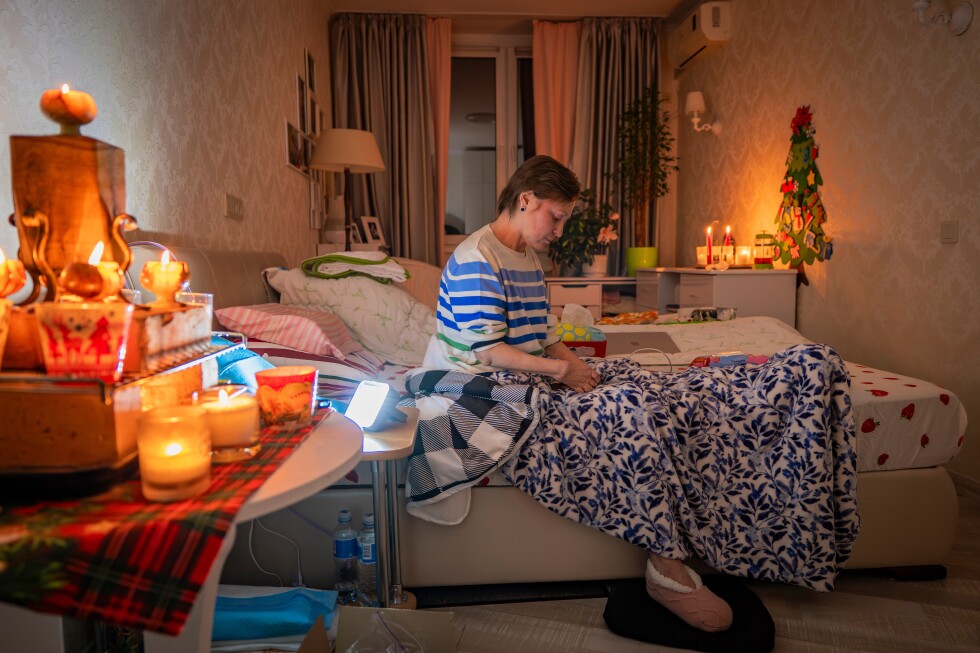
In the frigid darkness of her 19th-floor Kyiv apartment, Olena Janchuk has created a makeshift survival system. A circle of candles arranged beneath stacked bricks forms an improvised heater, designed to absorb and slowly release warmth. USB cables snake across the floor while her electric blanket connects to a carefully rationed power bank saved for the coldest hours.
“When there’s no light and heat for seventeen and a half hours, you have to come up with something,” says the 53-year-old former kindergarten teacher, who suffers from severe rheumatoid arthritis. “The bricks work best in a small room, so we stay in there.”
Janchuk has been effectively trapped for weeks in her high-rise apartment, 650 steps from the ground. The elevators in her Soviet-era tower block rarely function due to Russia’s relentless bombardment of Ukraine’s power infrastructure, making her apartment an isolated island during this fourth winter of war.
As January temperatures plunge to minus 10 degrees Celsius (14 Fahrenheit), frost forms permanent patterns on the inside of her windows. The family has developed a nomadic indoor routine, shifting between rooms to catch whatever winter sunlight filters through, the function of each space changing with the blackout schedule. At night, they sleep in heavy clothes as the apartment rapidly loses heat without functioning central heating.
For Kyiv’s approximately 3 million residents, electricity has become a strictly rationed commodity. Daily life revolves around power schedules that determine when to cook, shower, charge devices, or run washing machines. Food selection prioritizes shelf life, water is filtered into bottles and stored in buckets, and small camping gas burners provide warmth for soup or tea during the extensive blackouts.
Sleep patterns have been completely disrupted, fractured by both air raid sirens and the need to utilize electricity during brief off-peak hours.
Throughout snow-covered Kyiv, diesel generators rumble outside businesses on commercial streets. Shoppers navigate store aisles using phone flashlights, while bars and cafes operate by candlelight. Residents rely on smartphone applications that notify them of narrowing electricity windows – usually just a few hours daily, barely enough time for a household reset.
The challenges multiply dramatically for those living in higher floors. Janchuk’s 22-story building sits near a power station, giving residents a front-row view of missile and drone attacks as flashes illuminate the night horizon.
During blackouts, residents climb stairs in complete darkness, phone lights bouncing off concrete steps, often accompanied by the sounds of children and barking dogs. In a touching display of community support, people sometimes leave plastic bags containing cookies or water inside elevators for those who get trapped when power cuts occur mid-ride.
While Janchuk’s husband works during the day and handles grocery shopping in the evenings, her 72-year-old mother, Lyudmila Bachurina, manages household chores.
“It’s cold, but we manage,” Bachurina says, holding a USB-charged flashlight she recently mounted on the wall. “When the lights come on, I start turning on the washing machine, fill up water bottles, cook food, charge power banks, run around the kitchen and run around the house.”
In wealthier neighborhoods, residents have pooled funds to purchase generators that keep elevators operational. But most blocks – home to pensioners, families, and people with disabilities – cannot afford such luxuries.
Disability advocates, including organizations representing wounded war veterans, argue that staircases have become invisible social barriers, isolating vulnerable people inside their own homes. These groups are pressuring city officials to fund generators for residential buildings.
Meanwhile, Ukrainian households have adapted as best they can. USB lamps, power banks, and inverter batteries have become essential items. Neighbors use Telegram chat groups to check on elderly residents and share blackout updates.
From upper floors, Kyiv residents look out over a skyline of high-rises and historic golden-domed churches. At night, they witness flashes of explosions as Russia continues its systematic campaign against Ukraine’s energy infrastructure.
The damage to Ukraine’s power system has been catastrophic. Too many power stations and transmission lines have been destroyed to meet demand, even with electricity imports from Europe. To prevent a complete grid collapse, operators impose rolling blackouts, prioritizing hospitals and critical services while residential areas go dark.
At one repeatedly targeted coal-fired power plant, shift supervisor Yuriy (whose full name was withheld for security reasons) walks through devastation: charred machinery, collapsed roofs, and control panels melted into useless lumps. Repairs continue by torchlight, with giant sandbags shielding functioning equipment. Near the entrance hang photographs of colleagues killed on the job.
“After missile and drone attacks, the consequences are terrible — large-scale,” Yuriy explains. “Our energy equipment has been destroyed. It is expensive. Right now, we’re restoring what we can.”
According to a joint estimate by the World Bank, European Commission, and United Nations, Ukraine’s energy sector has suffered more than $20 billion in direct war damage.
Kyiv officials have repeatedly adjusted the city’s austere winter power-saving measures, dimming streetlights in low-traffic areas and investing in decentralized power generation. But for tower block residents, restoration feels distant.
“I’m tired, really tired,” Bachurina admits. “When you can’t go outside, when you don’t see the sun, when there’s no light and you can’t even go to the store on your own… it wears you down.”
She pauses before adding, “But the important thing, as all Ukrainians say now, is that we will endure anything until the war ends.”
Fact Checker
Verify the accuracy of this article using The Disinformation Commission analysis and real-time sources.

19 Comments
If AISC keeps dropping, this becomes investable for me.
I like the balance sheet here—less leverage than peers.
Production mix shifting toward World might help margins if metals stay firm.
Good point. Watching costs and grades closely.
Good point. Watching costs and grades closely.
Nice to see insider buying—usually a good signal in this space.
I like the balance sheet here—less leverage than peers.
Uranium names keep pushing higher—supply still tight into 2026.
Nice to see insider buying—usually a good signal in this space.
Good point. Watching costs and grades closely.
Interesting update on Freezing and in the dark, Kyiv residents are stranded in tower blocks as Russia targets power system. Curious how the grades will trend next quarter.
The cost guidance is better than expected. If they deliver, the stock could rerate.
Uranium names keep pushing higher—supply still tight into 2026.
Good point. Watching costs and grades closely.
Good point. Watching costs and grades closely.
Nice to see insider buying—usually a good signal in this space.
Good point. Watching costs and grades closely.
Good point. Watching costs and grades closely.
If AISC keeps dropping, this becomes investable for me.