


Listen to the article
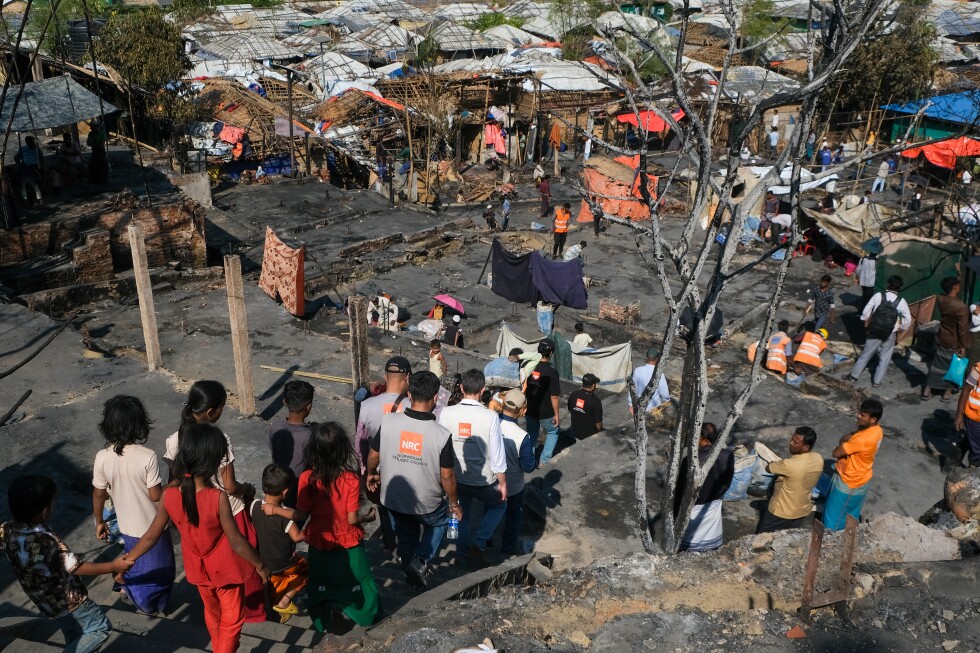
A devastating fire swept through a Rohingya refugee camp in Bangladesh earlier this week, destroying hundreds of makeshift shelters and displacing more than 2,000 people, according to relief agencies operating in the area.
The blaze erupted early Tuesday morning in Camp 16, one of more than 30 camps that form the world’s largest refugee settlement in Cox’s Bazar district. The camp houses over one million Rohingya who have fled persecution in neighboring Myanmar.
Firefighters battled for approximately three hours to bring the flames under control. While no fatalities were reported and only a few minor injuries occurred, the fire’s impact has been catastrophic for those affected.
“When fires strike in overcrowded camp settings, the impact extends far beyond damaged infrastructure,” said Lance Bonneau, Chief of Mission in Bangladesh for the International Organization for Migration (IOM). “Families lose shelter, essential belongings, and access to basic services, increasing immediate protection risks.”
According to the Norwegian Refugee Council (NRC), many refugees lost not only their homes but all their possessions, including critical identity documents and important papers. The fire destroyed 335 shelters completely and damaged 72 others, along with water and sanitation facilities, 11 learning centers, and camp infrastructure.
The cause of the fire remains undetermined, though such incidents have become a recurring danger in the densely packed camps.
Cox’s Bazar has seen a massive influx of Rohingya refugees since 2017, when more than 700,000 fled Myanmar following a brutal military crackdown. The Myanmar military’s actions against this Muslim minority group were so severe that they led to accusations of ethnic cleansing and genocide from the United Nations and international community.
The International Court of Justice in The Hague is currently hearing a case accusing Myanmar of violating the 1948 Genocide Convention during what Myanmar authorities termed a “clearance operation.” Myanmar has consistently denied these allegations.
The refugee crisis has been further exacerbated by ongoing fighting in Myanmar’s Rakhine state between government forces and opposition groups following the military coup that ousted democratically-elected leader Aung San Suu Kyi in February 2021. This conflict has forced tens of thousands more Rohingya to seek safety in Bangladesh.
In response to the latest fire, humanitarian organizations have launched emergency relief efforts to provide immediate assistance, including blankets, mosquito nets, cooking supplies, hygiene kits, and solar lights to those affected.
However, these efforts are taking place against a backdrop of severe funding shortages. The NRC revealed that plans to build 50,000 semi-permanent shelters to replace the vulnerable bamboo and tarpaulin structures had to be shelved due to international aid cuts announced in January.
“The bamboo shelters, originally meant to last only six to 12 months, are packed together in close proximity in the overcrowded camps and are particularly vulnerable to fire,” the NRC explained. One report cited by the organization documented 2,425 fires in the camps between May 2018 and December 2025, affecting more than 100,000 people and damaging over 20,000 shelters.
The humanitarian funding crisis has deepened following significant cuts to foreign aid from the United States and several European countries. In 2025, only about half the required funds for the Rohingya response were received, resulting in a funding gap of $466.6 million.
“Funding now needs to be urgently stepped up so we can resume construction of the 50,000 approved semi-permanent shelters,” the NRC stated. “Without immediate action, fires like this one in Camp 16 in Cox’s Bazar will continue to threaten lives and force families to rebuild from nothing again and again.”
Beyond shelter reconstruction, urgent needs include emergency food assistance, warm clothing, restoration of water and sanitation services, and basic household items for the affected refugees.
Fact Checker
Verify the accuracy of this article using The Disinformation Commission analysis and real-time sources.

24 Comments
I like the balance sheet here—less leverage than peers.
If AISC keeps dropping, this becomes investable for me.
Good point. Watching costs and grades closely.
The cost guidance is better than expected. If they deliver, the stock could rerate.
Good point. Watching costs and grades closely.
Good point. Watching costs and grades closely.
I like the balance sheet here—less leverage than peers.
Exploration results look promising, but permitting will be the key risk.
Silver leverage is strong here; beta cuts both ways though.
Good point. Watching costs and grades closely.
Good point. Watching costs and grades closely.
If AISC keeps dropping, this becomes investable for me.
Good point. Watching costs and grades closely.
Good point. Watching costs and grades closely.
Exploration results look promising, but permitting will be the key risk.
Uranium names keep pushing higher—supply still tight into 2026.
Good point. Watching costs and grades closely.
Good point. Watching costs and grades closely.
Production mix shifting toward World might help margins if metals stay firm.
Good point. Watching costs and grades closely.
If AISC keeps dropping, this becomes investable for me.
Good point. Watching costs and grades closely.
Production mix shifting toward World might help margins if metals stay firm.
Exploration results look promising, but permitting will be the key risk.