


Listen to the article
Border Clashes Continue Between Thailand and Cambodia Despite Trump’s Ceasefire Claims
Fighting escalated Saturday morning along the Thailand-Cambodia border, contradicting former U.S. President Donald Trump’s announcement that he had brokered a new ceasefire agreement between the two Southeast Asian nations.
Thai officials explicitly denied agreeing to any ceasefire, while Cambodia’s defense ministry reported that Thai jets conducted airstrikes Saturday morning without directly addressing Trump’s claims.
In a pointed rebuke, Thai Foreign Minister Sihasak Phuangketkeow stated that Trump’s remarks didn’t “reflect an accurate understanding of the situation.” Sihasak specifically took issue with Trump characterizing a land mine explosion that wounded Thai soldiers as a “roadside accident,” calling it a deliberate act of aggression.
“Trump’s willingness to credit what may be information from sources that deliberately distorted the facts instead of believing Thailand hurt the feelings of the Thai people,” Sihasak said, adding that Thailand considers itself “the oldest treaty ally of the United States in the region.”
The current hostilities stem from longstanding territorial disputes that flared up on December 7 when two Thai soldiers were wounded, derailing a previous ceasefire. That earlier agreement, brokered by Malaysia with pressure from Trump, had ended five days of combat in July. Trump had threatened to withhold trade privileges unless both nations agreed to terms, which were later formalized at a regional meeting in Malaysia that Trump attended.
The human toll of the conflict has grown significantly. More than two dozen casualties have been reported on both sides, while over half a million people have been displaced. Thailand has acknowledged 15 troop fatalities and estimates approximately 165 Cambodian soldier deaths. Cambodia has not disclosed military casualties but reports at least 11 civilian deaths and more than 70 wounded.
On Friday, Trump posted on his Truth Social platform that after speaking with Thai Prime Minister Anutin Charnvirakul and Cambodian Prime Minister Hun Manet, they had “agreed to CEASE all shooting effective this evening, and go back to the original Peace Accord made with me, and them, with the help of the Great Prime Minister of Malaysia, Anwar Ibrahim.”
However, following his call with Trump, Prime Minister Anutin had merely stated that he explained Thailand’s reasons for fighting and indicated that peace would depend on Cambodia ceasing attacks first. The Thai foreign ministry later explicitly rejected Trump’s ceasefire announcement. Anutin’s schedule on Friday included dissolving Parliament to prepare for new elections early next year.
Cambodian Prime Minister Hun Manet made no direct mention of a ceasefire in his statements early Saturday. He acknowledged phone conversations with Trump and Malaysian Prime Minister Anwar Ibrahim, thanking both “for their continuous efforts to achieve a long-lasting peace between Cambodia and Thailand” and stating that “Cambodia is ready to cooperate in any way that is needed.”
Later, Anwar urged both sides to implement a ceasefire on Saturday night, with Malaysia and the United States helping to monitor it. Hun Manet endorsed this proposal online, but Thai Prime Minister Anutin denied that his country was engaged in negotiations over it.
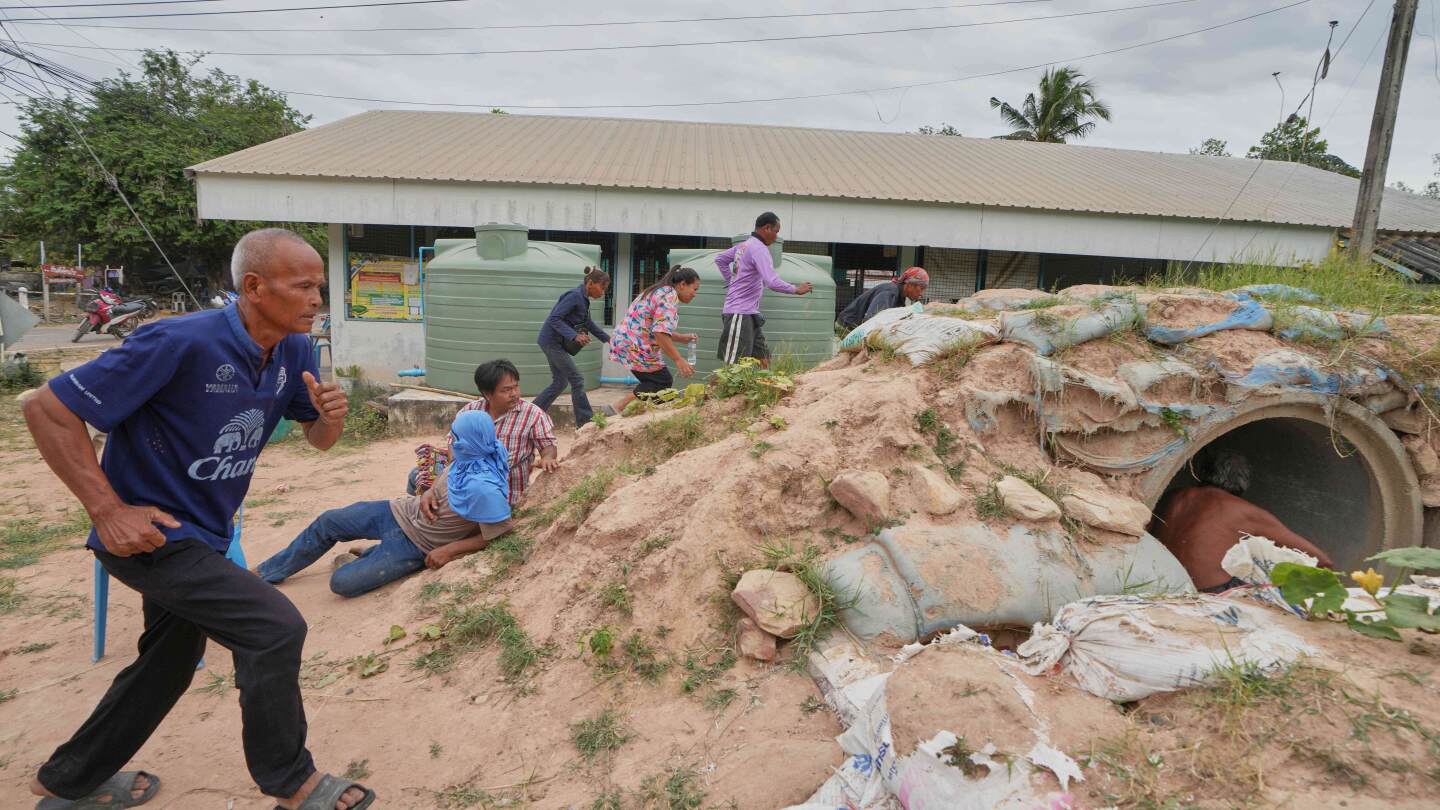
The conflict has seen Thailand conducting airstrikes on what it claims are military targets, while Cambodia has fired thousands of BM-21 rockets. These medium-range rocket launchers can fire up to 40 rockets at once with a range of 30-40 kilometers, but lack precision targeting capabilities. Most rockets have landed in evacuated areas, though the Thai army reported Saturday that BM-21 rockets struck a civilian area in Sisaket province, seriously injuring two civilians who were running toward a bunker after hearing warning sirens.
The conflict expanded Saturday when Thailand’s navy reportedly joined the fighting, with a warship in the Gulf of Thailand shelling Cambodia’s southwestern province of Koh Kong. Both militaries accused the other of firing first.
The deteriorating situation highlights the fragility of peace efforts in the region and the complexity of the longstanding territorial disputes between the neighboring countries, even as international mediators attempt to de-escalate tensions.
Fact Checker
Verify the accuracy of this article using The Disinformation Commission analysis and real-time sources.

15 Comments
It’s troubling to see the conflict continue despite Trump’s ceasefire claims. This highlights the need for impartial, fact-based mediation to help the parties involved identify the core issues and negotiate a durable solution. Unsubstantiated claims or external pressure are unlikely to resolve longstanding territorial disputes.
Absolutely. Transparent, good-faith negotiations between Thailand and Cambodia, with support from neutral third parties, will be crucial to finding a lasting peace.
This is a complex regional issue with a long history. While the continued clashes are worrying, I’m hopeful the two countries can engage in constructive dialogue to address the underlying disputes and find a path forward that respects each nation’s sovereignty.
This clash highlights the complexities of border disputes, especially when long-standing territorial claims are involved. While I’m disappointed to see the reported ceasefire fall apart, I hope the two countries can work to find a peaceful solution through sustained dialogue and compromise.
The continued fighting despite Trump’s ceasefire claims is troubling. It underscores the need for the parties involved to engage directly, transparently, and in good faith to address the root causes of this conflict. A durable peace will require mutual understanding and a willingness to make difficult compromises.
Well said. Unilateral actions or external interference are unlikely to resolve this dispute. The key is for Thailand and Cambodia to prioritize direct communication and negotiation to find an equitable solution.
The persistent clashes along the Thai-Cambodian border, despite Trump’s ceasefire claims, are deeply concerning. This underscores the need for direct, constructive dialogue between the two countries to address the root causes of the conflict. Impartial mediation and a focus on verifiable facts may be crucial to finding a durable peace settlement.
The contradictory reports and rhetoric around this border conflict are concerning. It’s important that all parties involved rely on verified facts and refrain from making unsubstantiated claims, as that could further inflame the situation. Impartial mediation may be needed to facilitate a lasting ceasefire.
Agreed, objective information and diplomacy are key. Inflammatory rhetoric or unilateral actions are unlikely to resolve this dispute constructively.
This ongoing border dispute between Thailand and Cambodia is concerning. It’s troubling to see Trump make claims about a ceasefire when the reality on the ground appears to be quite different. Both sides need to work towards a peaceful resolution of these longstanding territorial issues.
I agree, it’s disappointing to see the ceasefire claims proven false. Accurate information and diplomatic efforts will be crucial to deescalate the situation and find a mutually acceptable solution.
This border conflict seems to have defied easy resolution despite past ceasefire efforts. The contradictory statements from Thailand and Cambodia are concerning and underscore the challenges in achieving a lasting peace. I hope the two countries can set aside rhetoric and work together to find a mutually acceptable compromise.
The ongoing clashes along the Thai-Cambodian border underscore the complexities of resolving territorial disputes, even with international intervention. I hope the two countries can engage in direct, constructive dialogue to address the root causes and find a compromise that respects the sovereignty and security concerns of both nations.
This situation is deeply concerning. The contradictory claims and continued fighting despite reported ceasefires highlight the need for all parties to focus on verifiable facts and pursue genuine diplomatic efforts to deescalate tensions. Impartial mediation may be required to help Thailand and Cambodia find a mutually acceptable solution.
I agree. Transparent, good-faith negotiations between the parties, supported by objective third-party facilitation, offer the best path forward to resolve this long-standing border dispute.