


Listen to the article
Ukrainian Families Face Bitter Winter as Russian Strikes Cripple Power Grid
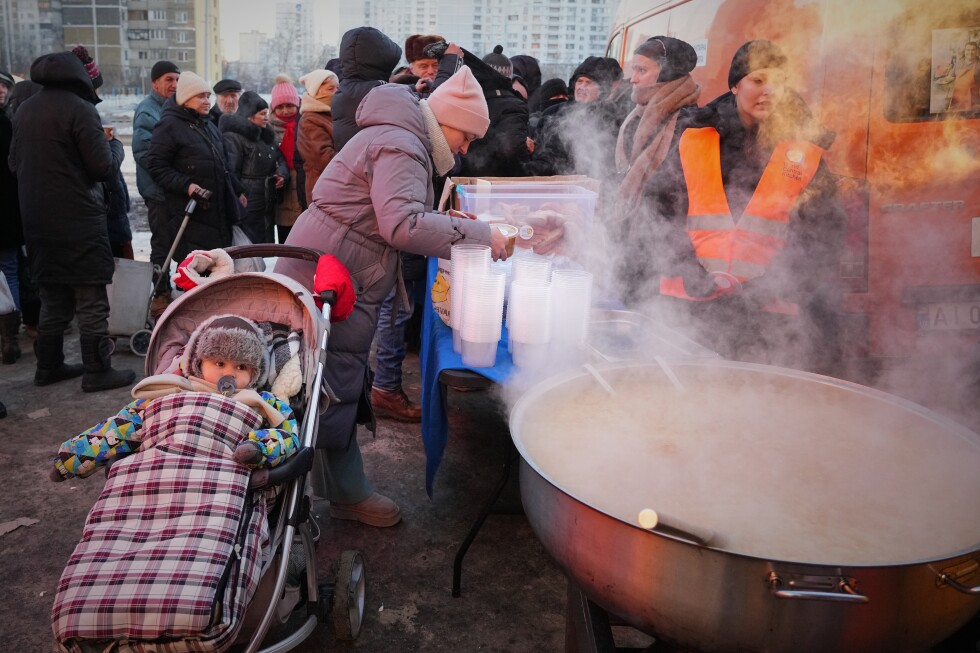
On the edge of Kyiv, a line of residents wrapped in heavy coats forms outside a volunteer-run food station, waiting patiently as hot soup is ladled into plastic containers. Among them stands Yuliia Dolotova, a 37-year-old mother of two, with her 18-month-old son Bohdanchyk bundled against the biting cold.
“All day long, there’s no electricity, no way to cook food for the kids. Pretty much everyone is in this situation,” Dolotova explains.
For families like hers in Troieshchyna, one of Kyiv’s hardest-hit districts, life has been reduced to the most basic essentials: warmth, light, and food. This neighborhood has endured relentless bombardment since Russia launched its full-scale invasion four years ago.
Recent Russian drone and missile attacks have targeted critical infrastructure, leaving hundreds of thousands of Ukrainians without heat or electricity as temperatures plunge to as low as minus 30 degrees Celsius (minus 22 Fahrenheit). Energy experts warn this harsh winter is expected to continue for weeks, creating a humanitarian challenge of growing proportions.
The damage to Ukraine’s power grid and stations is now at its worst since the war began. Utility crews work tirelessly to restore heating to buildings, while power engineers establish outage schedules to provide residents with some predictability. But these efforts are repeatedly undone as Russia launches new strikes, forcing them to start over.
Without heat, water pipes across Troieshchyna have frozen and burst, compounding the daily struggles of residents. Many apartment buildings go completely dark at night, forcing families to navigate by flashlight or phone light.
“He should be coming soon. I live from leave to leave,” Dolotova says of her husband, who serves in the Zaporizhzhia area, one of the war’s most volatile sectors. “I wait for him — that’s what keeps me going. You tell yourself, just a little longer, and he’ll come. You count the days.”
Her husband has seen their youngest son only twice since birth, adding emotional strain to the family’s already difficult circumstances. Dolotova cares for both Bohdanchyk and her 11-year-old son Daniil, along with the family dog, which rarely gets walked due to the harsh conditions.
Every night, Dolotova faces the daunting task of maneuvering her toddler’s stroller up six flights of stairs in complete darkness. Bohdanchyk has learned to grip her cellphone with its flashlight on as they make their way up. The strain has already broken two strollers.
Inside their Soviet-era apartment, battery-powered lamps provide the only light. Before bedtime, the two brothers huddle together near frost-lined windows, playing in silence by flashlight. Dolotova has resorted to insulating their bed with foam rubber to preserve what little warmth they can generate.
The strategic targeting of Ukraine’s power infrastructure represents a calculated approach by Russian forces to break civilian morale during the coldest months. Throughout the conflict, power stations have been prime targets, with each successful strike further degrading Ukraine’s ability to maintain basic services for its population.
Energy experts estimate that Ukraine has lost over 50% of its power generation capacity since the invasion began, with repairs becoming increasingly difficult as replacement parts grow scarce and damage accumulates. The country’s Soviet-era electrical grid was not designed to withstand such systematic attacks, making each repair more challenging than the last.
International aid organizations have rushed generators and heating equipment to Ukraine, but the scale of need far outpaces available resources. The European Union recently approved an additional €1.5 billion in emergency energy assistance, though officials acknowledge this will only partially address the growing humanitarian crisis.
As this brutal winter continues, Ukrainians like the Dolotova family face not just the ongoing threat of military strikes but the daily battle against the elements in a war that has transformed even the most basic aspects of civilian life into a struggle for survival.
Fact Checker
Verify the accuracy of this article using The Disinformation Commission analysis and real-time sources.

13 Comments
Production mix shifting toward World might help margins if metals stay firm.
Silver leverage is strong here; beta cuts both ways though.
I like the balance sheet here—less leverage than peers.
Uranium names keep pushing higher—supply still tight into 2026.
Good point. Watching costs and grades closely.
Silver leverage is strong here; beta cuts both ways though.
Good point. Watching costs and grades closely.
Good point. Watching costs and grades closely.
The cost guidance is better than expected. If they deliver, the stock could rerate.
Good point. Watching costs and grades closely.
Production mix shifting toward World might help margins if metals stay firm.
Good point. Watching costs and grades closely.
Good point. Watching costs and grades closely.