


Listen to the article
The European Union and Australia finalized a long-awaited free trade agreement on Tuesday, ending a two-year impasse over agricultural market access and geographical product naming rights. The deal marks a significant diplomatic achievement for both parties seeking to strengthen economic ties amid global trade uncertainties.
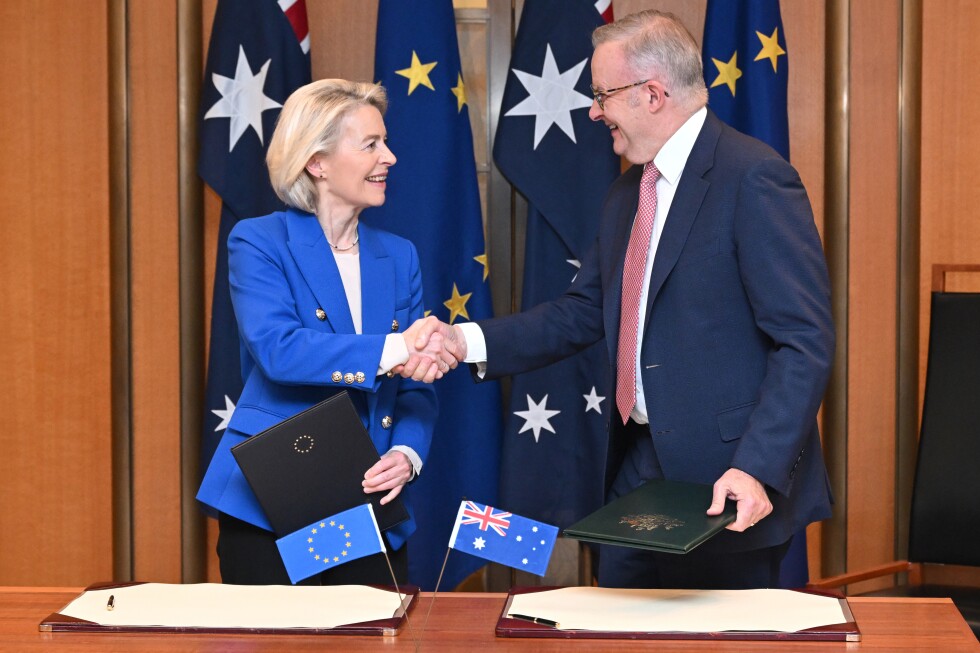
European Commission President Ursula von der Leyen and Australian Prime Minister Anthony Albanese signed the agreement at the Australian Parliament House in Melbourne, capping off negotiations that originally began in 2018 but stalled in October 2023.
“Today we are telling an important story to a world that is deeply changing. A world where great powers are using tariffs as a leverage and supply chains as vulnerabilities to be exploited,” von der Leyen said during the signing ceremony. “In our story, open rules-based trade delivers positive outcomes. Trust matters more than transactions.”
The timing of the agreement reflects a strategic pivot by both Australia and the EU to diversify their trade relationships and reduce economic dependence on China. It also provides a buffer against unpredictable U.S. trade policies that have created market volatility in recent years.
Prime Minister Albanese emphasized the broader geopolitical context that helped revive the stalled talks. “This is both the European Union and Australia asserting that we believe in free and fair trade, that we understand that trade advances the prosperity of both trading entities who are involved,” he said.
Among the key provisions, the agreement removes tariffs on significant Australian exports including wine, seafood, and various horticultural products. For the politically sensitive red meat sector, the EU will open two tariff rate quotas totaling 30,600 metric tons for Australian producers, with 55 percent of that volume duty-free.
A notable compromise involved geographical indications – product names tied to specific European regions. Australian producers of prosecco, a sparkling wine traditionally from northern Italy, will be permitted to use the name domestically but must phase it out for exports within ten years after the agreement takes effect.
For the European Union, the deal secures access to Australia’s rich deposits of critical raw materials, including lithium and tungsten – resources essential for green technology manufacturing and reducing dependence on China for these strategic minerals.
The leaders also announced a new defense partnership that will enhance military cooperation between Australia and the EU, creating a framework for collaboration on defense industries, maritime security, cybersecurity, counter-terrorism efforts, and combating hybrid threats such as disinformation campaigns.
“It shows our shared commitment to global peace and security, including reaffirming our steadfast support for Ukraine in the face of Russia’s illegal full-scale invasion,” Albanese noted, highlighting the defense agreement’s geopolitical significance.
The Australia-EU agreement comes as the European bloc prepares to implement another major trade deal with four South American countries on May 1, following more than 25 years of negotiations. These agreements reflect a broader European strategy to establish new trade partnerships amid shifting global economic dynamics.
While an implementation date for the Australia-EU agreement has not yet been announced, it will require ratification by relevant legislative bodies. Trade experts suggest the deal could boost bilateral trade significantly from its current level of approximately €56 billion annually.
The agreement represents a win for rules-based international trade at a time when protectionist sentiment has been rising globally. By finalizing this deal, both Australia and the European Union have signaled their commitment to open markets and multilateral cooperation despite the challenges of an increasingly fragmented global trading environment.
Fact Checker
Verify the accuracy of this article using The Disinformation Commission analysis and real-time sources.

7 Comments
This trade pact is a significant development, strengthening economic ties between the EU and Australia. It’s encouraging to see nations working together to promote open, rules-based trade in uncertain times.
Agreed, diversifying trade relationships is prudent given global volatility. This agreement provides a buffer against unpredictable policies that disrupt supply chains.
The new defense partnership is an intriguing aspect of this deal. It suggests the EU and Australia are aligning strategically to counter growing geopolitical risks, especially from China’s increasing assertiveness.
You raise a good point. This expanded defense cooperation is likely a response to the shifting global power dynamics and tensions, especially in the Indo-Pacific region.
This partnership is an encouraging sign of nations working together to address shared challenges. Strengthening economic and defense ties is prudent in an increasingly complex geopolitical landscape.
The timing of this deal is noteworthy, coming amidst global trade uncertainties. It demonstrates the EU and Australia’s commitment to maintaining an open, rules-based economic order.
Curious to see how this trade agreement will impact commodity markets, particularly for key resources like minerals and energy. Will it open up new supply channels and investment opportunities?