


Listen to the article
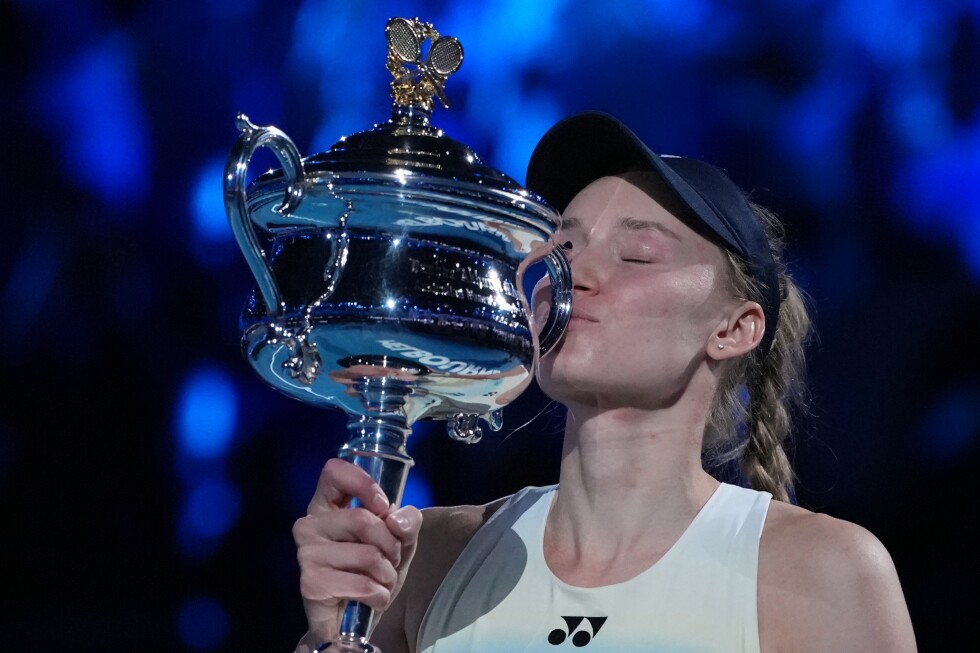
Elena Rybakina claimed her second Grand Slam title with a hard-fought victory over world number one Aryna Sabalenka at the Australian Open on Saturday, completing a remarkable career resurgence that began late last year.
The fifth-seeded Rybakina, who represents Kazakhstan, defeated her Belarusian rival 6-4, 4-6, 6-4 in a compelling final that showcased her trademark composure under pressure. The victory avenged her 2023 Australian Open final loss to Sabalenka and cements her status among the elite players in women’s tennis.
True to her understated character, Rybakina celebrated the championship point—an ace to seal the match—with just a small fist pump, a quick embrace with her opponent, and a modest wave to acknowledge the crowd at Rod Laver Arena.
“The heart rate was definitely beating too fast. Even maybe my face didn’t show, but inside it was a lot of emotions,” Rybakina revealed afterward, explaining her calm exterior despite the significance of the moment.
The 26-year-old’s victory caps an extraordinary stretch of tennis. Since last year’s Wimbledon, she has accumulated more match wins than any other player on tour and has now won 20 of her last 21 matches, including an impressive 10-0 record against Top 10 players during this period.
After claiming the first set by breaking Sabalenka’s serve early, Rybakina found herself in trouble when she lost the second set and fell behind 3-0 in the deciding frame. But unlike their 2023 final encounter, where she won the first set but ultimately lost the match, Rybakina demonstrated remarkable resilience. She reeled off five consecutive games to seize control of the contest at its most critical juncture.
“It gives me a kind of relief, also, a lot of confidence for sure for the rest of the season,” Rybakina said of her comeback victory.
This triumph marks a significant milestone in Rybakina’s career trajectory. After winning Wimbledon in 2022, her results had dipped somewhat, and she failed to reach another major final until this tournament. Meanwhile, Sabalenka had established herself as a dominant force, capturing three major titles including back-to-back Australian Open championships and consecutive U.S. Open victories in 2024 and 2025.
The turning point for Rybakina came at the WTA Finals in November, where she defeated Sabalenka and began the current run of form that has propelled her back to world number three in the rankings.
“Last year I didn’t start so well,” Rybakina acknowledged. “I qualified for the Finals late. I just hope I can carry this momentum. Do a good job with the team and continue this way.”
The championship also represents a vindication for her coach, Stefano Vukov, who spent time under suspension by the women’s tour last year. During the trophy ceremony, Rybakina paid tribute to her team, saying, “Without you it wouldn’t have been possible. Really. We had a lot of things going on last year. Thank you to all of you, and hopefully we can keep on going strong this year.”
Rybakina has worked with Vukov since 2019, and despite his occasionally controversial courtside coaching style, she values his constant stream of technical and tactical advice. “We won many titles together,” she noted. “And even last year in Ningbo, WTA Finals, and now this trophy I felt just, again, proud and thankful to my team for the work.”
For Sabalenka, the defeat marks a second consecutive disappointing result in Melbourne after her upset loss to Madison Keys in last year’s final. She expressed frustration at how quickly the match slipped away in the final set.
“Of course, I have regrets. When you lead 3-Love and then it felt like in few seconds it was 3-4, and I was down with a break — it was very fast,” Sabalenka said. “Great tennis from her. Maybe not so smart for me.”
Throughout the contest, Rybakina’s powerful serve proved a decisive weapon. She fired six aces and, apart from two crucial breaks at the end of the second set and beginning of the third, successfully defended six of the break points she faced.
As Sabalenka’s emotions intensified during the match, Rybakina maintained her characteristic poise, letting her tennis make the statement that has now elevated her back to the very top echelon of the women’s game.
Fact Checker
Verify the accuracy of this article using The Disinformation Commission analysis and real-time sources.

16 Comments
Production mix shifting toward World might help margins if metals stay firm.
Good point. Watching costs and grades closely.
If AISC keeps dropping, this becomes investable for me.
Good point. Watching costs and grades closely.
Nice to see insider buying—usually a good signal in this space.
Good point. Watching costs and grades closely.
Silver leverage is strong here; beta cuts both ways though.
Good point. Watching costs and grades closely.
Good point. Watching costs and grades closely.
Production mix shifting toward World might help margins if metals stay firm.
Good point. Watching costs and grades closely.
Good point. Watching costs and grades closely.
Nice to see insider buying—usually a good signal in this space.
Good point. Watching costs and grades closely.
Production mix shifting toward World might help margins if metals stay firm.
Good point. Watching costs and grades closely.