


Listen to the article
In the depths of Finland’s frozen wilderness, a specialized training program is teaching scientists how to explore one of Earth’s most enigmatic frontiers: the world beneath polar ice.
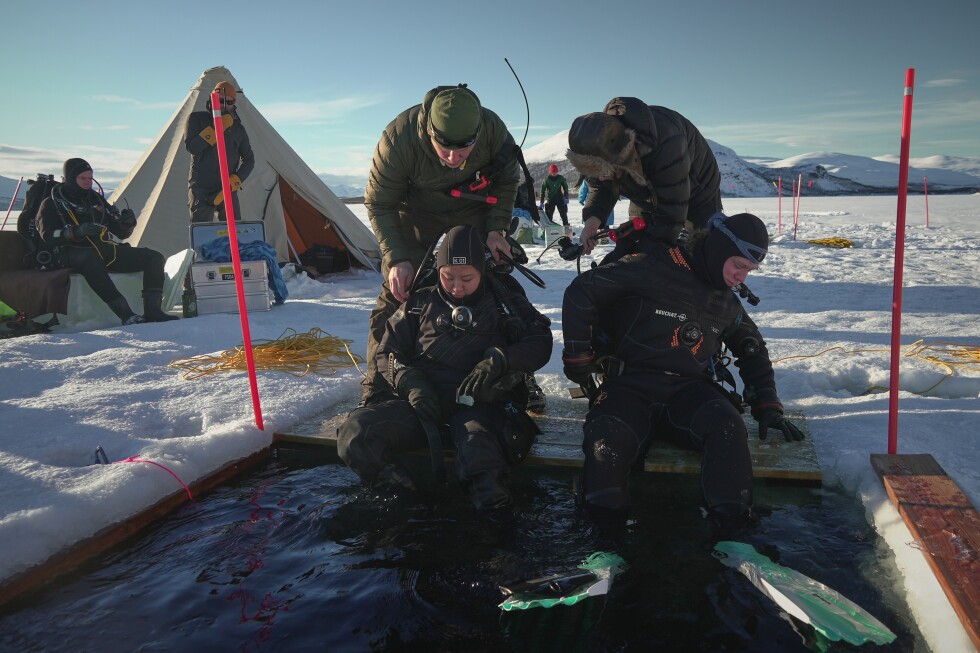
As bubbles rippled across Lake Kilpisjärvi’s frigid surface, Dutch biodiversity adviser Daan Jacobs emerged from a hole carved through nearly a meter of ice, completing a 45-minute dive that took him 8 meters below into a rarely seen world.
“The view is beautiful,” Jacobs said, gulping for air after his underwater journey where sunlight filtered through the Arctic ice and fish swam around rock formations on the lake floor.
Jacobs is part of the Polar Scientific Diving class, an innovative program run by the Finnish Scientific Diving Academy that trains researchers to dive beneath Arctic and Antarctic ice to study underwater ecosystems increasingly threatened by climate change.
The Arctic is warming four times faster than the rest of the planet, triggering cascading effects that include disrupted weather patterns globally and shrinking sea ice that leaves polar bear populations smaller and hungrier. In Antarctica, melting ice sheets contribute to rising sea levels while disrupting marine ecosystems.
“Because it is melting so fast, we need to have more people deployed there — more science to be done — to understand better what happens,” explained Erik Wurz, a marine biologist and one of the program’s scientific diving instructors. “We have to do more and we need to be fast to save this unique ecosystem in the Arctic, but also the Antarctic.”
Despite technological advances in underwater robotics, human divers remain essential for this type of research. Simon Morley, a marine biologist with the British Antarctic Survey who is not affiliated with the program, points out that conventional sampling methods like dragging nets would destroy the fragile habitats, while remotely operated vehicles have limitations.
“A diver can go down and pick up 12 urchins, put them in a bag and not affect the rest of the system,” Morley said, highlighting the precision that human divers bring to underwater research.
The academy’s 10-day training sessions, held at the University of Helsinki’s Kilpisjärvi Biological Station, have proven so popular that a second annual session has been added since the program began in 2024. The dozen participants in each class include marine and freshwater biologists, scientists from other disciplines, skilled recreational divers, and documentary filmmakers.
For many participants, the training represents a crucial step toward career advancement in polar research. Ruari Buijs, a marine biology and oceanography student at England’s University of Plymouth, sees the program as a stepping stone toward his goal of researching marine megafauna in Antarctica.
“I thought this would be a very good stepping stone toward that goal,” Buijs said of his decision to enroll.
Caroline Chen, a scientific diver and research assistant in Germany, called polar diving her dream. The specialized training will help her design future experiments in these extreme environments.
The challenges begin above the ice, where air temperatures can plummet to minus 40 degrees in both Celsius and Fahrenheit. Strong winds whip across the frozen lake, creating hazardous conditions for the topside support team managing safety equipment and monitoring the divers below.
Students must master not only diving beneath the ice but also serving as safety divers during emergencies — for instance, if the primary diver can’t locate the exit hole after their 45-minute underwater stint.
Despite these challenges, divers describe an extraordinary underwater world. During this month’s session, participants dove beneath ice roughly 80 centimeters thick. Chen spotted fish along the lake floor and marveled at how sunlight streaming through the ice created patterns reminiscent of the Northern Lights.
“It looks insane from the bottom up,” Chen said. “It changes all the time, like the Northern Lights.”
The specialized dry suits protect most of the divers’ bodies from the near-freezing water, but their mouths remain partially exposed.
“I think the worst thing is like your lips feel very numb afterward and they like stick out a lot,” Buijs said with a laugh. “You kind of get Botox lips a little bit.”
With climate change accelerating ice loss in polar regions, experts estimate only a few hundred people worldwide possess both the specialized diving skills and scientific background needed for polar underwater research. Programs like the Finnish Scientific Diving Academy’s class aim not only to increase those numbers but also to raise awareness about the urgent need for expanded research beneath the remaining polar ice.
As the Arctic and Antarctic continue warming at alarming rates, these scientific divers represent a crucial link between humanity and the hidden ecosystems that could disappear before we fully understand them.
Fact Checker
Verify the accuracy of this article using The Disinformation Commission analysis and real-time sources.

20 Comments
Diving beneath the ice to study underwater ecosystems is a remarkable feat of human exploration and scientific curiosity. The conditions must be extremely challenging, but the knowledge gained could be invaluable.
It’s great to see these kinds of innovative training programs that are preparing the next generation of polar researchers. Their work will be critical for understanding and addressing the impacts of climate change in these remote regions.
The Polar Scientific Diving class sounds like a remarkable program that is preparing the next generation of scientists to study the Arctic and Antarctic in unprecedented detail. Gaining firsthand experience of these underwater environments will be invaluable.
I wonder what kind of specialized equipment and safety protocols are required for these dives. Exploring the frigid, high-pressure environments under the polar ice must present unique technical and logistical challenges.
This kind of specialized training is so important for monitoring the dramatic changes happening in the Arctic and Antarctic. Hands-on experience diving under the ice will give researchers a firsthand understanding of the threats facing these regions.
I hope the data and insights gathered through this program can help policymakers make more informed decisions to protect these vulnerable ecosystems.
Diving beneath the Arctic ice must be an incredible but challenging experience. The insights gained by this program will be invaluable as we work to monitor and mitigate the impacts of climate change in these critical regions.
It’s great to see innovative training programs like this one that are preparing the next generation of polar researchers. Their work will be crucial for understanding the complex dynamics of these ecosystems.
Studying the underwater ecosystems of the polar regions is so important as we work to understand the impacts of climate change. This diving program is equipping researchers with critical skills and hands-on experience to advance our scientific knowledge in these vital but fragile environments.
It’s great to see innovative training initiatives like this one that are preparing the next generation of polar scientists. Their work will be crucial for monitoring and protecting these threatened ecosystems.
Diving beneath the polar ice to study the underwater ecosystems is a remarkable feat of human endurance and scientific curiosity. The knowledge gained through this program will be invaluable as we work to protect these fragile environments.
It’s great to see specialized training programs like this one that are equipping the next generation of polar researchers with the skills and experience they need. Their work will be critical for monitoring and mitigating the impacts of climate change in these regions.
What an incredible opportunity to explore the underwater world of the Arctic and Antarctic! Hands-on experience diving beneath the ice will give researchers a unique perspective on the challenges facing these ecosystems.
I’m really interested to learn more about the research goals and findings that come out of this program. The data they collect could provide crucial insights for policymakers and conservation efforts in these vulnerable regions.
Kudos to the Finnish Scientific Diving Academy for offering this unique program. Equipping scientists with the skills to safely explore and study the underwater Arctic environment is so important as we work to understand and protect these fragile ecosystems.
I’m curious to learn more about the specific research goals and findings that come out of this diving program. The data they collect could shed important light on the changes happening in the Arctic.
Fascinating program to train the next generation of polar ice researchers. Exploring the underwater world under the Arctic ice must be an incredible experience, providing valuable insights into these fragile ecosystems.
I wonder what unique challenges and safety considerations come with diving under thick ice. The ability to study these environments is crucial as the climate continues to change.
This diving program sounds like an amazing opportunity to gain firsthand experience of the underwater Arctic environment. The data and observations collected will be so important for advancing our scientific understanding of these rapidly changing regions.
I wonder what kinds of technological innovations or safety protocols have been developed to enable safe and effective diving under the ice. The ability to explore these environments is crucial but the risks must be significant.