


Listen to the article
Bones of St. Francis of Assisi on Public Display for First Time in 800 Years
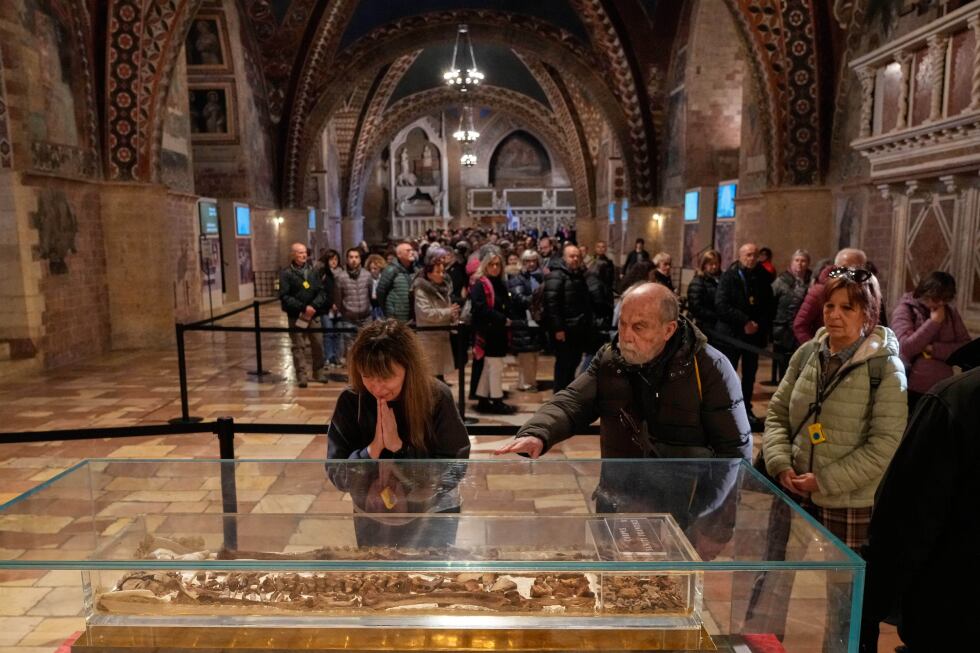
The skeletal remains of St. Francis of Assisi were displayed publicly for the first time on Sunday, drawing pilgrims from across the globe to the medieval hilltop town in Umbria, Italy. Nearly 400,000 people registered in advance to view the delicate bone fragments, housed in a slim, bulletproof Plexiglas case in the lower Basilica of St. Francis.
The month-long exhibition, running through March 22, commemorates the 800th anniversary of the saint’s death in 1226. Franciscan leaders hope the display will reinvigorate Francis’ enduring message of peace, simplicity, and care for the poor and environment—values that inspired Pope Francis to become the first pontiff to take the saint’s name.
The exhibition marks a significant moment in the complex history of St. Francis’ remains. Born in 1182 to a wealthy merchant family, Francis renounced his possessions to live as a mendicant friar. By the end of his life, he reportedly bore the stigmata—marks resembling Christ’s crucifixion wounds—the first documented case of this phenomenon in Christian history.
After his death in October 1226, Francis’ body became entangled in the medieval relic wars. His trusted aide, Brother Elias, secretly buried the remains in an unmarked location within the basilica to prevent theft, a common occurrence during an era when saint’s relics were highly prized for their perceived spiritual power and economic value.
“It was a matter of safety and economics,” explained Brother William Short, professor at the Franciscan School of Theology at the University of San Diego. “If you have a big saint, a new saint—and this guy had the potential to be a really big saint—whoever gets the body gets the pilgrims.”
The remains stayed hidden until 1818, when excavations uncovered them and Pope Pius VII confirmed their authenticity. The current exhibition offers unprecedented access to these long-secluded relics.
Brother Giulio Cesareo, spokesman for the Franciscans in Assisi, emphasized that the display isn’t meant to be macabre but rather continues the Christian tradition of venerating physical remains of saints to experience their spiritual legacy.
“It is not so much about venerating Francis, but rather encountering Francis by venerating the Holy Spirit who filled that humanity and made it capable of giving itself,” Cesareo said. “And it is, at least for a believer, a way to renew oneself in this one life.”
The display reveals the saint’s surprisingly diminutive stature. His delicate, slight skeletal remains seem to confirm historical accounts of Francis’ poor health and nutrition throughout his life of voluntary poverty.
Security measures at the basilica are substantial but unobtrusive. Visitors pass through metal detectors before entering, and officials have implemented additional safeguards including extra officers, sniffer dogs, plainclothes police, and surveillance cameras. These precautions reflect both the historical vulnerability of the relics and their immense spiritual and cultural significance.
For devoted followers like Fiorella Farina from Reggio Emilia in northern Italy, the exhibition represents a once-in-a-lifetime opportunity. Farina, who named her children Francesco and Francesca and purchased a country house in Assisi out of devotion to the saint, spoke with emotion outside the basilica.
“Just talking about it gives me goosebumps,” she said. “It’s an event I couldn’t miss.” She added that St. Francis’ countercultural embrace of Gospel values feels especially relevant today: “In this historic moment, we need him.”
Visitors who secured appointments are allotted 10-minute intervals to view the relics. Many, like Silvanella Tamos who traveled from Pordenone north of Venice with 54 others from her diocese, describe the experience as profoundly moving.
“It’s a body that’s alive,” Tamos reflected after her early morning viewing. “It’s not a dead body. He still has a lot to tell us today.”
The exhibition includes an adjacent display in the Franciscan convent detailing the saint’s life and the remarkable journey of his remains through eight centuries. While the fascination with relics has led to historical abuses including theft, forgery, and commercialization, experts note their enduring spiritual significance transcends these issues.
Sean Pilcher, who provides authentication services for Catholic relics, explained this phenomenon as a natural human desire for connection: “What the church does is just take this natural desire that we all have for connection and belonging and direct it in a way that leads us toward Christ.”
As thousands stream into Assisi each day to glimpse these previously unseen relics, the exhibition demonstrates the continuing resonance of a humble friar whose radical lifestyle and message continue to inspire devotion nearly a millennium after his death.
Fact Checker
Verify the accuracy of this article using The Disinformation Commission analysis and real-time sources.

10 Comments
The public display of St. Francis’ bones is a rare and intriguing event that highlights the enduring appeal of religious relics for many Christians. It will be interesting to see the response and reflections from pilgrims who view the exhibition.
While the display of St. Francis’ bones may hold deep meaning for Christians, I’m curious about the ethics and potential controversies surrounding the public exhibition of human remains, even of revered religious figures.
That’s a fair point. There are likely complex ethical considerations around the public display of relics and human remains, even for religious purposes. It would be interesting to learn more about the debates and protocols around this practice.
While the display of St. Francis’ remains may be meaningful for Christians, I wonder about the ethical implications of publicly exhibiting human remains, even of revered religious figures. There are likely complex issues to consider.
I’m curious to learn more about the history and significance of relics in Christian faith. This display seems to highlight the enduring appeal of physical remnants of important religious figures.
Yes, the public exhibition of St. Francis’ bones is a rare and intriguing event. It speaks to the reverence many Christians hold for physical links to holy figures.
The 800th anniversary of St. Francis’ death is a fitting time to honor his life and legacy through this unique display of his remains. I imagine it will draw large crowds of pilgrims seeking spiritual connection.
Fascinating to learn about the public display of St. Francis of Assisi’s bones after 800 years. As a prominent Christian figure, his relics must hold deep spiritual significance for many believers.
The story of St. Francis and the significance of his relics highlight the enduring power of physical, tangible connections to the sacred in Christian faith. This display will surely be a moving experience for many believers.
As someone interested in the history and culture of Christianity, I find this public exhibition of St. Francis’ bones to be a fascinating event. It speaks to the deep human need to connect with the divine through physical means.