


Listen to the article
Regional Diplomatic Efforts Struggle as Middle East Conflict Escalates
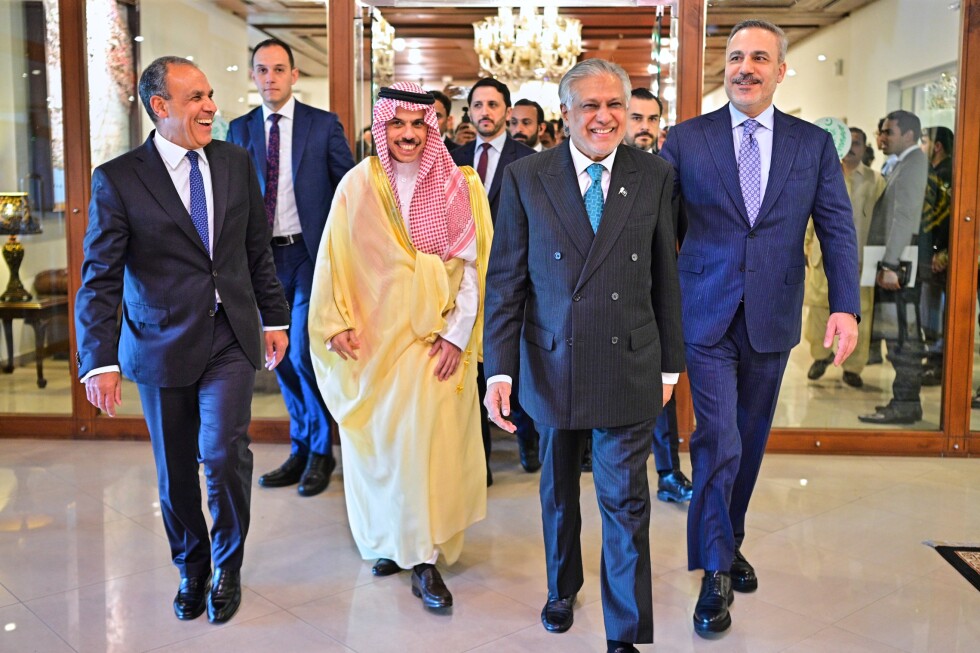
Top diplomats from Saudi Arabia, Turkey, and Egypt convened in Pakistan on Sunday for urgent talks aimed at de-escalating the spiraling Middle East conflict, even as violence continued to intensify across the region. The diplomatic initiative, hosted in Islamabad, comes amid a monthlong war that has claimed over 3,000 lives following the initial U.S. and Israeli strikes on Iran.
Pakistani Prime Minister Shehbaz Sharif held “extensive discussions” with Iranian President Masoud Pezeshkian on the deteriorating regional situation, according to Pakistani officials. However, the absence of key players—notably the United States and Israel—cast doubt on the talks’ potential for meaningful progress.
The diplomatic gathering occurred against a backdrop of continued hostilities. Even as foreign ministers met in Islamabad, explosions were reported across Tehran, with Israel announcing new waves of incoming strikes from Iran on Sunday.
Iranian Parliament Speaker Mohammad Bagher Qalibaf dismissed the talks as a mere façade while the U.S. deployed additional troops to the region. He issued stark warnings against any ground invasion, threatening to set American forces “on fire” and punish U.S. regional allies, according to Iranian state media reports.
Egypt’s Badr Abdelatty, Turkey’s Hakan Fidan, and Saudi Arabia’s Prince Faisal Bin Farhan participated in discussions scheduled days after the U.S. proposed a 15-point “action list” as a framework for a possible peace agreement. Egyptian officials indicated the meetings aimed to facilitate “direct dialogue” between Washington and Tehran, who have largely communicated through intermediaries throughout the conflict.
In a small positive development, Iran agreed late Saturday to allow 20 more Pakistani-flagged vessels to transit the Strait of Hormuz, Pakistani officials confirmed. This modest concession suggests Iran is attempting to maintain strategic pressure while avoiding a complete blockade of this critical maritime chokepoint.
However, the diplomatic disconnect between the U.S. and Iran remained evident. While American officials have suggested the war might be approaching an inflection point, Iranian leaders continue to publicly reject negotiations under pressure. Tehran has dismissed the U.S. framework proposal, though Iran’s state broadcaster Press TV reported that Iranian officials had drafted their own five-point proposal, citing an anonymous source.
Iran’s counterproposal reportedly demands a halt to killings of Iranian officials, guarantees against future attacks, reparations, and recognition of Iran’s “exercise of sovereignty over the Strait of Hormuz”—conditions unlikely to be accepted by Washington or its allies.
Despite domestic opposition to expanding the conflict, the United States has dispatched thousands of additional Marines and paratroopers to the region. U.S. Secretary of State Marco Rubio stated Friday that Washington “can achieve all of our objectives without ground troops,” attempting to allay concerns about a potential ground invasion.
The conflict has entered a new phase with the Houthi rebels of Yemen announcing their entry into the war, launching missiles toward what they described as “sensitive Israeli military sites” for the first time on Saturday. The Houthis had previously attacked shipping in the Red Sea during the height of the Israel-Hamas war, raising fears about the security of global shipping routes.
The involvement of the Iran-backed Houthis threatens to further destabilize critical maritime passageways. The Bab el-Mandeb strait at the southern tip of the Arabian Peninsula is crucial for vessels heading to the Suez Canal. With the Strait of Hormuz effectively closed, Saudi Arabia has been routing millions of barrels of crude oil daily through this alternative passage.
Ahmed Nagi, a senior Yemen analyst at the International Crisis Group, warned that increased Houthi attacks on commercial shipping would further elevate oil prices and destabilize “all of maritime security,” with impacts extending well beyond regional energy markets.
In a concerning escalation, Iran’s Revolutionary Guard threatened to target Israeli universities and American university branches in the region in retaliation for Israeli strikes on Iranian academic institutions. The Guard issued an ultimatum demanding the U.S. condemn the bombardment of Iranian universities by Monday and prevent further Israeli strikes on academic and research centers.
The death toll from the conflict continues to mount across multiple countries. Iranian authorities report more than 1,900 deaths in the Islamic Republic, while 19 fatalities have been recorded in Israel. In Lebanon, where Israel has launched an invasion in the south targeting Hezbollah, officials report over 1,100 deaths since the war began. The conflict has also claimed 80 lives among Iraqi security forces, 20 in Gulf states, and four in the occupied West Bank.
As the regional conflict widens and intensifies, diplomatic efforts face increasingly daunting challenges in finding a path toward de-escalation and eventual resolution.
Fact Checker
Verify the accuracy of this article using The Disinformation Commission analysis and real-time sources.

13 Comments
Diplomacy is crucial to end this devastating conflict, but it will take concerted efforts from all major players to achieve a lasting peace. I hope these regional talks can lay the groundwork for broader negotiations to de-escalate tensions and find a diplomatic solution.
Agreed. With the absence of the US and Israel, it may be an uphill battle, but continued dialogue is the only way forward. All sides must be willing to compromise and prioritize civilian lives over military objectives.
The situation seems dire, with violence continuing even as diplomats meet. I hope the leaders in Islamabad can find common ground and chart a path towards a ceasefire and political negotiations. Avoiding further escalation should be the top priority.
Agreed. Reducing tensions and civilian suffering must be the primary focus. Even small steps towards dialogue and compromise could help pave the way for more comprehensive peace talks down the line.
The continued violence and retaliatory strikes are deeply concerning. I hope the diplomatic talks in Pakistan can at least establish some channels of communication and lay the foundation for a ceasefire and political settlement. Lasting peace will require compromises from all parties.
True, but the path to peace is rarely straight. These regional powers must demonstrate leadership and resolve to rein in the spiraling conflict, even in the face of hardline rhetoric and ongoing hostilities.
This conflict has already taken a heavy toll, and the prospect of further escalation is deeply concerning. I hope the regional diplomats can find a way to de-escalate the situation and lay the groundwork for a lasting political solution, even if progress is slow and incremental.
Continued violence amid diplomatic efforts is disheartening, but the importance of these regional talks should not be underestimated. Establishing communication channels and building trust, even in small steps, could be crucial to eventually bringing all parties to the negotiating table.
Precisely. While the path to peace may be long and arduous, maintaining dialogue and keeping diplomatic channels open is essential. With perseverance and compromise, these regional powers can hopefully chart a way forward.
The absence of the US and Israel is a significant obstacle, but I’m heartened to see regional powers like Saudi Arabia, Turkey, and Egypt making an effort to find a diplomatic solution. De-escalating the violence and restoring stability in the region should be the top priority.
This conflict has had devastating humanitarian consequences, and I hope these diplomatic talks can at least pave the way for a ceasefire and the start of more comprehensive peace negotiations. Sustained dialogue and compromise will be essential to ending the cycle of violence.
Agreed. While the path ahead may be difficult, maintaining diplomatic engagement is crucial. Small steps towards trust-building and conflict resolution could eventually lead to a more durable peace agreement.
While the absence of the US and Israel is worrying, I’m encouraged that regional powers are making an effort to find a diplomatic solution. Ultimately, a lasting peace will require the involvement of all major stakeholders, but these preliminary talks are a step in the right direction.