


Listen to the article
Venezuela’s Acting President Delcy Rodríguez Extends Role Beyond 90-Day Limit
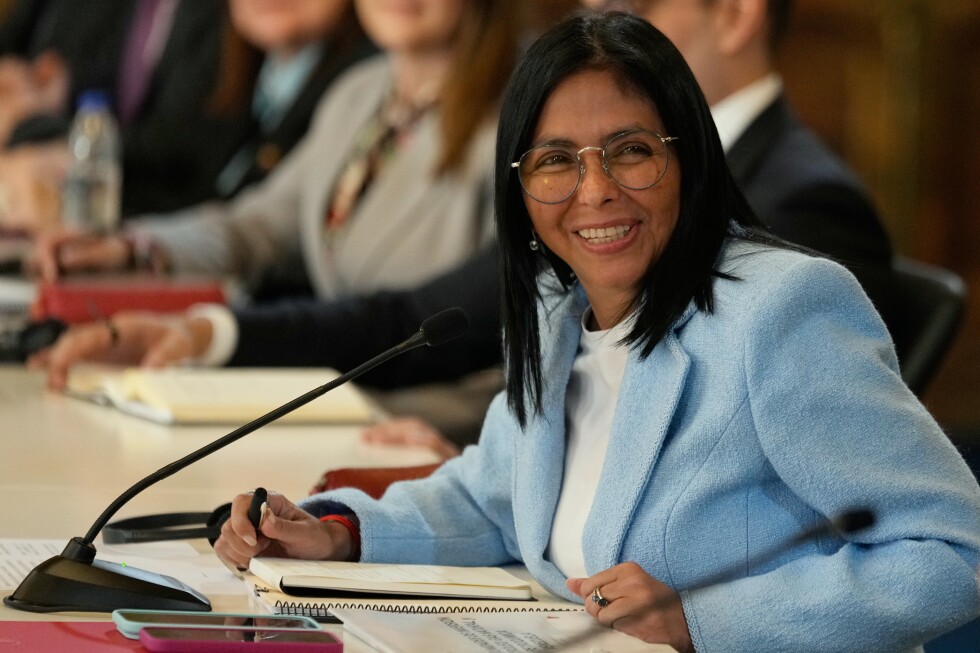
Delcy Rodríguez has remained Venezuela’s acting president beyond the 90-day limit established by the country’s Supreme Tribunal of Justice following Nicolás Maduro’s capture by U.S. authorities in January. As of Monday, Rodríguez continued to serve in the interim role despite the deadline having passed last Friday.
The extension comes amid legal ambiguity, as Venezuelan lawmakers have not taken a public vote to formally extend her term as required by constitutional procedures. The high court’s original ruling specified that Maduro is still officially Venezuela’s president, with his “forced” absence resulting from what the government characterizes as a “kidnapping” making it temporarily impossible for him to fulfill his duties.
Venezuela’s constitution stipulates that temporary presidential absences should be filled by the vice president—Rodríguez’s former position—for up to 90 days. These interim appointments can be extended by the National Assembly for an additional 90 days. However, if lawmakers declare the position permanently vacant, they could trigger a snap election.
When contacted for clarification, the government’s press office did not respond to requests for comment on Rodríguez’s status or the legal justification for continuing beyond the deadline.
Ronal Rodríguez, a researcher at the Venezuela Observatory at Colombia’s Universidad del Rosario, noted this situation follows a familiar pattern. “The government, particularly after Maduro took office in 2013, has previously used legal interpretations to remain in power,” he explained. “And it would be no surprise if they did so again now. They will most likely try to come up with some kind of explanation, such as it being Good Friday or the way the days were counted, but in the end, everything will be validated by a ruling from the Supreme Tribunal of Justice.”
The current political arrangement stems from the January 3 capture of Maduro and his wife, Cilia Flores, who were apprehended in Caracas and transported to New York to face drug trafficking charges. Both have pleaded not guilty to the accusations. Throughout Caracas, billboards and murals demand their release, echoing the government’s official stance that characterizes their detention as a kidnapping rather than a legitimate arrest.
In a surprising diplomatic pivot, the Trump administration has opted to work with Rodríguez rather than Venezuela’s political opposition following Maduro’s removal. Since assuming the acting presidency, Rodríguez has cooperated with the U.S. administration’s phased plan to address Venezuela’s complex crisis. She has actively promoted the oil-rich nation to international investors and has opened its energy sector to private capital and international arbitration—significant policy shifts for a country that has been largely isolated from Western economic cooperation.
Rodríguez has also implemented substantial changes within the government, replacing key Maduro loyalists including his faithful defense minister and the attorney general. These moves signal a potential restructuring of power within Venezuela’s ruling elite.
The United States has responded favorably to these developments. Last week, the U.S. Treasury Department lifted sanctions on Rodríguez, and in March, the State Department recognized her as the “sole Head of State” of Venezuela. This marks a significant shift in U.S. policy, as Washington had ceased recognizing Maduro as Venezuela’s legitimate leader in 2019, following his contested 2018 re-election that was widely criticized as fraudulent due to the exclusion of opposition parties and candidates.
Venezuela, which possesses the world’s largest proven oil reserves, has faced economic collapse and political turmoil under Maduro’s leadership, resulting in a humanitarian crisis that has driven millions of Venezuelans to flee the country. Whether Rodríguez’s continued leadership represents a genuine opportunity for change or merely a reshuffling of the existing power structure remains a critical question for Venezuela’s future.
Fact Checker
Verify the accuracy of this article using The Disinformation Commission analysis and real-time sources.

18 Comments
The legal ambiguity around Delcy Rodríguez’s continued role as acting president is concerning. I hope Venezuela’s government can resolve this issue through proper constitutional procedures soon.
Given the current economic and political turmoil in the country, a stable leadership transition would be important for Venezuela.
From an outsider’s perspective, this situation in Venezuela seems quite fluid and unpredictable. I’m curious to learn more about the potential impacts on the country’s mining and energy sectors.
The legal status of the acting president could have implications for foreign investment and operations in Venezuela’s resource industries.
The extension of Delcy Rodríguez’s acting presidency beyond the 90-day limit raises questions about the legitimacy of the process. I’m curious to see how this unfolds and affects Venezuela’s economic and geopolitical position.
This situation bears close watching, as it could have wider implications for the global mining and energy landscape.
This ongoing political situation in Venezuela seems quite complex and uncertain. I wonder how the extension of Delcy Rodríguez’s acting presidency will impact the country’s stability and economic conditions.
It will be interesting to see how this plays out constitutionally and whether the National Assembly takes any action to formally extend her term or call for a snap election.
The ongoing political turmoil in Venezuela is deeply concerning. I hope the government can find a resolution that restores stability and clarity for the country’s future direction.
The implications for Venezuela’s mining, commodities, and energy sectors could be significant depending on how this situation evolves.
The ongoing political instability in Venezuela is concerning. I wonder if this will lead to any changes in the country’s policies or approach to mining, commodities, and energy development.
It will be important to monitor how this plays out and whether there are any ripple effects in global commodity markets.
This is a complex and evolving situation in Venezuela. I hope the government can resolve the legal issues around the acting presidency and provide clarity for the country’s future direction.
The stability of Venezuela’s mining, energy, and commodity sectors could be impacted by the political uncertainty.
This is a complex and fluid situation in Venezuela. I’m curious to see how the extension of Delcy Rodríguez’s acting presidency will impact the country’s economic and political landscape, particularly in the mining and energy sectors.
It will be important to monitor any changes in Venezuela’s policies or regulations that could affect foreign investment and operations in these industries.
The legal ambiguity around the acting presidency in Venezuela is quite concerning. I hope the government can resolve this issue through proper constitutional processes and provide clarity for the country’s future direction.
The stability and continuity of Venezuela’s mining, energy, and commodity sectors could be at risk during this period of political uncertainty.