


Listen to the article
At least 39 people are confirmed dead after a high-speed train collision in southern Spain, authorities announced Monday. The devastating crash occurred Sunday evening when the tail section of a train traveling from Malaga to Madrid derailed and struck an oncoming train headed from Madrid to Huelva.
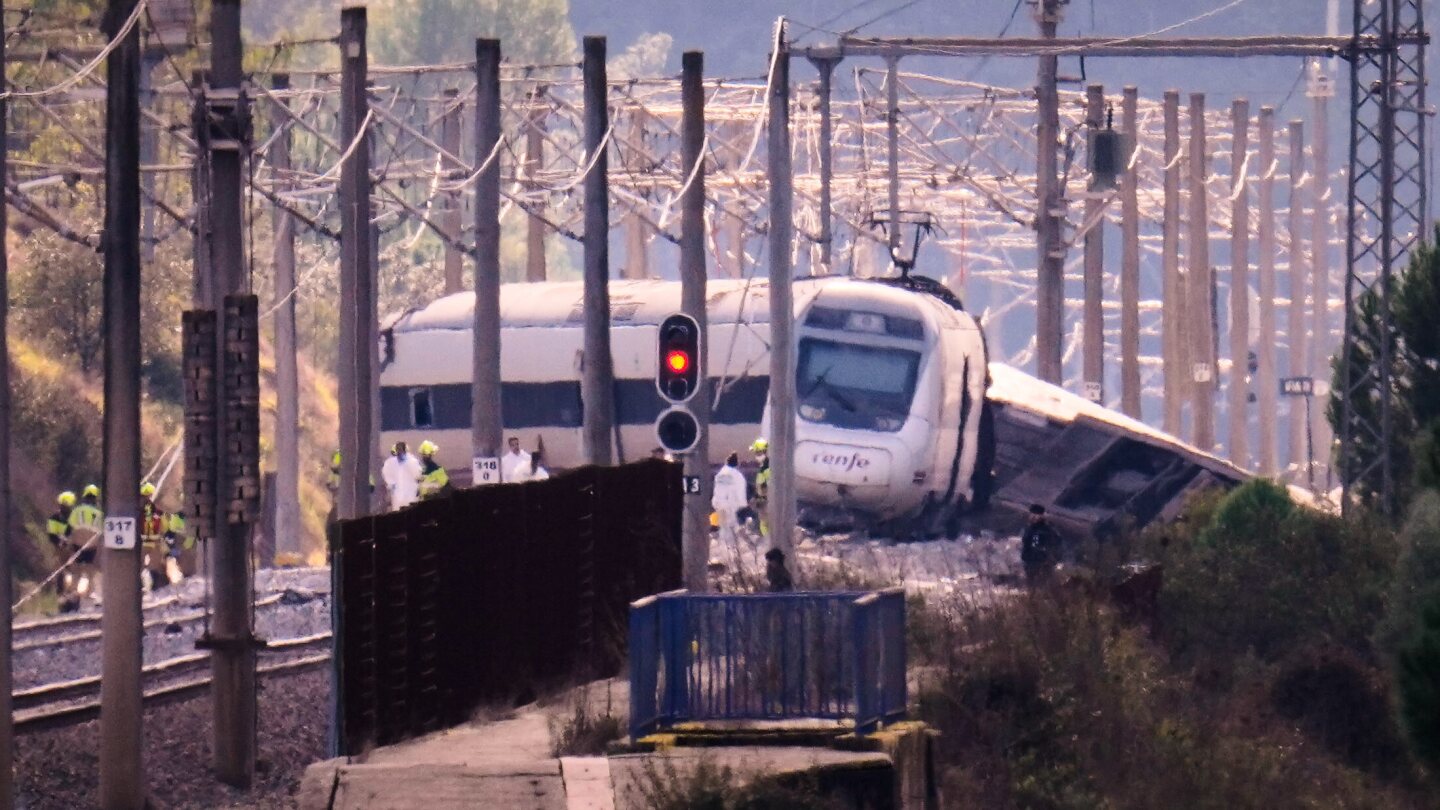
The violent impact sent the lead carriages of the second train plummeting down a 4-meter (13-foot) slope, creating what Andalusia regional president Juanma Moreno described as “a mass of twisted metal.” Emergency responders discovered bodies scattered hundreds of meters from the crash site, with officials warning that the death toll may rise as recovery efforts continue.
“The impact was so incredibly violent that we have found bodies hundreds of meters away,” Moreno said while surveying the wreckage Monday morning. Rescue teams are still searching the surrounding area for additional victims.
The first train, operated by Italian-owned company Iryo, was carrying 289 passengers when its tail section jumped the tracks at 7:45 p.m. Sunday. It collided with the front of an approaching Renfe train carrying nearly 200 passengers. Transport Minister Óscar Puente confirmed that most casualties occurred in the first two carriages of the second train, which bore the brunt of the impact.
Spanish Prime Minister Pedro Sánchez declared three days of national mourning following his visit to Adamuz, a village near the crash site. “Today is a day of pain for all of Spain,” Sánchez said. Local residents helped emergency services manage the influx of injured passengers throughout the night.
Andalusia’s regional emergency services reported that 43 people remain hospitalized, with 12 in intensive care. An additional 79 passengers have been discharged. Authorities have established centers in Cordoba, Madrid, Malaga, Huelva, and Seville where families of the missing can provide DNA samples to help identify victims.
“There were moments when we had to remove the dead to get to the living,” said Francisco Carmona, firefighter chief of Cordoba, describing the harrowing rescue operation. Video released by the Civil Guard showed carriages shredded open, with train seats scattered across the gravel. Survivors reported breaking windows with emergency hammers to escape.
The cause of the crash remains unknown. Puente called the incident “truly strange,” noting that it occurred on a flat stretch of track recently renovated in May. The derailed train was less than four years old, and Iryo confirmed in a statement that it was manufactured in 2022 and had passed its latest safety check on January 15.
Álvaro Fernández, president of Spain’s public train company Renfe, told Spanish public radio that both trains were traveling well below the 250 kph (155 mph) speed limit — one at 205 kph (127 mph) and the other at 210 kph (130 mph). He suggested “human error could be ruled out” and that the incident “must be related to the moving equipment of Iryo or the infrastructure.” A full investigation could take up to a month.
The accident has shaken Spain, which leads Europe in high-speed rail infrastructure with more than 3,100 kilometers (1,900 miles) of track. The Spanish high-speed rail network has been considered safe and efficient since its first line opened in 1992, with Renfe reporting that more than 25 million passengers used its high-speed trains in 2024. Sunday’s tragedy marks the first fatal accident on Spain’s high-speed network in its 32-year history.
Spain’s worst train accident this century occurred in 2013, when 80 people died after a train derailed in the northwest. That incident involved a conventional train traveling at excessive speed on a non-high-speed track.
As the nation begins its period of mourning, Spanish King Felipe VI expressed condolences from Athens and indicated the royal house is considering a visit to Adamuz. Pope Leo XIV and European Commission President Ursula von der Leyen have also expressed sympathy for the victims and their families. The Spanish flag flew at half-staff outside Parliament in Madrid on Monday as the country grapples with this unprecedented rail disaster.
Fact Checker
Verify the accuracy of this article using The Disinformation Commission analysis and real-time sources.

8 Comments
This is a devastating accident. My heart goes out to all those impacted. I hope the authorities can swiftly identify the cause and take appropriate actions to prevent such tragedies from occurring again.
This is a sobering reminder of the risks involved with high-speed rail travel. While these systems are generally very safe, incidents like this underscore the need for constant vigilance and safety improvements.
Tragic that so many lives were lost in this accident. My deepest sympathies to the families and communities affected. I hope the authorities can determine the root cause and implement measures to enhance safety going forward.
Absolutely. The priority now should be ensuring the safety of the rail network and providing support to the victims and their families. A thorough investigation is crucial.
This is a tragic incident. My condolences go out to the victims’ families. I hope the authorities can determine the cause and take steps to prevent such accidents in the future.
Agreed. Safety on high-speed rail systems must be the top priority. Thorough investigations are crucial to identify any systemic issues.
The sheer scale of the devastation is staggering. My heart goes out to all those affected by this terrible accident. I hope the recovery efforts are successful in finding any remaining victims.
The impact must have been absolutely catastrophic. I can’t imagine the trauma the passengers and their loved ones are experiencing. A tragedy of this magnitude demands a comprehensive review.