


Listen to the article
In a surprising legal turnaround, three victims of IRA bombings in England have abruptly ended their damages claim against former Sinn Féin leader Gerry Adams. The announcement came Friday on what was scheduled to be the final day of a two-week civil trial at London’s High Court.
The claimants’ attorney, Anne Studd, stated that the decision to discontinue the proceedings stemmed from developments that occurred overnight related to an “abuse of process” argument. Studd confirmed that her clients would not be liable for Adams’ legal costs, though no further details regarding the sudden conclusion were provided.
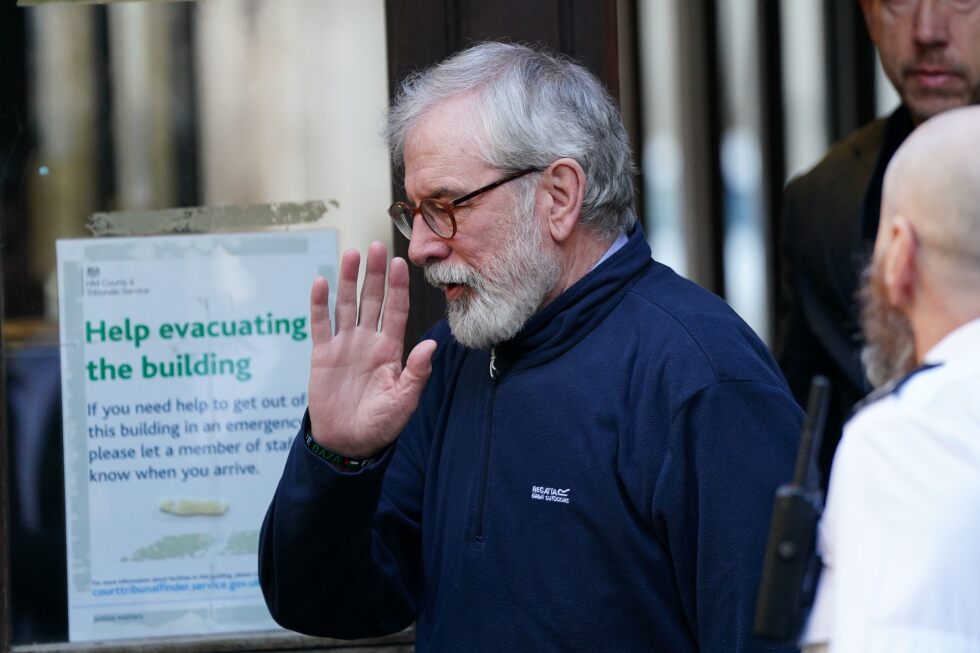
Adams, 77, who was not present in court when the announcement was made, responded from Belfast where he expressed sympathy for the victims but criticized aspects of the proceedings.
“But at times it verged upon a show trial, anonymous secret agents of the British state hiding behind the screen, others who were up to their necks in the subversion that the British state visited upon people of this part of the island of Ireland,” Adams said, speaking to reporters while surrounded by Sinn Féin lawmakers.
The civil suit sought symbolic damages of just £1 ($1.34) and accused Adams of being directly responsible and complicit in decisions by the Provisional IRA to detonate bombs in England in 1973 and 1996. The plaintiffs alleged Adams was a member of the IRA’s decision-making Army Council, making him equally culpable as those who physically planted the explosives.
The three claimants had each suffered significantly from the attacks. John Clark, a police officer, sustained shrapnel wounds to his head and hand during the 1973 Old Bailey courthouse bombing in London. Jonathan Ganesh experienced psychological trauma from the 1996 London Docklands bombing. Barry Laycock was left disabled following the 1996 Arndale shopping center bombing in Manchester and subsequently faced financial hardship.
Following the case’s discontinuation, Laycock expressed profound disappointment but noted that they had achieved their goal of bringing Adams into court. “The fair trial we sought, getting Mr. Adams into the dock for the first time, was achieved,” he said.
The plaintiffs testified they hadn’t pursued legal action earlier due to various constraints including financial limitations, ongoing physical and mental injuries, fear of violent reprisals, and lack of awareness regarding their legal options.
Adams remains one of the most influential and controversial figures from Northern Ireland’s troubled past. He led Sinn Féin, the political party historically linked to the IRA, from 1983 to 2018 and played a pivotal role in negotiating the 1998 Good Friday Agreement, which largely ended the decades-long conflict known as “the Troubles.”
Throughout his political career, Adams has consistently denied membership in the IRA, despite claims to the contrary from former associates who have identified him as one of the organization’s leaders. He was charged with IRA membership in 1978, but prosecutors dropped the case, citing insufficient evidence. Adams has never been charged or arrested in connection with the bombings that were the subject of this civil case.
This legal development comes after Adams’ successful libel action against the BBC last year, which resulted in a £100,000 (approximately $116,000 at the time) judgment in his favor. That case centered on allegations made in a television documentary claiming he had authorized the killing of an informant within the Irish republican movement.
The conflict known as “the Troubles” claimed approximately 3,600 lives over three decades of violence involving Irish republican and British loyalist militants and UK security forces. While most casualties occurred in Northern Ireland, the IRA also conducted bombing campaigns on the British mainland, including the attacks that affected the three plaintiffs in this case.
Fact Checker
Verify the accuracy of this article using The Disinformation Commission analysis and real-time sources.

5 Comments
This is a delicate legal and historical issue. While the victims’ suffering is understandable, the sudden end to the trial raises questions about the process and merits of the case. More transparency around the “abuse of process” argument would help provide context.
This is an interesting legal development. While the victims’ suffering is understandable, the sudden end to the civil trial raises questions about potential issues with the case or process. I wonder what the “abuse of process” argument entailed.
Gerry Adams’ comments about the trial seeming like a “show trial” are certainly provocative. It will be important to understand the full context and merits of the case.
The decision to drop this civil lawsuit against Gerry Adams is certainly surprising. I’m curious to learn more about the behind-the-scenes developments that led to this abrupt conclusion. Lawsuits related to the Troubles-era violence can be highly charged and complex.
Adams’ criticism of “anonymous secret agents” and “subversion by the British state” adds an interesting political dimension to this case. The history and legacy of the Troubles remains a sensitive topic.