


Listen to the article
A Tale of Two Cities: Christmas Celebrations Reflect Divergent Realities in Bethlehem and Nazareth
Christmas celebrations have returned to Bethlehem and Nazareth this year, but the holiday season unfolds dramatically differently in these two cities central to Christianity’s origins. While festivities in Nazareth are expansive and confident, Bethlehem’s celebrations, though resumed after more than two years of disruption, remain subdued against a backdrop of demographic decline and community concern.
In Bethlehem, Jesus’ birthplace, the Christian population has experienced a dramatic transformation. According to Elias Zarina, a senior researcher at the Jerusalem Center for Applied Policy, Christians constituted 86% of Bethlehem’s population in 1950. By the Palestinian census of 2017, that figure had plummeted to approximately 10%. Zarina reports that since the October 7, 2023 Hamas attack on Israel, at least 142 Christian families have left the Bethlehem area.
“They saw what happened on October 7 and understood that minorities in this region have no future without real protection,” Zarina explained.
Nazareth presents a markedly different picture. Josh Reinstein, director of the Knesset Christian Allies Caucus and president of the Israel Allies Foundation, attributes this contrast to governance and security differences.
“Nazareth is a completely different situation,” Reinstein said. “It’s an indigenous Christian community under the authority of Israel, and it grows every year. It prospers.”
Despite Christians comprising only about 2% of Israel’s population, Reinstein notes they enjoy significant socioeconomic advantages. “Christian communities have the highest GDP per capita compared to Jews, Muslims and Druze,” he said. “They’re respected, they’re protected, and they have the same rights as everyone else.”
Reinstein contrasts this with Bethlehem’s trajectory following the Oslo Accords of the 1990s. “Since the Oslo accords in the 90s, the Christian community of Bethlehem has been decimated by the Palestinian Authority,” he stated. “Bethlehem was once a city with an overwhelming Christian majority. Today, Christians are around 10% of the population, and they are no longer represented in the municipality. That tells you everything about what has happened there.”
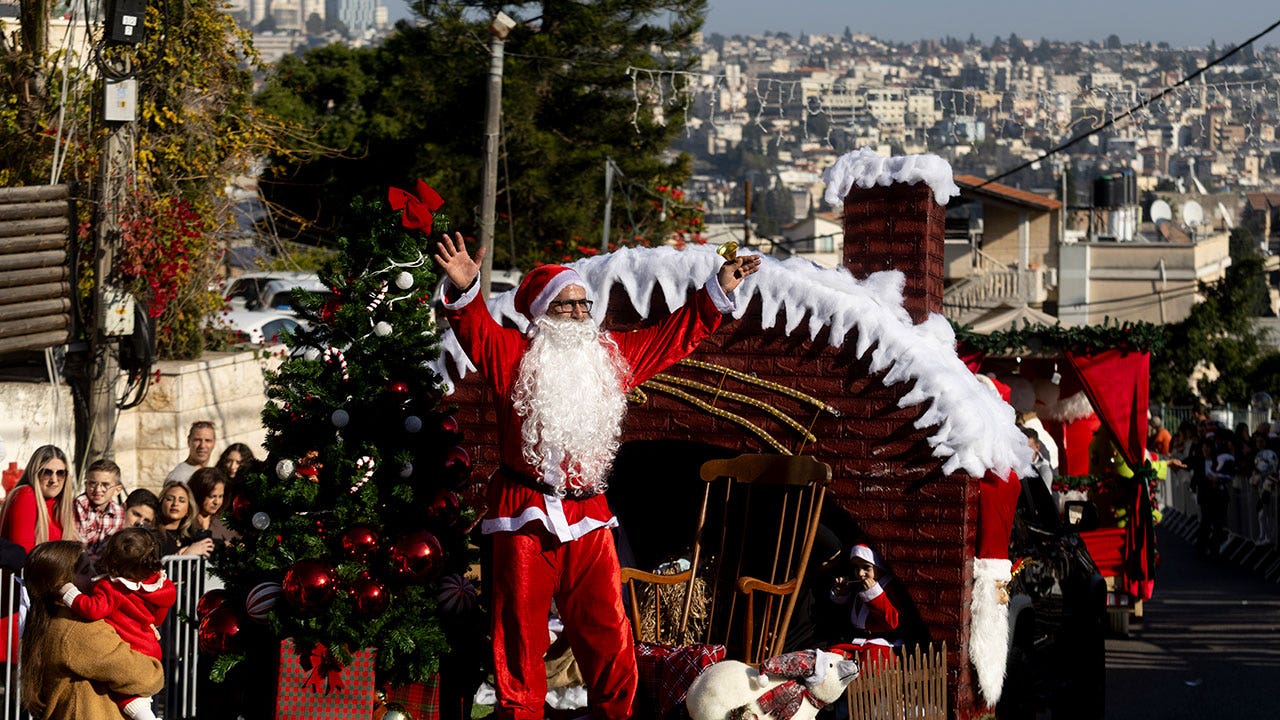
Bethlehem did mark Christmas this year, with crowds gathering in Manger Square, the Christmas tree lighting, and religious ceremonies at the Church of the Nativity. Local officials framed these celebrations as demonstrations of resilience amid years of conflict and economic hardship.
Zarina, however, views the Palestinian Authority’s decision to permit Christmas events this year through a more skeptical lens. “In recent months, the Palestinian Authority has sought to reintroduce itself to international public opinion, particularly to the Christian world, through symbolic festive displays,” he said. “These efforts are meant to market the Palestinian Authority as moderate, especially as discussions continue about Gaza’s future. But events on the ground over just a few days have sharply contradicted that image.”
Several incidents targeting Christians reportedly occurred within a single week ahead of Christmas, including threats against churches and violent disputes over land. “Christians in these areas are subjected to a systematic policy manifested through harassment, violence, psychological terror, forced displacement and the confiscation of property,” Zarina claimed, adding that “the Palestinian Authority appears either unable or unwilling to enforce the rule of law and protect the Christian minority.”
Recent incidents have reinforced these concerns. A church in Jenin was firebombed earlier this week, and a Christmas tree was set ablaze outside another church. Israel’s Foreign Ministry responded by warning of “growing hostility toward Christians” under Palestinian Authority governance.
Israel has occasionally seen attacks against its Christian community by extreme religious-nationalist elements who have vandalized religious sites and verbally assaulted clergy. Nevertheless, in his Christmas message, Israeli Prime Minister Benjamin Netanyahu emphasized Israel’s commitment to protecting its Christian population, stating, “Israel is the only country in the Middle East where Christians can practice their faith with full rights and in total freedom.”
According to Zarina, Christian residents in nearby Beit Jala and in Nablus avoided visible festivities out of fear of harassment. Not all Christian leaders share this assessment. Pastor Naim Khoury told Israeli news agency TPS-IL that conditions in Bethlehem have improved this year. Other activists, however, contend that many Christians cannot speak freely due to fear.
“The Christians are under enormous pressure and cannot speak freely,” said Shadi Khalloul, founder and CEO of the Israeli Christian Aramaic Association. “They are trying to survive quietly.”
This contrast appears in official demographic data as well. According to Israel’s Central Bureau of Statistics, approximately 184,200 Christians live in Israel as of Christmas Eve 2025, accounting for about 1.9% of the population. The Christian population grew by 0.7% in 2024, making Israel one of the few Middle Eastern countries where the Christian community continues to expand.
Nazareth anchors this growth, hosting the largest Arab Christian population in Israel with roughly 18,900 residents, followed by Haifa and Jerusalem. Most Arab Christians reside in Israel’s Northern and Haifa districts, where Christian communities have expanded alongside rising education and income levels.
Heather Johnston, founder and CEO of the U.S. Israel Education Association, summarizes the situation: “Christians are flourishing in Nazareth under Israeli rule, while in Bethlehem, under the Palestinian Authority, the Christian population has been shrinking for years. That difference speaks volumes about which systems actually protect religious freedom and allow ancient Christian communities to endure.”
While both cities celebrated Christmas with lights and hymns this year, the question remains whether international attention will persist beyond the holiday season to ensure lasting protection for one of Christianity’s oldest communities.
Fact Checker
Verify the accuracy of this article using The Disinformation Commission analysis and real-time sources.

23 Comments
The cost guidance is better than expected. If they deliver, the stock could rerate.
Good point. Watching costs and grades closely.
Good point. Watching costs and grades closely.
Interesting update on Christmas Returns to Holy Land Cities: Bethlehem’s Christian Population Dwindles as Nazareth Remains Strong. Curious how the grades will trend next quarter.
Interesting update on Christmas Returns to Holy Land Cities: Bethlehem’s Christian Population Dwindles as Nazareth Remains Strong. Curious how the grades will trend next quarter.
Good point. Watching costs and grades closely.
Interesting update on Christmas Returns to Holy Land Cities: Bethlehem’s Christian Population Dwindles as Nazareth Remains Strong. Curious how the grades will trend next quarter.
Good point. Watching costs and grades closely.
Good point. Watching costs and grades closely.
Production mix shifting toward World might help margins if metals stay firm.
Good point. Watching costs and grades closely.
Good point. Watching costs and grades closely.
Silver leverage is strong here; beta cuts both ways though.
Good point. Watching costs and grades closely.
Good point. Watching costs and grades closely.
I like the balance sheet here—less leverage than peers.
Good point. Watching costs and grades closely.
Silver leverage is strong here; beta cuts both ways though.
Good point. Watching costs and grades closely.
Exploration results look promising, but permitting will be the key risk.
Good point. Watching costs and grades closely.
The cost guidance is better than expected. If they deliver, the stock could rerate.
Good point. Watching costs and grades closely.