


Listen to the article
Chinese astronauts stranded at Tiangong space station after space debris hits return capsule
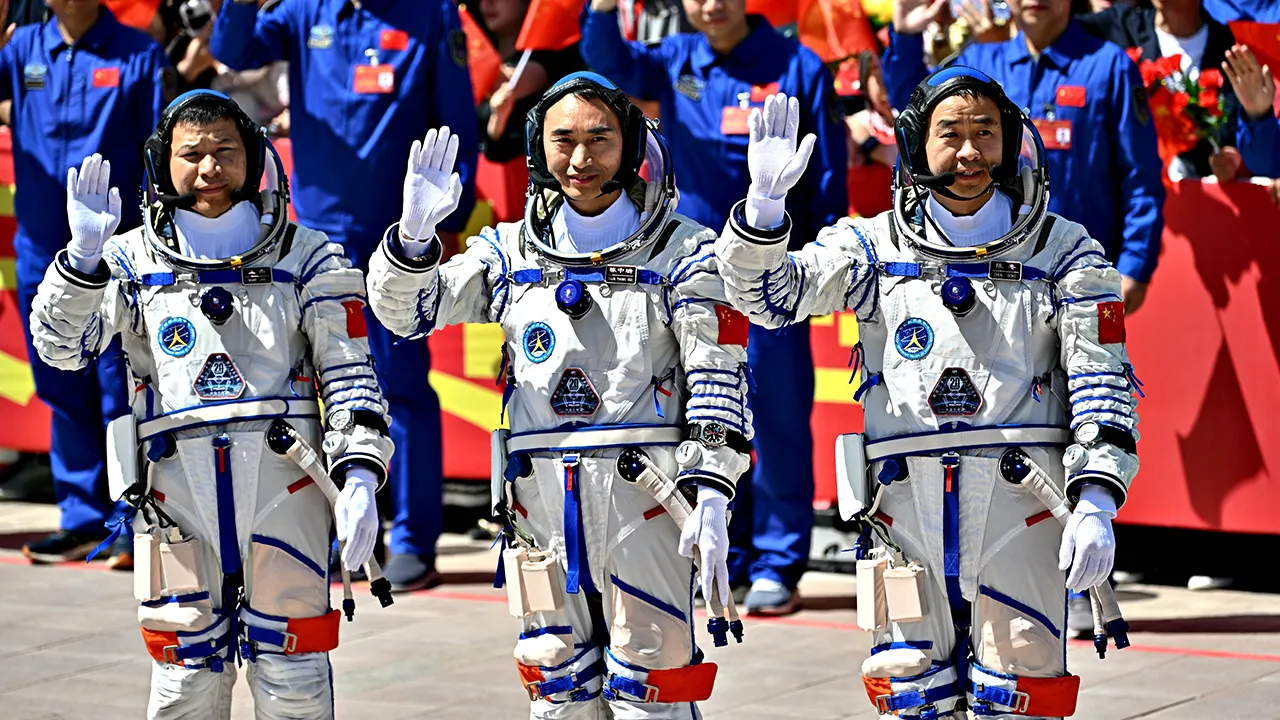
Three Chinese astronauts find themselves unexpectedly extended in orbit after their return capsule was struck by space debris, China’s space agency reported Wednesday. The Shenzhou-20 crew, who had completed their scheduled six-month mission aboard China’s Tiangong space station, now face an indefinite delay to their return.
The China Manned Space Agency (CMSA) announced that engineers are conducting thorough impact analysis and risk assessments on the damaged spacecraft. According to state broadcaster CCTV, no specific return date has been established as officials evaluate the situation.
“The collision with micrometeorites or orbital debris represents one of the most persistent threats to spacecraft in low Earth orbit,” said a CMSA statement. The agency has not disclosed the extent of damage to the return capsule or what repairs might be necessary.
The Shenzhou-20 crew consists of mission commander Chen Dong, fighter pilot Chen Zhongrui, and engineer Wang Jie, who arrived at Tiangong in April. They were scheduled to return to Earth this week following the successful arrival of their replacements.
The Shenzhou-21 mission successfully docked with the station on Saturday, bringing astronauts Zhang Hongzhang, Wu Fei, and Zhang Lu to the orbiting laboratory. This planned crew rotation has now become more complicated with both teams currently aboard the station.
If repairs to the damaged capsule prove impossible, established protocols would allow the Shenzhou-20 crew to return using the Shenzhou-21 team’s spacecraft. This contingency plan highlights the redundancy built into China’s space program but would create additional logistical challenges.
The growing threat of space debris has become an increasing concern for all spacefaring nations. With thousands of defunct satellites, spent rocket stages, and fragments from previous collisions orbiting Earth, even tiny pieces can cause significant damage due to their extreme velocities.
“Even a paint chip traveling at orbital speeds can penetrate spacesuits or damage critical systems,” explained an aerospace engineer familiar with orbital debris issues. “The international space community has been warning about the escalating debris problem for years.”
This incident underscores the hazards faced by China’s ambitious space program, which has advanced rapidly since launching its first taikonaut into orbit in 2003. China has systematically built up its space capabilities independent of international cooperation, constructing its own space station after being excluded from the International Space Station program.
The Tiangong space station, though smaller than the ISS, represents a significant achievement for China’s space program. Regular crew rotations have maintained a continuous Chinese presence in orbit since the station became operational. Astronauts conduct scientific experiments and perform maintenance tasks, including occasional repairs for debris damage.
China’s space ambitions extend beyond Earth orbit, with plans to land astronauts on the lunar surface by 2030. This goal places China in direct competition with NASA’s Artemis program and reflects the growing strategic importance of space exploration and utilization among major powers.
The CMSA has emphasized that the stranded crew remains in good health and has adequate supplies. The Tiangong station is designed to accommodate both crews temporarily, though such extended occupancy was not part of the original mission plan.
As engineers continue their assessment, this incident highlights both the technical challenges of operating in Earth orbit and China’s growing capabilities to handle space emergencies. The international space community will be watching closely to see how China resolves this unexpected mission extension.
Fact Checker
Verify the accuracy of this article using The Disinformation Commission analysis and real-time sources.

8 Comments
This is a stark reminder of the hazards of operating in the space environment. I’m curious to learn more details about the specific damage and what options the Chinese space agency is considering to resolve the situation.
Yes, transparency around the incident and repair plans would be helpful to understand the challenges they are facing. Hopefully they can get the astronauts home soon, safely.
This underscores the risks and challenges of long-duration spaceflight. Orbital debris is a growing concern, and incidents like this highlight the need for better tracking and mitigation efforts globally.
You’re right, space agencies worldwide will need to collaborate to address the space debris issue more effectively. The safety of astronauts has to come first.
Wow, this is quite an unexpected situation for the Chinese astronauts. Space debris is a real hazard they have to contend with. I hope the engineers can quickly assess the damage and get them safely back to Earth soon.
Agreed, it’s a challenging scenario. Spacecraft and astronaut safety have to be the top priority as they evaluate the options.
It’s unfortunate that the Chinese astronauts’ return has been delayed due to the damage to their spacecraft. I hope the engineers can quickly determine the extent of the repairs needed and get them home safely.
Space travel is inherently risky, and incidents like this underscore the importance of robust safety protocols and redundancies. I hope the Chinese engineers can find a solution to get the crew back to Earth in a timely manner.