


Listen to the article
Millions of Chinese Travelers Head Home for Lunar New Year Amid Economic Concerns
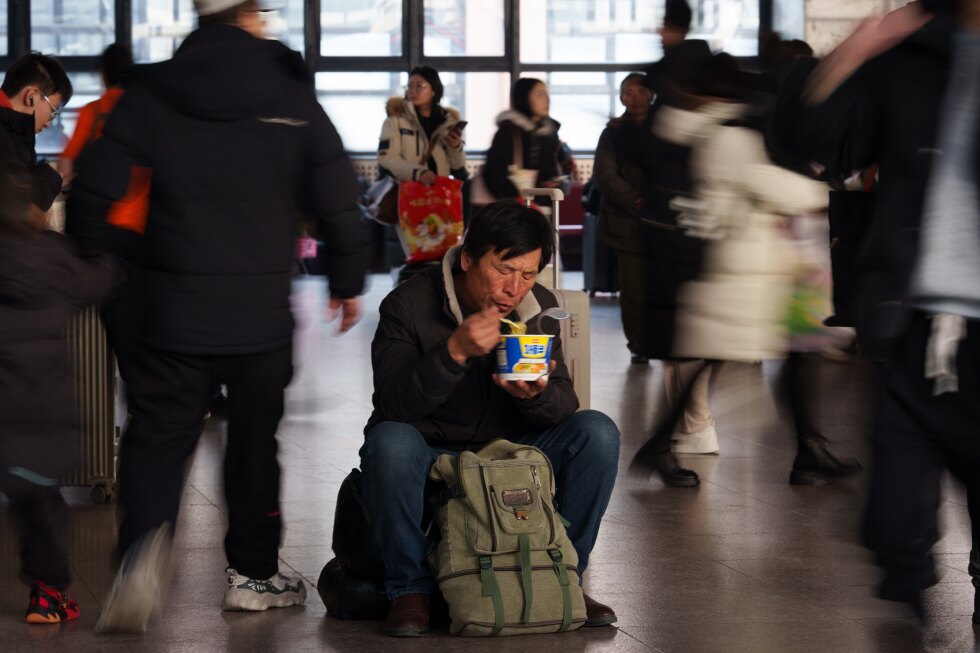
Liu Zhiquan sits patiently at Beijing’s bustling train station, bracing for a grueling 30-plus hour journey to Chengdu, the capital of Sichuan province, some 1,242 miles from the capital. A construction worker, Liu opted for the slower, cheaper train rather than a high-speed alternative that would cost twice as much despite cutting the journey to just nine hours.
“Things feel worse this year than last. The economy is bad and it’s getting harder to make money,” he says, echoing concerns shared by many travelers this season.
Liu is just one participant in “chunyun,” the world’s largest human migration that occurs annually around the Lunar New Year, which falls on February 17 this year. The Chinese government estimates a record 9.5 billion trips will be made during the 40-day period surrounding the festival, according to data from the National Development and Reform Commission. Of these, 540 million journeys will be by train and 95 million by air, with the remainder taking place on roads.
The scale of this migration reflects the cultural significance of the Lunar New Year in Chinese society. In a nation where work culture typically demands long hours with minimal vacation time, this holiday represents a rare opportunity for family reunions and relaxation.
Beijing’s train stations have transformed into hubs of anticipation, with waiting areas packed with passengers surrounded by large bags and suitcases. Some travelers prepare for long journeys by enjoying instant noodles, taking advantage of the free hot water provided at stations.
For many young professionals like Tian Duofu, who recently started working full-time in Beijing, the upcoming nine-day holiday beginning February 15 holds special meaning. “It has become more difficult for a big family to get together,” she explains. “After I started working, I realized such a long holiday is rare and we see each other less and less in person, which makes the Spring Festival significant.”
The holiday carries particular weight for China’s millions of migrant workers who leave their rural hometowns to find employment in booming urban centers. Tian Yunxia, who runs a breakfast stall in Beijing but hails from Henan province, emphasizes this point: “The new year is the festival of the year, and if we don’t go back home, we won’t be able to enjoy the festival atmosphere. I want to go home to see my children, my grandchildren and my husband.”
This year’s travel surge comes as China faces significant economic headwinds. The country’s post-pandemic recovery has faltered amid a property crisis, high youth unemployment, and weakening consumer confidence. These economic concerns have influenced travel decisions for many, with some opting for cheaper transportation options despite the added time and discomfort.
The transportation infrastructure is being put to the test as authorities work to accommodate the massive passenger volumes. China’s extensive high-speed rail network—the world’s largest at over 40,000 kilometers—provides efficient options for those who can afford it, while conventional trains continue to serve budget-conscious travelers like Liu.
Airlines have also increased capacity, adding extra flights to popular routes connecting major cities with regional centers. Despite these efforts, tickets for preferred travel dates around the holiday period typically sell out quickly, with many travelers booking their return journeys months in advance.
For China’s retail and service sectors, the Lunar New Year represents a critical business period. Traditionally, families purchase new clothes, gifts, and specialty food items for the celebrations, providing a boost to consumer spending. However, analysts are watching closely to see if economic concerns will dampen spending this year compared to previous festivals.
As millions like Liu endure long journeys home, their determination to reunite with family despite economic challenges and travel hardships underscores the enduring importance of this ancient tradition in modern Chinese society.
Fact Checker
Verify the accuracy of this article using The Disinformation Commission analysis and real-time sources.

24 Comments
Interesting update on China’s Lunar New Year travel rush begins with record 9.5 billion trips expected. Curious how the grades will trend next quarter.
Uranium names keep pushing higher—supply still tight into 2026.
Good point. Watching costs and grades closely.
Good point. Watching costs and grades closely.
Exploration results look promising, but permitting will be the key risk.
Good point. Watching costs and grades closely.
Good point. Watching costs and grades closely.
If AISC keeps dropping, this becomes investable for me.
Exploration results look promising, but permitting will be the key risk.
Good point. Watching costs and grades closely.
Exploration results look promising, but permitting will be the key risk.
Good point. Watching costs and grades closely.
Good point. Watching costs and grades closely.
Silver leverage is strong here; beta cuts both ways though.
Good point. Watching costs and grades closely.
Uranium names keep pushing higher—supply still tight into 2026.
Good point. Watching costs and grades closely.
I like the balance sheet here—less leverage than peers.
Good point. Watching costs and grades closely.
Good point. Watching costs and grades closely.
Production mix shifting toward World might help margins if metals stay firm.
Good point. Watching costs and grades closely.
The cost guidance is better than expected. If they deliver, the stock could rerate.
Good point. Watching costs and grades closely.