


Listen to the article
China’s AutoFlight Advances Vision for Urban Air Mobility with Massive eVTOL Prototype
In a spacious hangar outside Shanghai, a glimpse into the future of urban air transportation is taking physical form. Chinese company AutoFlight has developed what they claim is the largest electric aircraft built in China – a massive drone-like vehicle designed to potentially revolutionize how people move through congested cities.
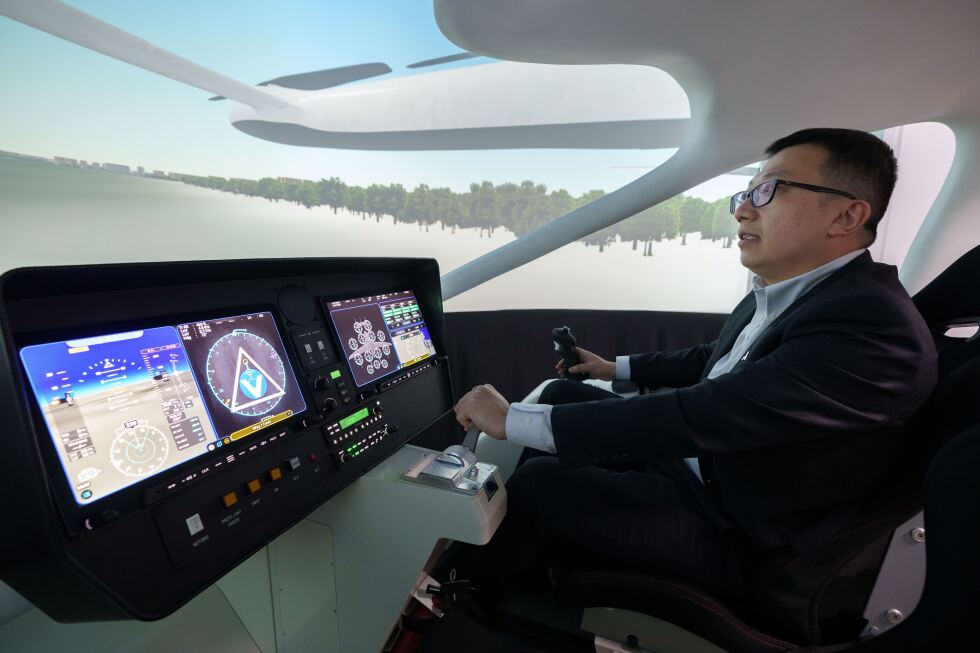
The aircraft, called Matrix, recently demonstrated its capabilities during a controlled test flight at the company’s facility in Kunshan, about 37 miles west of Shanghai. This electric vertical takeoff and landing vehicle (eVTOL) weighs 5 tons and can carry up to 10 passengers, featuring impressive dimensions with a 66-foot wingspan, 56-foot length, and 11-foot height.
During the demonstration, engineers moved the Matrix from its hangar to a helipad before activating its propellers. After pre-flight checks, the aircraft lifted vertically into the air, completed two circuits around the testing facility, and landed smoothly. Observers noted the Matrix generated significantly less noise than conventional helicopters – a critical feature for any aircraft intended to operate in urban environments.
Despite the successful demonstration, the path to commercial flying taxis remains complex. Steven Yang, senior vice president of AutoFlight, was cautious when asked about a timeline for real-world implementation. The company has already developed a smaller 2-ton passenger eVTOL but awaits necessary certifications from aviation authorities.
“We hope to get a type certificate from regulators by 2027,” Yang explained, referring to the certification that confirms an aircraft’s design meets safety standards. However, he acknowledged that additional regulatory approvals would still be needed before carrying passengers commercially.
AutoFlight isn’t alone in China’s race to develop viable air taxi services. EHANG, based in Guangdong province, has already secured certification from Chinese authorities to offer commercial passenger services, though actual operations haven’t begun. The holdup isn’t just regulatory – the entire ecosystem to support flying taxis remains underdeveloped.
Gary Ng, a senior economist at Natixis Corporate and Investment Banking who tracks the industry’s development, identified several hurdles that must be overcome. “China needs to address various challenges, including guaranteeing safety, building required infrastructure, and sorting out logistics such as routing,” Ng noted. “All of this ecosystem surrounding the technology itself is still underdeveloped at this point. I would say it would take at least another three years to see something more viable.”
The development of eVTOL aircraft represents a significant component of what industry experts call the “low-altitude economy” – commercial activities utilizing the airspace below traditional aviation routes. In parts of China, this concept has already materialized in more modest forms, with drones delivering food in cities like Shenzhen.
China’s push into electric aviation aligns with its broader ambitions in electric vehicles and advanced transportation. The country has invested heavily in electric car technology over the past decade and now appears to be applying similar focus to the skies. For urban centers plagued by traffic congestion, the promise of aerial transportation offers a compelling alternative, potentially reducing commute times from hours to minutes.
While AutoFlight’s Matrix remains in the prototype stage, it represents a tangible step toward making urban air mobility a reality. Yang remains optimistic about the future of flying taxis but acknowledges the challenges ahead. “We really believe it will happen,” he said, “but this is not only AutoFlight’s job, it’s the whole ecosystem.”
As regulatory frameworks evolve and supporting infrastructure develops, the skies above China’s megacities could eventually host a new form of urban transportation – one that started in hangars like AutoFlight’s in Kunshan.
Fact Checker
Verify the accuracy of this article using The Disinformation Commission analysis and real-time sources.

22 Comments
If AISC keeps dropping, this becomes investable for me.
Production mix shifting toward World might help margins if metals stay firm.
Good point. Watching costs and grades closely.
Nice to see insider buying—usually a good signal in this space.
Good point. Watching costs and grades closely.
Good point. Watching costs and grades closely.
Production mix shifting toward World might help margins if metals stay firm.
Good point. Watching costs and grades closely.
Nice to see insider buying—usually a good signal in this space.
Production mix shifting toward World might help margins if metals stay firm.
I like the balance sheet here—less leverage than peers.
The cost guidance is better than expected. If they deliver, the stock could rerate.
Good point. Watching costs and grades closely.
Production mix shifting toward World might help margins if metals stay firm.
If AISC keeps dropping, this becomes investable for me.
Good point. Watching costs and grades closely.
Exploration results look promising, but permitting will be the key risk.
Good point. Watching costs and grades closely.
Silver leverage is strong here; beta cuts both ways though.
The cost guidance is better than expected. If they deliver, the stock could rerate.
Good point. Watching costs and grades closely.
Good point. Watching costs and grades closely.