


Listen to the article
China Sets Lower Economic Growth Target Amid Domestic and Global Challenges
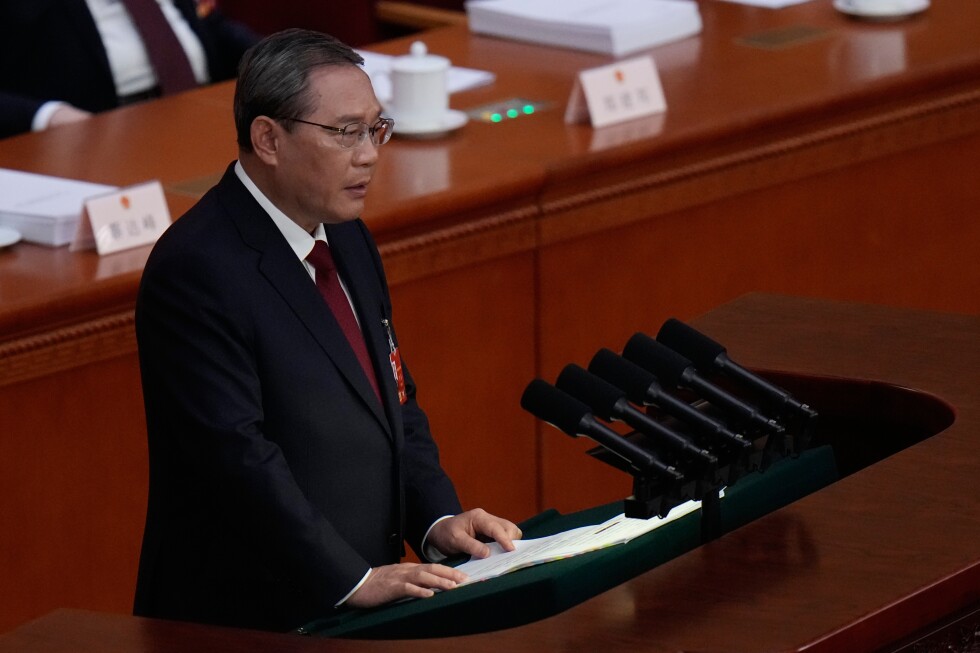
China has signaled a more conservative approach to economic planning, setting a growth target of 4.5% to 5% for 2024, slightly below last year’s actual growth of 5%. The announcement came during Premier Li Qiang’s address at the opening session of the National People’s Congress, where he delivered a sobering assessment of the challenges facing the world’s second-largest economy.
“While recognizing our achievements, we are also clear-eyed about the difficulties and challenges we face,” Li said during his more than hour-long speech to the nearly 3,000-member legislative body, which typically endorses policies already determined by Communist Party leadership.
The lowered growth expectations—the lowest since 1991—reflect China’s struggle with a persistent property market slump, weak consumer spending, and growing external pressures including trade tensions with Western nations. Experts suggest this conservative target aligns with the government’s evolving priorities.
“GDP targets in recent years have become less important than before because the overarching, and most important political priority has shifted from promoting economic development to so-called ‘high-quality development,'” explained Xin Sun, a senior lecturer in Chinese and East Asian business at King’s College London.
Chinese policymakers face the difficult task of reinvigorating domestic consumption while simultaneously advancing President Xi Jinping’s strategic goals of technological self-sufficiency in critical sectors like artificial intelligence, robotics, and semiconductor production. This balancing act takes place against what Li described as “a grave and complex landscape” of global uncertainty.
The property crisis continues to weigh heavily on economic prospects. Real estate, traditionally a driver of Chinese growth, has been mired in a prolonged downturn that has eroded household wealth and suppressed consumer spending. He Meiru, a real estate agent in southern China, describes firsthand the market’s struggles: “It’s been a tough period for many—jobs are hard to find, people don’t have money.” His monthly income has fallen to around 10,000 yuan ($1,400), less than a third of what he earned five years ago.
In response, the government plans to issue 250 billion yuan ($36 billion) in bonds to fund consumer rebates for trading in cars, appliances, and other products. Li also announced city-specific policies to manage housing supply and reduce property inventory.
However, experts caution that more substantial measures may be necessary to revitalize consumer spending. “Reviving domestic demand is key for sustained long-term growth,” said Ecaterina Bigos of AXA Investment Managers. “However, redirecting China toward higher levels of domestic consumption will take time.” She emphasized that meaningful recovery would require improved social welfare spending and job security to encourage families to spend rather than save.
China’s record $1.2 trillion trade surplus last year underscores its continued reliance on exports to maintain economic momentum. But this strategy faces growing headwinds as major trading partners, including the United States and European nations, raise concerns about market imbalances and implement protective measures.
The government also trimmed its annual increase in defense spending to 7%, down from 7.2% in recent years, bringing the total military budget to 1.9 trillion yuan ($270 billion). This adjustment comes amid a significant purge of military officials on corruption charges, widely seen as an effort to modernize the armed forces while reinforcing Communist Party control.
Li’s report notably emphasized “the Party’s absolute leadership over the people’s armed forces” and introduced new language about “ensuring political loyalty in the military” and improving “military political conduct,” reflecting the ongoing campaign to tighten oversight of the People’s Liberation Army.
As the National People’s Congress continues its deliberations before concluding next week, international observers will be watching closely for additional policy signals that might indicate how China plans to navigate its complex economic challenges while pursuing its long-term strategic objectives.
Fact Checker
Verify the accuracy of this article using The Disinformation Commission analysis and real-time sources.

9 Comments
Shifting priorities from pure GDP growth to more sustainable development is a commendable move, but the execution will be critical. Curious to see China’s policy responses in the coming years.
Absolutely. Striking the right balance between economic growth and environmental/social considerations will be a key challenge for China’s leadership.
This lower growth target could signal China’s increased focus on quality over quantity when it comes to economic development. It’ll be interesting to see how this plays out in the resource and energy sectors.
A 4.5-5% growth target is still respectable, especially given the global uncertainties. China seems to be taking a more measured, long-term approach to economic planning.
This lower growth target reflects the challenging economic realities China faces, both domestically and globally. It’s a pragmatic move that aligns with their evolving priorities beyond just GDP numbers.
The property market slump and weak consumer spending are significant headwinds. Lowering the growth expectations could allow China to focus on more sustainable, quality-driven development.
This moderation in growth targets could have ripple effects across industries and markets. It’ll be important to monitor how it influences China’s trade and investment decisions going forward.
Agreed. The global impact of China’s economic policy shifts shouldn’t be underestimated, especially in sectors like mining and energy.
Curious to see how this shift in priorities plays out in the commodities and energy sectors. Will it impact China’s demand for resources like minerals, metals, and fossil fuels?