


Listen to the article
China Passes Ethnic Unity Law Amid Concerns Over Minority Rights
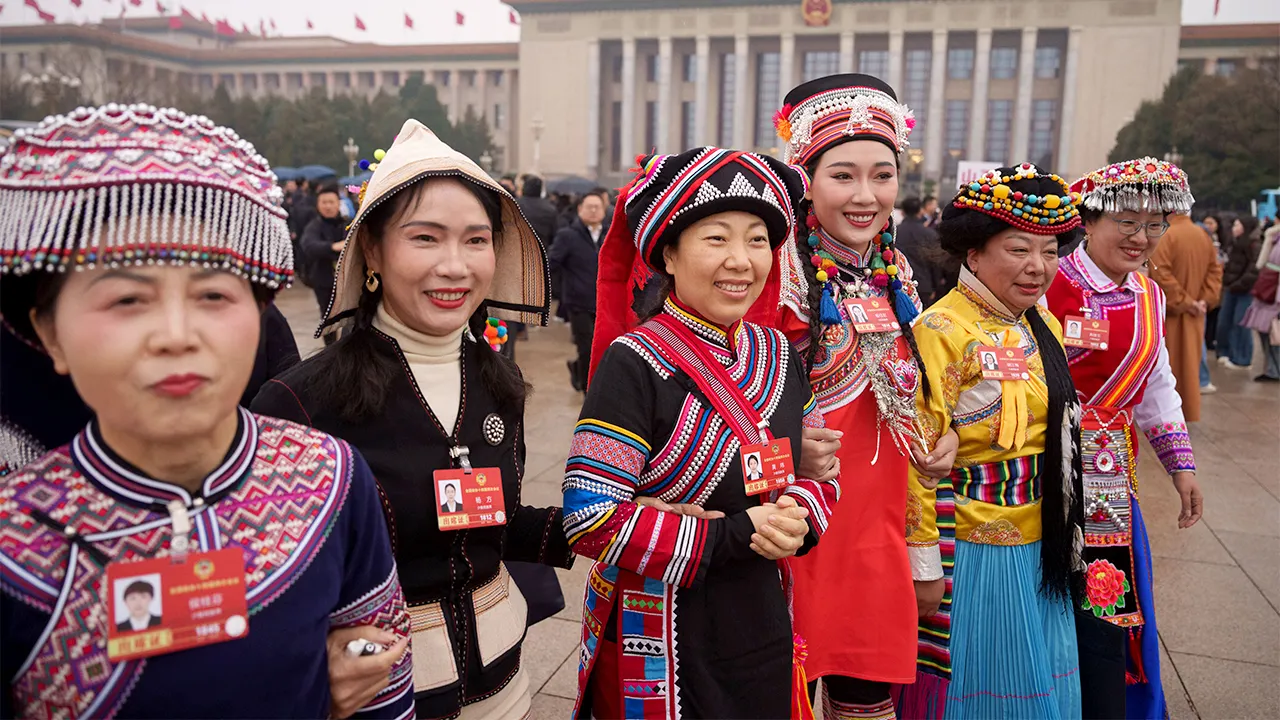
China’s top legislature has formalized Beijing’s long-standing push to strengthen national identity and ethnic integration with the passage of a new “Ethnic Unity and Progress Promotion Law” on Thursday. The legislation was approved during the closing meeting of the fourth session of the 14th National People’s Congress in Beijing.
According to state-affiliated media Xinhua, the law aims to codify “fostering a strong sense of community for the Chinese nation” into state policy. The legislation also seeks to promote economic development in regions with significant ethnic minority populations while advancing what Chinese officials describe as “common prosperity” among China’s 56 recognized ethnic groups.
Li Hongzhong, vice chairman of the National People’s Congress Standing Committee, stated that the measure was designed to advance the governance of ethnic affairs under a legal framework.
The new law mandates that “the people of each ethnic group, all organizations and groups of the country, armed forces, every Party and social organization, every company, must forge a common consciousness of the Chinese nation according to law and the constitution, and take the responsibility of building this consciousness,” according to a translation provided by The Associated Press.
While Beijing frames the legislation as promoting unity and development, academics and international observers have raised serious concerns. Critics argue the law could undermine cultural identities of ethnic minorities by requiring the use of Mandarin in compulsory education and establishing legal grounds to pursue individuals or organizations—even those outside China—whose actions are deemed to undermine “ethnic unity.”
China’s population stands at 1.44 billion according to the most recent national census released in 2021. Of this total, 91.11% are Han Chinese, with the remaining 8.89% belonging to various ethnic minority groups, including Uyghurs, Tibetans, Hui, Zhuang, Mongols, and others.
The legislation comes amid growing international scrutiny of China’s policies toward ethnic minorities, particularly in regions like Xinjiang, Tibet, and Inner Mongolia. Human rights organizations have documented systematic efforts to assimilate these populations through various means, including language policies, religious restrictions, and cultural regulations.
James Leibold, a professor at Australia’s La Trobe University who specializes in Chinese ethnic politics, offered a stark assessment of the new law, telling the Associated Press it “puts a death nail in the party’s original promise of meaningful autonomy.” This refers to China’s system of nominally autonomous regions for ethnic minorities, which critics say has been steadily eroded in favor of centralized control.
Rayhan Asat, a legal scholar at Harvard University, similarly criticized the legislation, arguing it “serves as a strategic tool and gives the pretext to government to commit all sorts of human rights violations.”
The passage of this law represents a significant milestone in President Xi Jinping’s approach to ethnic affairs, which has emphasized integration and the primacy of a unified Chinese national identity over the protection of distinct cultural identities. Under Xi’s leadership, China has moved away from earlier policies that provided greater space for cultural expression among minority groups.
The legislation will have far-reaching implications for China’s ethnic minorities, potentially accelerating cultural assimilation policies and further restricting expressions of distinct ethnic identities. It also signals Beijing’s determination to counter what it views as separatist tendencies and foreign interference in its ethnic affairs.
As China implements this new law, international human rights advocates will likely continue to monitor its effects on minority communities and press for adherence to international standards protecting cultural and religious freedoms.
Fact Checker
Verify the accuracy of this article using The Disinformation Commission analysis and real-time sources.

6 Comments
Strengthening national identity is a delicate balance when dealing with diverse ethnic groups. I hope this law can achieve economic progress while respecting the unique heritage and autonomy of China’s minority populations.
Good point. Preserving cultural diversity alongside economic development will be crucial for long-term stability and social cohesion.
Codifying ethnic unity into law is a bold move by the Chinese government. While the intentions may be to strengthen national identity, there are valid concerns about potential assimilation policies and the erosion of minority autonomy.
This is a complex issue surrounding ethnic identity and integration in China. While the government aims to promote national unity, there are concerns about protecting minority rights and cultures. I’m curious to see how this new law is implemented in practice.
The concept of “common prosperity” is intriguing, but the details will be crucial. I wonder how this law will impact the Uyghurs, Tibetans, and other ethnic minorities who have faced human rights concerns in recent years.
This legislation reflects the Chinese government’s push to exert greater control over ethnic affairs. It will be important to monitor how it is implemented and whether it aligns with international standards for minority rights.