


Listen to the article
China’s Pacific Island Strategy Raises Security Concerns for US Defense Experts
China’s expanding influence in the Pacific Islands is triggering alarm among defense experts who warn that Beijing is methodically establishing a strategic foothold in territory historically vital to American security interests.
Rather than deploying military forces or constructing obvious military installations, China has adopted a more subtle approach, leveraging infrastructure development, political relationships and economic incentives to gain access to strategically sensitive areas across Micronesia—a region bound to the United States through long-standing security agreements.
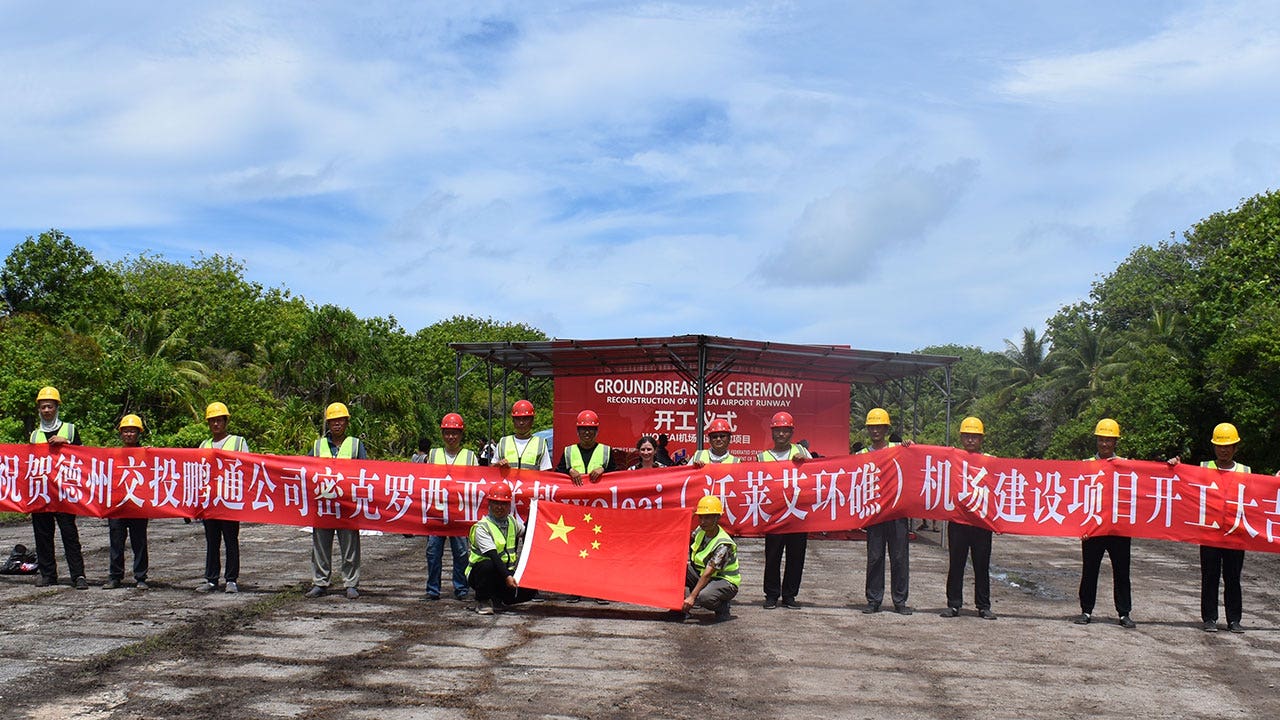
A Chinese-backed runway project on the island of Yap is scheduled for an official handover ceremony on February 9, with the president of the Federated States of Micronesia expected to attend alongside representatives from the Chinese company involved in the construction.
Cleo Paskal, senior fellow at the Foundation for Defense of Democracies (FDD), traveled to the region to witness these developments firsthand. She spent four days sleeping on the deck of a Chinese-donated cargo ship to observe a Chinese company breaking ground on a project rehabilitating a World War II-era Japanese runway.
“It’s not a huge runway, but what it does is it gets China in the door and on the ground in a very strategic location,” Paskal explained.
The project is situated in Yap, a remote east-west island chain that occupies crucial maritime and air corridors connecting Hawaii, Guam, and East Asia. U.S. military strategists have historically considered Yap among the Pacific’s most strategically significant locations.
According to Paskal, the same Chinese company involved with the runway is simultaneously working on another major infrastructure initiative on Yap’s main island: the reconstruction of a critical bridge.
This activity comes as the United States has announced approximately $2 billion in defense infrastructure investments specifically for Yap’s main island. However, Paskal highlights a crucial distinction in approach: “The Department of War is focused on the main island, but, from what I’ve seen, there are no plans for the rest of the island chain. Meanwhile, the Chinese are using other entry points into the political and economic system in order to start to break open access to Yap.”
The contrasting strategies reflect fundamentally different approaches to regional influence. “It’s not just a physical kinetic infrastructure operation,” Paskal noted. “It’s also a political warfare operation, whereas the U.S. is focusing more just on a very narrow band of the kinetic map.”
The geographic area in question has shaped American security planning for generations. During World War II, the lagoon at Ulithi, part of the Yap island chain, served as the world’s largest U.S. naval base, hosting hundreds of American warships during operations against Imperial Japan.
Under the Compact of Free Association, the United States maintains exclusive defense rights in Micronesia. These agreements permit Washington to deny military access to other nations, establish defense facilities, and maintain strategic control, while granting Micronesians the right to live and work in the United States and serve in the U.S. military. The Compact establishes such close ties that Micronesia is included in the U.S. domestic mail system.
These compacts were established after World War II specifically to ensure Pacific islands formerly under Japanese control could never again be used as staging grounds for attacks against the United States.
Paskal warns that China is finding ways to circumvent, and potentially undermine, these arrangements. She notes that U.S. officials often focus on visible construction activities while underestimating the broader political campaign that enables Chinese access. This includes building relationships with national leaders, engaging local officials such as customs and immigration officers, and securing contracts through regional development banks to position Chinese companies and personnel on the ground.
According to Paskal, Chinese firms are frequently willing to accept financial losses to achieve long-term strategic positioning.
These concerns are intensified by political shifts within Micronesia itself. While states like Yap have historically resisted Chinese engagement, the national government has grown increasingly receptive to Beijing in recent years.
Former Micronesian President David Panuelo warned in a March 2023 letter that China was engaging in political warfare, including alleged bribery and pressure campaigns. He subsequently lost his re-election bid, with the current administration viewed as more open to Chinese involvement.
When questioned about China’s activities in Micronesia, a spokesperson for the Chinese Embassy in Washington stated they were “not aware of the specifics” and emphasized that China views Pacific Island Countries as development partners without geopolitical motives.
China expert Gordon Chang expressed frustration about the situation: “We lost so many American lives in World War Two, taking these islands from the Japanese. And now we are letting China dominate them. This is just wrong.” He emphasized that the U.S. has the capability to prevent Chinese influence in the region but is failing to exercise it.
For U.S. security experts, the concern extends beyond individual projects to the gradual erosion of strategic access in a region that has underpinned American defense for more than 80 years.
Fact Checker
Verify the accuracy of this article using The Disinformation Commission analysis and real-time sources.

9 Comments
This situation highlights the complex geopolitical dynamics at play in the Pacific. The US will need to carefully weigh its options to maintain its influence without triggering an escalation with China.
The strategic implications of China’s infrastructure projects in Micronesia are certainly concerning. It will be interesting to see how the US responds to maintain its influence in the region.
Agreed, this is a concerning development. The US will need to carefully balance its response to avoid further escalation with China.
Cleo Paskal’s firsthand observations of a Chinese company breaking ground in Micronesia provide valuable on-the-ground insight. Her perspectives will be important to consider as the US formulates its response.
It’s understandable that the US would feel pressured to respond to China’s growing influence in Micronesia given the region’s strategic importance. However, any response will need to be carefully calibrated to avoid further escalating tensions.
A Chinese-backed runway project on Yap Island is an interesting development. I wonder what the specific concerns are around this particular project and how it fits into China’s broader strategy in the region.
I’m curious to learn more about the specific security and geopolitical concerns that these Chinese-backed infrastructure projects raise for US defense experts. The article provides some good context but more details would be helpful.
Yes, the article touches on the security concerns but more analysis would be useful to fully understand the implications. Monitoring this situation closely will be important.
The Chinese approach of leveraging infrastructure, political relationships and economic incentives to gain influence is quite savvy. It will be a challenge for the US to counter these tactics in the Pacific Islands.