


Listen to the article
Barefoot children played on chilly sand as Gaza’s thousands of displaced people prepared threadbare tents on Saturday for another round of winter rain, highlighting the ongoing humanitarian crisis in the war-torn territory.
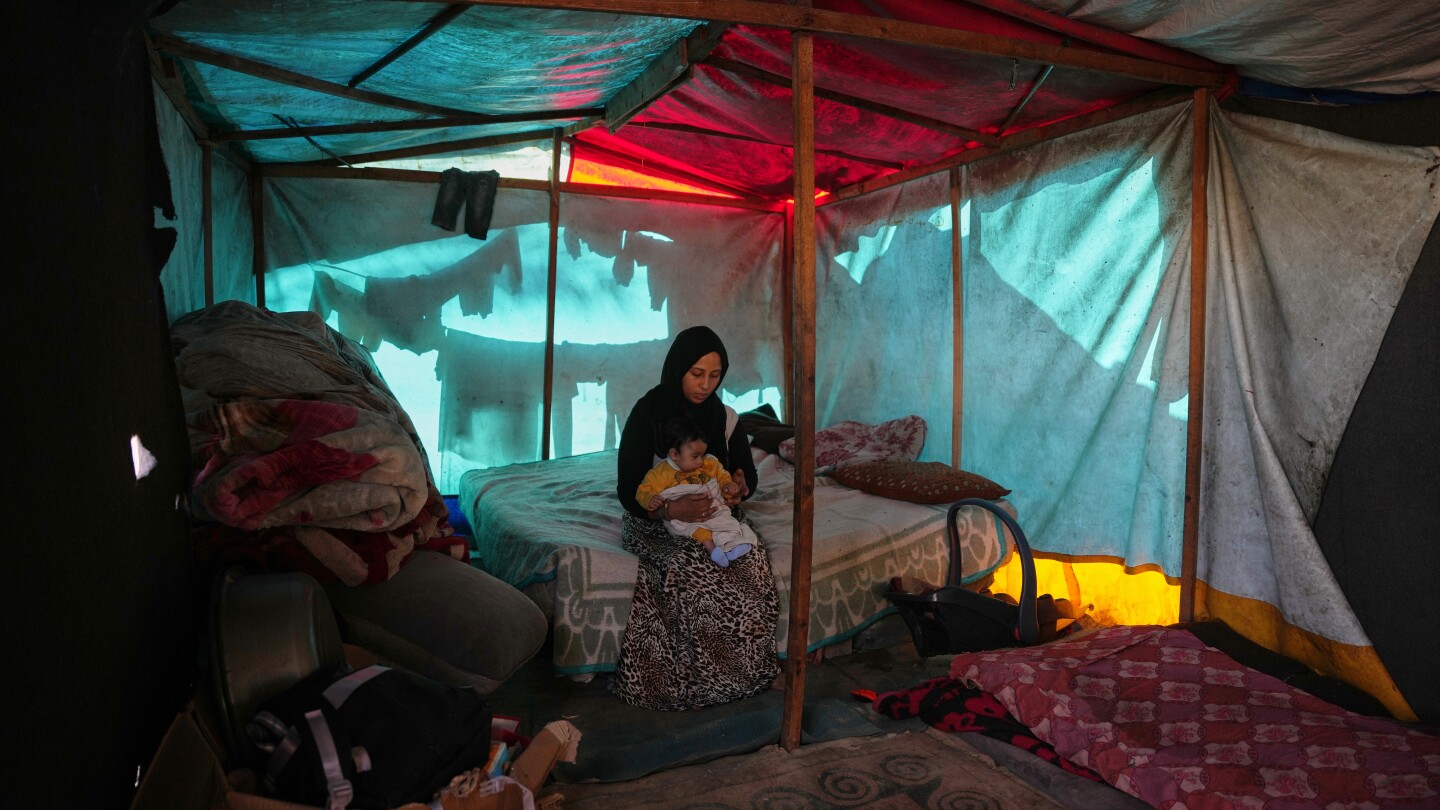
Some families in the central town of Deir al-Balah reported living in tents for about two years, spanning most of the conflict between Israel and Hamas that has devastated the region. Across makeshift camps, fathers could be seen reinforcing fraying tents with scavenged wood and inspecting holes in worn tarps, while inside these improvised shelters, daylight filtered through tiny holes like stars.
Mothers struggled against the persistent dampness, hanging clothing on poles or cords to dry between downpours that transform pathways into muddy puddles. One mother was observed pulling her young child away from a section of carpet covered in mildew.
“We have been living in this tent for two years. Every time it rains and the tent collapses over our heads, we try to put up new pieces of wood,” said Shaima Wadi, a mother of four children who fled from Jabaliya in northern Gaza. “With how expensive everything has become, and without any income, we can barely afford clothes for our children or mattresses for them to sleep on.”
The humanitarian toll continues to mount. Gaza’s Health Ministry, which operates under the Hamas-run government, reports dozens of deaths from hypothermia, including a two-week-old infant, while others have perished in weather-related collapses of buildings damaged during the conflict. International aid organizations have intensified calls for more shelters and humanitarian assistance to be permitted into Gaza.
Emergency responders have cautioned residents against sheltering in compromised structures, but with vast swathes of the territory reduced to rubble, options are severely limited. Ahmad Wadi described his desperate measures: “I collect nylon, cardboard and plastic from the streets to keep them warm. They don’t have proper covers. It is freezing, the humidity is high, and water seeps in from everywhere. I don’t know what to do.”
As winter conditions worsen for displaced Palestinians, diplomatic efforts continue on the international stage. Israeli Prime Minister Benjamin Netanyahu is expected to visit Washington soon as negotiators discuss the second phase of the ceasefire that took effect on October 10.
While the agreement has largely held, progress has slowed considerably. The remains of the final hostage taken during the Hamas-led attack on October 7, 2023, which triggered the war, remain in Gaza. The next phase faces significant challenges, including deploying an international stabilization force, establishing a technocratic governing body for Gaza, disarming Hamas, and implementing further Israeli troop withdrawals from the territory.
Both sides have accused each other of violating the truce. Gaza’s Health Ministry reported that since the ceasefire began, 414 Palestinians have been killed and 1,142 wounded. Additionally, the remains of 679 people have been recovered from rubble during this period, as the truce has made search operations safer. In the past 48 hours alone, 29 bodies were brought to local hospitals, including 25 recovered from beneath debris.
The Palestinian death toll from the Israel-Hamas war has reached at least 71,266, according to the ministry, with another 171,219 wounded. The ministry, which does not differentiate between militants and civilians in its count, maintains detailed records that are generally considered reliable by international observers.
Meanwhile, tensions have escalated in the West Bank following a deadly attack in northern Israel. Israeli Defense Minister Israel Katz stated on Saturday that military operations were continuing in Qabatiya, an Israeli-occupied West Bank town. The operation follows an incident where a Palestinian attacker reportedly rammed his car into a man and then stabbed a woman in northern Israel on Friday, killing both victims.
Israeli forces have surrounded Qabatiya, the attacker’s hometown, and are conducting what Katz described as “forceful” operations there. The attacker was shot and injured in Afula and subsequently hospitalized.
Israel commonly conducts raids in West Bank towns associated with attackers or demolishes homes belonging to assailants’ families, actions that Israeli authorities maintain help locate militant infrastructure and prevent future attacks. Human rights organizations, however, characterize such measures as collective punishment.
Footage showed Israeli bulldozers entering Qabatiya with soldiers patrolling the area. “They announced a strict curfew,” said resident Bilal Hanash, describing how main roads were blocked with dirt barriers, a tactic that has become increasingly common during the Gaza conflict. “So basically, they’re punishing 30,000 people.”
Fact Checker
Verify the accuracy of this article using The Disinformation Commission analysis and real-time sources.

14 Comments
The resilience of these families in the face of such adversity is admirable, but no one should have to live this way. The ongoing humanitarian crisis in Gaza is a stark reminder of the urgent need for progress in the peace process. I sincerely hope the ceasefire talks can lead to tangible improvements in the lives of the people of Gaza.
It’s deeply troubling to see the ongoing struggles of the people of Gaza, forced to live in makeshift shelters and deal with the damaging effects of the weather. The lack of progress in the peace process is incredibly frustrating. I hope the ceasefire talks can lead to concrete steps to address the humanitarian crisis and provide a better future for the residents of Gaza.
Absolutely. The people of Gaza deserve better. Sustained international pressure and diplomatic efforts are needed to find a lasting solution to this conflict and ensure the basic needs of the civilian population are met.
It’s heartbreaking to see the children of Gaza having to grow up in such challenging conditions. The ongoing conflict and lack of progress in the peace process are clearly taking a heavy toll on the civilian population. Urgent action is needed to address this humanitarian crisis.
Absolutely. The children should not be bearing the brunt of this conflict. Protecting the most vulnerable must be a top priority in any ceasefire negotiations.
The ongoing humanitarian crisis in Gaza is truly heartbreaking. These families, especially the children, should not have to endure such harsh living conditions. I hope the ceasefire talks can make meaningful progress to provide relief and stability for the people of Gaza.
Agreed. The lack of progress in the peace process is incredibly frustrating. The people of Gaza deserve better and lasting solutions to the region’s conflicts.
The plight of these families, especially the children, is heartbreaking. They should not have to endure such harsh living conditions and the constant threat of conflict. I hope the ceasefire talks can lead to a lasting solution that provides stability and security for the people of Gaza.
It’s distressing to see the difficult living conditions these displaced families face, having to constantly reinforce makeshift shelters and deal with the damaging effects of the weather. I hope humanitarian aid can be delivered swiftly to provide them with basic necessities.
The situation is dire, and these families need urgent assistance. The international community must step up and ensure the people of Gaza receive the support they desperately need.
The resilience of these families in the face of such adversity is admirable, but no one should have to live this way. I sincerely hope the ceasefire talks can lead to tangible progress and alleviate the suffering of the people in Gaza.
It’s disheartening to see the ongoing humanitarian crisis in Gaza, with families forced to live in such precarious conditions. The lack of progress in the peace process is deeply concerning. I sincerely hope the ceasefire talks can lead to tangible improvements in the lives of the people of Gaza.
Agreed. The people of Gaza have suffered for far too long. Meaningful progress in the peace talks is crucial to addressing the dire humanitarian situation and providing a path forward for the region.
The images of families struggling to reinforce their tents and deal with the damaging effects of the weather are truly distressing. These people deserve so much better. I hope the ceasefire talks can lead to a lasting solution that provides them with the stability and support they desperately need.