


Listen to the article
Chile’s President-Elect Visits El Salvador’s Controversial Mega-Prison
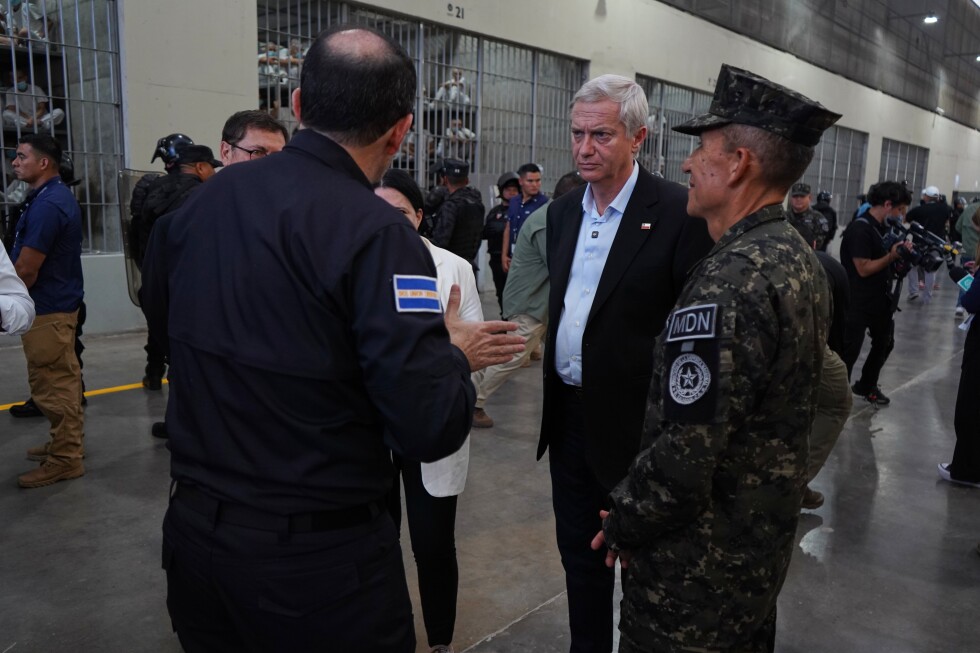
Chile’s far-right President-elect José Antonio Kast toured El Salvador’s massive gang detention facility on Friday, seeking insights into President Nayib Bukele’s controversial security approach before their scheduled meeting to discuss strategies against organized crime.
The visit to the Terrorism Confinement Center (CECOT) comes as Kast prepares to implement his campaign promise of cracking down on crime when he assumes office. He shared a photo on X (formerly Twitter) showing him en route to the prison via helicopter, accompanied by his security minister.
“We need to import good ideas and proposals to combat organized crime, drug trafficking and terrorism,” Kast wrote on the social media platform.
El Salvador’s presidential office stated that Chile’s incoming administration wants firsthand knowledge of the country’s security model to evaluate its potential adaptation to Chile’s context. “We are ready to work hand-in-hand with our Chilean brothers,” the statement added.
The CECOT facility has become something of a model for right-wing politicians across Latin America despite widespread human rights concerns. Costa Rican President Rodrigo Chaves recently broke ground on a similar maximum-security prison in his country to address rising crime rates. Honduras has proposed constructing a gang prison on a remote island, while Ecuador and Guatemala have implemented their own anti-gang measures modeled after El Salvador’s approach.
During brief comments to reporters at the prison entrance, Kast emphasized the importance of understanding El Salvador’s comprehensive prison system, which he described as part of a broader judicial and security framework. He noted that the system allows for complete isolation of individuals involved in serious crimes, including gang members responsible for murder and terrorism.
However, Kast acknowledged differences between El Salvador’s prison system and Chile’s, clarifying that his visit was intended “to study and understand it, not necessarily to replicate it in the same way.”
The CECOT facility, which can house up to 40,000 inmates, has faced intense international scrutiny for its harsh conditions and alleged human rights violations. Each cell holds between 65-70 prisoners who receive no visitors and are never allowed outdoors. The prison lacks workshops, educational programs, or rehabilitation initiatives to prepare inmates for eventual reintegration into society.
Human rights organization Socorro Juridico reported this week that at least 480 people have died in detention since Bukele declared a state of emergency in early 2022. Human rights groups have documented cases of torture and extremely harsh conditions within CECOT. The facility gained additional international attention earlier this year when the Trump administration deported over 200 Venezuelans to El Salvador to be held there.
Bukele’s crackdown has been controversial precisely because his government has suspended constitutional rights for years while detaining thousands of people with limited evidence or due process, often based merely on accusations of gang affiliation.
During his visit, Kast and his delegation met with El Salvador’s security cabinet before touring one of the prison’s cell blocks to observe the conditions under which the most dangerous alleged gang members are held. He was scheduled to hold a private meeting with Bukele at the presidential palace later in the day.
The visit highlights a growing trend among Latin American leaders seeking solutions to combat rising crime rates and gang violence. While Bukele’s approach has resulted in dramatically lower homicide rates in El Salvador, critics argue the human rights cost and the suspension of civil liberties have been too steep a price to pay.
As Kast prepares to take office in Chile, his interest in El Salvador’s security model signals potential policy directions for his administration, though he appears to recognize the need to adapt rather than directly copy Bukele’s controversial methods.
Fact Checker
Verify the accuracy of this article using The Disinformation Commission analysis and real-time sources.

14 Comments
Chile’s President-elect seems eager to learn from El Salvador’s security strategies, despite the concerns over human rights abuses. I hope they thoroughly evaluate the potential consequences before implementing similar policies.
Addressing shared challenges through international cooperation can be valuable, but it’s crucial that fundamental rights and democratic principles are upheld in the process.
Chile’s incoming administration is taking a proactive approach by seeking insights from El Salvador’s controversial security model. It will be interesting to see how they adapt it to their own context.
While addressing organized crime is important, human rights must be a top priority. I hope the discussion between the leaders focuses on finding a balanced and ethical approach.
Interesting to see the far-right President-elect of Chile visiting El Salvador’s controversial mega-prison. I’m curious to learn more about how he plans to adapt their security model to Chile’s context.
Implementing tough-on-crime policies often raises human rights concerns. I hope they carefully consider the implications before adopting such an approach.
The visit to El Salvador’s mega-prison by Chile’s far-right President-elect raises some red flags. I hope they thoroughly evaluate the potential consequences before implementing similar policies.
Security and crime prevention are complex issues. I’m curious to see what specific ideas and proposals the two leaders discuss to address these challenges.
Cooperation between nations can be valuable, but I’m skeptical of Chile’s far-right President-elect adopting El Salvador’s controversial security model. Upholding human rights should be the top priority.
It’s important to find a balanced approach that effectively addresses organized crime and drug trafficking while also protecting civil liberties and due process. I hope the leaders consider this carefully.
Cracking down on organized crime and drug trafficking is a priority for many Latin American leaders. Chile’s incoming administration seems eager to learn from El Salvador’s security model, despite the controversies.
Cooperation between nations to address shared challenges can be valuable, but it’s crucial that human rights and rule of law are upheld in the process.
The visit to El Salvador’s mega-prison by Chile’s far-right President-elect is concerning. I hope they carefully consider the potential human rights implications before implementing similar policies in Chile.
Security and crime prevention are complex issues that require nuanced solutions. I’m curious to see what specific ideas the two leaders exchange to address these challenges.