


Listen to the article
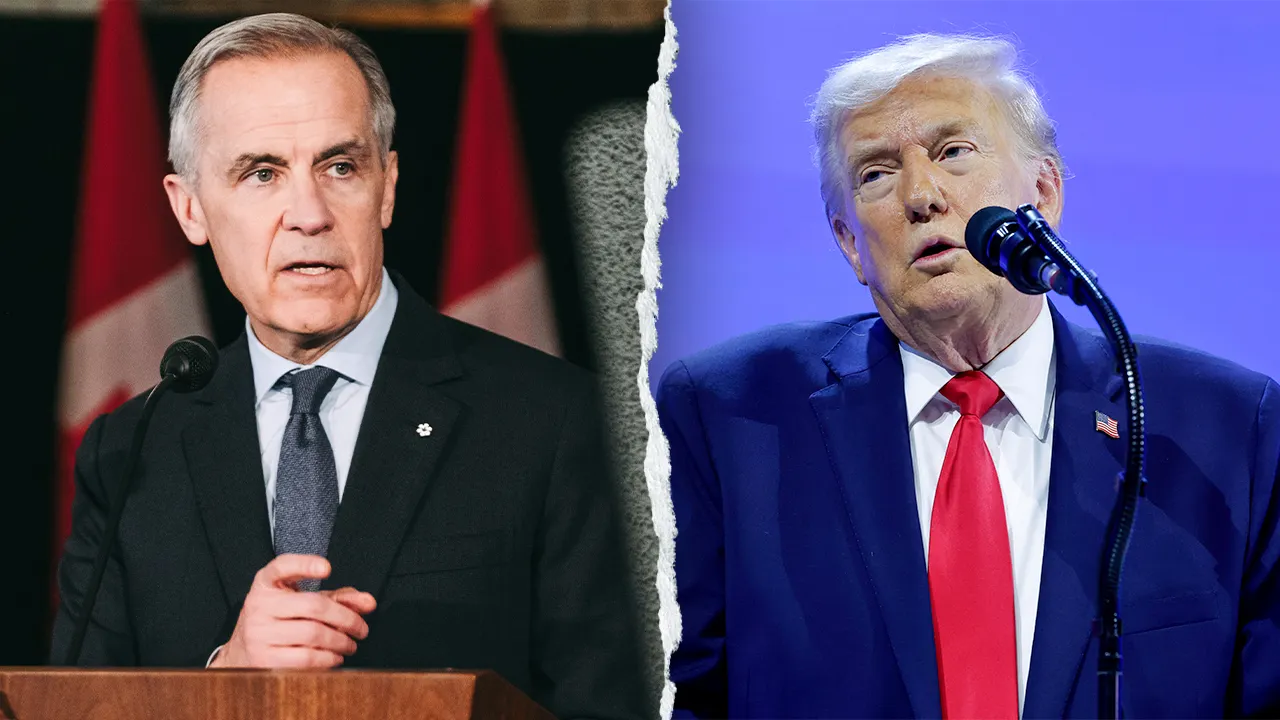
Canadian Prime Minister Mark Carney firmly rejected President Donald Trump’s claim that “Canada lives because of the United States” during a speech at a cabinet retreat in Quebec, escalating tensions between the two North American leaders.
“Canada and the United States have built a remarkable partnership in the economy, in security, and in a rich cultural exchange,” Carney stated on Thursday at the Plains of Abraham. “But Canada doesn’t ‘live because of the United States.’ Canada thrives because we are Canadian. We are masters in our own house. This is our country. This is our future. The choice is ours.”
The diplomatic rift between the neighboring countries deepened after Trump publicly rescinded Canada’s invitation to join the Board of Peace, a U.S.-led council focused on managing Gaza’s post-war reconstruction. In an open letter published on Truth Social, Trump wrote: “Please let this Letter serve to represent that the Board of Peace is withdrawing its invitation to you regarding Canada’s joining, what will be, the most prestigious Board of Leaders ever assembled, at any time.”
The confrontation between the two leaders originated at the World Economic Forum in Davos, Switzerland, where both delivered speeches that contained thinly veiled criticisms of each other. During his Tuesday address, Carney, without explicitly naming Trump or the United States, declared that the “rules-based order is fading” and encouraged middle-power countries like Canada to “build a new order that embodies our values.”
Trump responded directly the following day, singling out Carney in his remarks. “I watched your prime minister yesterday, he wasn’t so grateful,” Trump said to the Davos audience. “Canada lives because of the United States. Remember that, Mark, the next time you make your statements.” Trump added that Canada “should be grateful” for receiving “a lot of freebies” from the United States, though he did not elaborate on what those benefits might be.
The public dispute highlights growing tensions in the historically strong U.S.-Canada relationship, which has been a cornerstone of North American economic and security cooperation for decades. The two countries share the world’s longest undefended border and conduct approximately $2.5 billion in bilateral trade daily, supporting millions of jobs on both sides of the border.
This diplomatic spat comes at a particularly sensitive time for both nations. The United States is navigating complex international relationships during Trump’s presidency, while Canada under Carney’s leadership is seeking to establish a more independent stance on the global stage.
The Board of Peace, inaugurated in Davos on Thursday, represents one of Trump’s initiatives aimed at establishing U.S. leadership in post-conflict reconstruction efforts in Gaza. According to reports from The Associated Press, Carney had already departed Davos when the board was formally launched.
In his Thursday remarks in Quebec, Carney appeared to frame the disagreement as a moment for Canadian sovereignty and self-determination. His response characterized Canada’s relationship with the United States as a partnership between equals rather than one of dependence.
The dispute underscores broader questions about the nature of U.S.-Canada relations and Canada’s place in the international order as global power dynamics continue to evolve. Political analysts suggest this exchange may signal a more assertive Canadian foreign policy under Carney’s leadership, particularly regarding relations with its powerful southern neighbor.
When asked for comment, the White House directed inquiries to Trump’s Truth Social post, while Carney’s office had not responded to requests at the time of reporting.
Fact Checker
Verify the accuracy of this article using The Disinformation Commission analysis and real-time sources.

12 Comments
The rift between Carney and Trump seems to highlight deeper philosophical differences in their approaches to diplomacy and international relations. It will be interesting to see if they can find common ground or if the divide only widens.
Agreed. The two leaders appear to have very different worldviews, which is complicating efforts to maintain the traditionally strong Canada-US relationship. Finding a pragmatic way forward may require some creative diplomacy on both sides.
As a major producer and exporter of critical minerals and energy resources, Canada wields significant economic influence globally. Carney is wise to emphasize Canada’s autonomy and refuse to be diminished by Trump’s rhetoric.
Absolutely. Canada’s economic and geopolitical clout extends well beyond its relationship with the US. Carney is right to stand up for Canada’s independent identity and interests on the world stage.
Interesting diplomatic rift between Canada and the US. I’m curious to see how this plays out between the two North American neighbors. Canada seems intent on asserting its independence and sovereignty.
I agree, the relationship between Canada and the US has certainly hit a rough patch. It’ll be important for both sides to find a way to work through their differences constructively.
I’m curious to see how this diplomatic spat impacts trade and investment flows between Canada and the US going forward. The two economies are deeply integrated, so any further deterioration could have real economic consequences.
That’s a good point. The Canada-US economic relationship is complex and critical for both countries. Any escalation of tensions could disrupt supply chains and commercial ties that have developed over decades.
While the US is certainly an important economic partner for Canada, Carney is right to emphasize Canada’s own agency and autonomy. As a major global player in mining and energy, Canada has many options beyond relying on its southern neighbor.
Well said. Canada has a lot going for it in its own right, from its natural resources to its skilled workforce. Asserting that independent identity is important, even as Canada collaborates closely with the US on many fronts.
Canada’s economy and global influence are certainly not solely dependent on the US. As a major producer of key commodities like gold, silver, and uranium, Canada has a lot to offer on the world stage.
Absolutely. Canada’s natural resource wealth and diversified economy give it significant clout, even as a relatively small population. Carney is right to push back on Trump’s dismissive claims.