


Listen to the article
Canadian and Australian Leaders Call for Iran De-escalation While Emphasizing Nuclear Concerns
The prime ministers of Canada and Australia issued a joint appeal Thursday for de-escalation in the escalating conflict with Iran, while firmly stating that Iran must never be permitted to develop nuclear weapons.
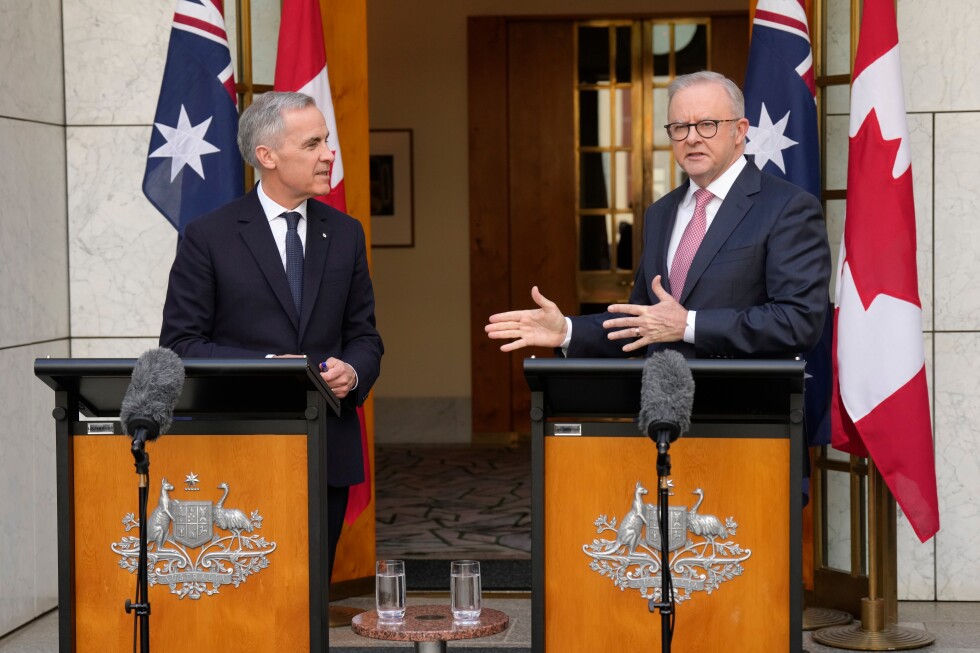
Canadian Prime Minister Mark Carney and Australian Prime Minister Anthony Albanese discussed the worsening situation during talks in Canberra, coming at a particularly tense moment in the conflict. Their meeting took place against the backdrop of reports that a U.S. submarine had sunk an Iranian warship in the Indian Ocean and Turkey’s announcement that NATO defense systems had intercepted an Iranian ballistic missile before it entered Turkish airspace.
“We want to see a broader de-escalation of these hostilities with a broader group of countries than just the direct belligerents involved,” Carney told reporters at a joint press conference. He emphasized that peace could not be achieved without addressing key concerns about Iran’s nuclear ambitions and support for terrorism.
“We stress that that cannot be achieved unless we’re in a position that Iran’s ability to acquire a nuclear weapon, develop a nuclear weapon, and to export terrorism, is ended. So that process must lead to those outcomes,” the Canadian leader added.
Carney also called for the involvement of the six-nation Gulf Cooperation Council in the de-escalation process, noting that these regional powers have demonstrated “tremendous restraint” despite the widening conflict.
Albanese echoed his Canadian counterpart’s sentiments, highlighting the indiscriminate nature of Iran’s recent attacks. “The world wants to see a de-escalation and wants to see Iran cease to spread the destinations of its attacks,” he said. “We’re seeing Gulf states, that have not been involved, attacked across the board, including the attacks on civilian and tourist areas as well.”
The Australian prime minister reinforced the nuclear concern, adding: “I want to see the possibility of Iran getting a nuclear weapon removed once and for all.”
When questioned by a reporter about potential Canadian military involvement in the conflict, Carney was careful not to rule out any options. “You’ve asked a fundamental hypothetical in a conflict that can spread very broadly,” he responded. “So one can never categorically rule out participation. We will stand by our allies when it makes sense.”
The statements from both leaders reflect the growing international concern about the escalation of hostilities and the potential for a wider regional conflict. The situation has rapidly deteriorated in recent weeks, with military exchanges between Iran and several countries, including Israel and the United States, intensifying.
The conflict has significant implications for global oil markets, with Iran being a major producer, and for shipping routes through the Strait of Hormuz, through which approximately 20 percent of the world’s oil supply passes. Regional instability also threatens to disrupt international trade and economic recovery efforts in the post-pandemic era.
Carney’s visit to Australia is part of a broader three-nation tour focused on trade relations. His trip began in India last week and included an address to the Australian Parliament on Thursday. The Canadian prime minister is scheduled to continue to Japan on Friday, where regional security concerns are likely to remain high on the agenda.
The coordinated messaging from the Canadian and Australian leaders underscores the unified approach many Western nations are taking toward the Iran situation, balancing calls for de-escalation with firm positions on nuclear non-proliferation and regional security priorities.
Fact Checker
Verify the accuracy of this article using The Disinformation Commission analysis and real-time sources.

16 Comments
Canada and Australia, as major mining and energy exporters, have a vested interest in ensuring a stable global commodities market. Preventing nuclear proliferation in the Middle East is crucial to safeguarding their economic interests, in addition to broader security concerns.
Well said. The economic interdependence of the global economy means that the fallout from an escalating conflict in the Middle East could have far-reaching consequences, underscoring the need for a coordinated diplomatic response.
The leaders’ emphasis on addressing Iran’s nuclear ambitions and support for terrorism is a pragmatic acknowledgement of the multifaceted challenges at play. A comprehensive approach that balances de-escalation with firm non-proliferation efforts will be essential.
Precisely. Navigating this complex geopolitical landscape will require nuanced diplomacy that addresses both immediate security concerns and the longer-term goal of regional stability and non-proliferation.
As major mining and energy exporters, both Canada and Australia have a strong interest in regional stability and secure supply chains. Preventing Iran from obtaining nuclear weapons is a shared priority that extends beyond just security concerns.
Absolutely. The economic implications of an unstable Middle East are far-reaching and could disrupt global commodity markets. Diplomatic efforts to defuse tensions are in the interests of all stakeholders.
As a major uranium producer, Canada has a vested interest in ensuring Iran’s nuclear program remains strictly for peaceful purposes. Australia’s stance as a close US ally also carries weight in these high-stakes negotiations.
Absolutely. The non-proliferation of nuclear weapons is a global security imperative that transcends any individual country’s interests.
As major producers and exporters of critical minerals like uranium, lithium, and copper, Canada and Australia have a vested interest in regional stability. Preventing nuclear proliferation is crucial to safeguarding their mining and energy supply chains.
Excellent point. The economic implications of an escalating conflict in the Middle East could have far-reaching consequences for the global commodities market, underscoring the importance of diplomatic solutions.
The sinking of an Iranian warship by a US submarine and the interception of an Iranian missile by NATO systems underscore the delicate and volatile nature of the current geopolitical landscape. Prudent diplomacy is essential to avoid further escalation.
Indeed, a measured, diplomatic approach is crucial to de-escalate the situation and find a peaceful resolution, while firmly upholding international norms against nuclear proliferation.
Diplomatic efforts to de-escalate tensions with Iran are crucial, but the global community must remain firm on preventing Iran from developing nuclear weapons. This is a complex geopolitical issue with significant implications for regional and global security.
Agreed. Balancing de-escalation with firm resolve on Iran’s nuclear ambitions will require careful, nuanced diplomacy from all sides.
The joint statement by the Canadian and Australian leaders highlights the importance of building a broader international coalition to address the complex challenges posed by Iran’s regional activities and nuclear ambitions. Multilateral cooperation will be key to finding a sustainable solution.
Agreed. A united global front, guided by principles of non-proliferation and diplomatic resolution, will be essential in navigating this delicate situation and preventing further escalation.