


Listen to the article
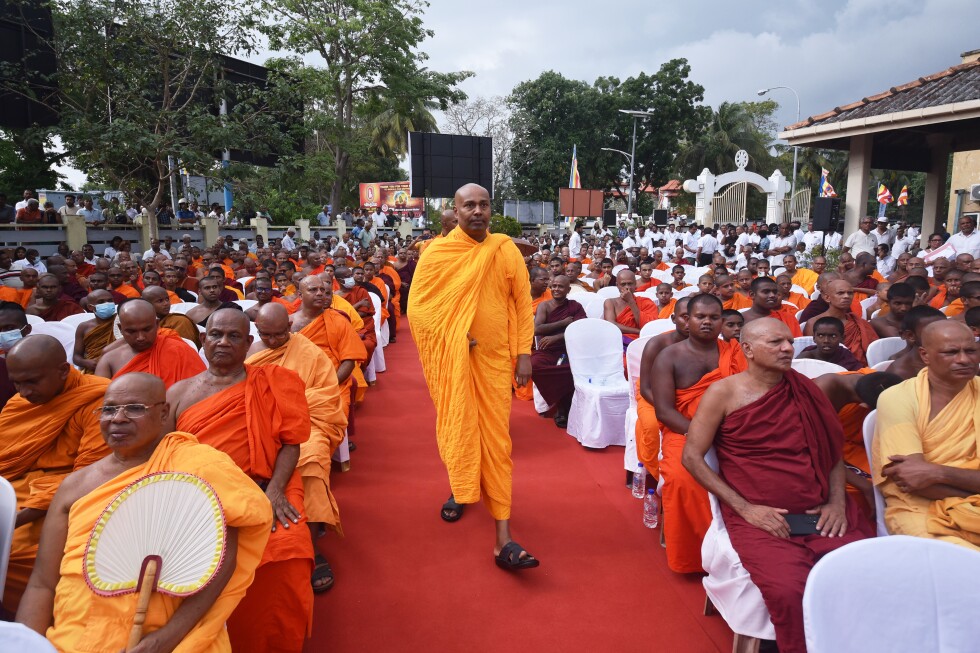
Hundreds of Buddhist monks gathered in Colombo on Friday to voice their concerns over what they perceive as government disrespect toward their religion, marking a significant display of religious activism in Sri Lanka’s political landscape.
The peaceful demonstration highlighted growing tensions between the Buddhist clergy and President Anura Kumara Dissanayake’s administration. During the rally, the monks presented a formal appeal addressed to the president, outlining several demands aimed at reinforcing Buddhism’s central role in the nation’s governance and society.
Sri Lanka’s constitution explicitly recognizes Buddhism as the state religion while guaranteeing freedom of worship to all citizens. The government is constitutionally obligated to “protect and foster” Buddhism, creating a unique relationship between religious institutions and state affairs that dates back centuries.
The monks’ petition emphasized that the government should ground its values in Buddhist principles and acknowledge the clergy’s traditional right to provide counsel on matters of state governance. This reflects a historical dynamic where Buddhist monks have played an advisory role to Sri Lankan leaders since ancient times.
Among their more controversial demands, the monks called for restricting top government positions to Buddhists only, a move that would affect the country’s diverse religious minorities. They also advocated for stronger integration of Buddhist values into the national education system and enhanced protection for archaeological sites with Buddhist significance.
Political analysts view these demands as part of a strategic pressure campaign by influential Buddhist leaders who have historically wielded considerable influence in Sri Lanka’s social and political spheres. With over 70% of Sri Lanka’s 22 million citizens identifying as Buddhist, the clergy’s stance carries substantial political weight.
The demonstration comes at a delicate time for Sri Lanka, which is still recovering from a devastating economic crisis that led to the ousting of former President Gotabaya Rajapaksa in 2022. President Dissanayake, who took office in 2023, has been focused on economic recovery and institutional reforms, potentially creating friction with traditional power structures.
Sri Lanka’s religious landscape includes significant Hindu, Muslim, and Christian minorities who have expressed concerns in the past about maintaining religious equality. Previous tensions between religious communities have occasionally flared into violence, making the Buddhist monks’ demands particularly sensitive in the country’s fragile social context.
Dr. Harini Amarasuriya, a political sociologist at the University of Colombo, explained the significance of the protest: “The Buddhist clergy in Sri Lanka has traditionally seen itself as guardian of both religion and nation. When they perceive their advisory role as being diminished, it often results in public demonstrations like this.”
The government has not yet issued an official response to the monks’ appeal. How President Dissanayake navigates this delicate balance between respecting Buddhist traditions while maintaining inclusive governance will likely influence both his administration’s stability and Sri Lanka’s ongoing efforts at post-crisis reconciliation.
The demonstration highlights the complex interplay between religion and politics in Sri Lanka, where Buddhist institutions have maintained significant influence over public affairs since the country gained independence from British colonial rule in 1948. While no violence was reported during Friday’s protest, it signals potential challenges ahead for the government as it attempts to implement reforms while respecting deeply entrenched religious traditions.
Fact Checker
Verify the accuracy of this article using The Disinformation Commission analysis and real-time sources.

8 Comments
This rally by Buddhist monks highlights the delicate balance Sri Lanka must strike between state and religion. Preserving religious freedom while also maintaining separation of church and state can be challenging, but it’s crucial for a pluralistic democracy.
These protests by Buddhist monks underscore the complex dynamics at play in Sri Lanka’s political landscape. Balancing the interests of different religious and secular factions will be a delicate challenge for the government.
Agreed, this issue highlights the need for Sri Lanka to carefully navigate the relationship between state and religion. Upholding democratic principles while respecting the country’s religious heritage will be crucial.
The role of religion in state affairs is a sensitive topic globally. I wonder how this situation in Sri Lanka will unfold and what implications it may have for the country’s political and social landscape going forward.
Interesting to see the Buddhist clergy in Sri Lanka asserting their influence on state affairs. They clearly want to preserve Buddhism’s central role in the country’s governance and society. It will be worth watching how the government responds to their demands.
It’s fascinating to see the continued influence of the Buddhist clergy in Sri Lankan politics. Their demands for a greater role in governance reflect the unique historical and constitutional relationship between religion and the state in the country.
The historical relationship between the Buddhist clergy and the Sri Lankan state is clearly a complex one. I’m curious to learn more about the specific demands the monks are making and how the government plans to address them.
Yes, the traditional advisory role of Buddhist monks in Sri Lankan politics is an intriguing dynamic. It’ll be important for the government to find a balanced approach that respects religious freedoms while also upholding democratic principles.