


Listen to the article
Former British Home Secretary Defects to Hard-Right Reform UK
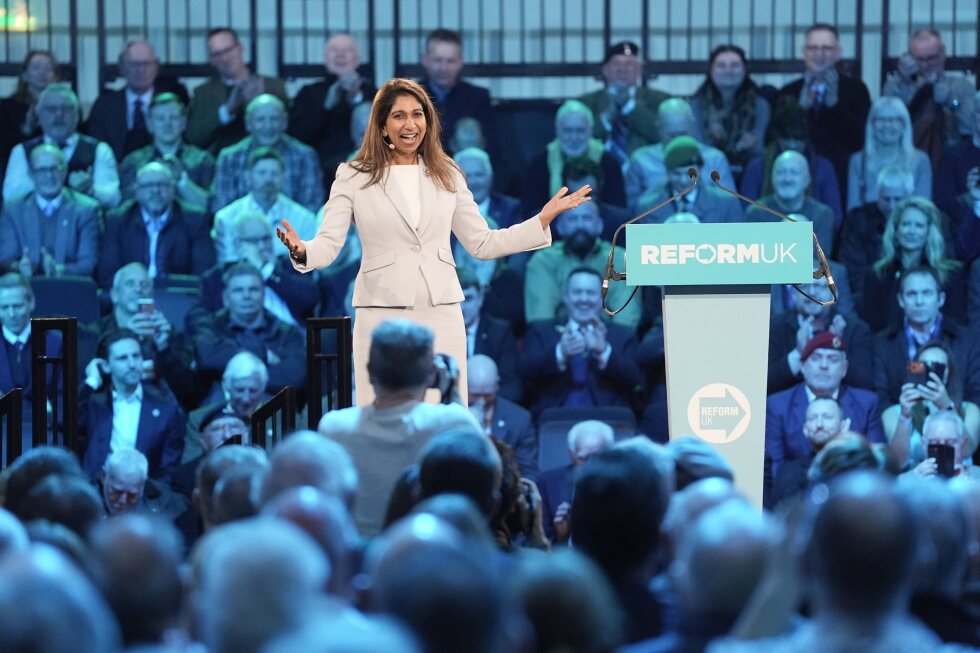
Former British Home Secretary Suella Braverman announced Monday she has abandoned the Conservative Party after three decades to join Nigel Farage’s hard-right Reform UK, dealing another blow to Britain’s beleaguered opposition party.
Braverman, who was fired from her role as interior minister in November 2023, will now represent her southern England constituency as a Reform lawmaker in Parliament.
“We can either continue down this route of managed decline to weakness and surrender,” Braverman said in her announcement. “Or we can fix our country, reclaim our power, rediscover our strength. I believe that a better Britain is possible.”
The defection marks the second high-profile Conservative departure to Reform UK in recent weeks, following Robert Jenrick’s move to Farage’s party. With Braverman’s addition, Reform UK now controls eight of the 650 seats in the House of Commons, while the Conservatives remain the official opposition with 116 seats to Prime Minister Keir Starmer’s Labour government.
Despite its limited parliamentary representation, Reform UK has been gaining momentum in opinion polls, where it currently leads both the governing Labour Party and the Conservatives ahead of crucial local elections in May, including votes for the Scottish and Welsh parliaments.
Braverman, 45, has built her political brand on hardline anti-immigration positions and conservative social values. During her tenure as Home Secretary, she provoked controversy by describing migration as a “hurricane” heading for Britain and referring to homelessness as a “lifestyle choice.” Her rhetoric against pro-Palestinian protesters, whom she labeled “hate marchers,” was particularly divisive.
Critics accused Braverman of inflaming tensions that contributed to far-right protesters clashing with police during a large pro-Palestinian demonstration in London. Her dismissal by then-Prime Minister Rishi Sunak came after repeated deviations from government policy positions.
The lawyer, who has frequently criticized what she calls the “tofu-eating wokerati” and liberal social values, said she declined to enter the contest for leadership of the Conservative Party following its crushing defeat to Labour in the July 2024 general election.
The Conservative Party responded dismissively to Braverman’s defection, noting in a statement that she had previously failed to garner enough support for a leadership bid. “It was always a matter of when, not if, Suella would defect,” the party stated.
Labour Party chairwoman Anna Turley seized the opportunity to criticize both Braverman and Farage, stating that the former Home Secretary shared responsibility for mismanaging Britain’s exit from the European Union. “Nigel Farage is stuffing his party full of the failed Tories responsible for the chaos and decline that held Britain back for 14 years,” Turley said.
Braverman’s defection represents a significant shift in her position. Following the 2024 election defeat, she had urged the Conservative Party to welcome Farage into its ranks. Writing in the Daily Telegraph at that time, she complained that her Conservative colleagues were unwilling to listen to her and had branded her “mad, bad and dangerous.”
For his part, Farage has apparently reversed his previous criticisms of Braverman. Having once described her as “utterly useless” in her role as Home Secretary for failing to stop migrants crossing the English Channel in small boats, he now welcomes her into Reform UK’s growing ranks.
“I think she’s reached the view that actually the center-right of British politics needs to unify around Reform,” Farage said of his newest party member.
The defection highlights the ongoing fragmentation of Britain’s traditional right-wing political establishment, with Reform UK increasingly positioning itself as an alternative for voters disaffected with the Conservative Party’s performance and direction following its electoral defeat.
Fact Checker
Verify the accuracy of this article using The Disinformation Commission analysis and real-time sources.

16 Comments
The Conservative Party’s struggles and the rise of Reform UK are indicative of the broader political turmoil in the UK. It will be important to see how this affects the country’s policy direction and international relations.
The defection of high-profile figures like Braverman to Reform UK suggests a shift in the political landscape. This could have significant implications for the UK’s future.
The Conservative Party’s internal divisions and the rise of Reform UK raise questions about the future direction of British politics. It will be interesting to see how this plays out in the upcoming elections.
The loss of experienced lawmakers like Braverman is a blow to the Conservatives. This could create opportunities for smaller parties like Reform UK to gain traction.
The Conservative Party’s struggles and the rise of Reform UK highlight the volatility and unpredictability of the UK’s political landscape. It will be crucial to see how this affects the country’s policy priorities and international standing.
The growing support for Reform UK suggests that some voters are seeking a more radical alternative to the traditional political parties. This could lead to a significant shift in the UK’s political dynamics.
The defection of Braverman to Reform UK is a significant development that reflects the broader turmoil within the UK’s political system. It will be important to closely monitor how this affects the balance of power and policy direction in the country.
The Conservative Party’s internal divisions and the rise of Reform UK underscore the need for a more diverse and representative political landscape in the UK. This could have far-reaching implications for the country’s future.
The defection of high-profile figures like Braverman to the Reform UK party signals a shift in the British political landscape. It will be crucial to see how this affects the balance of power and the policy priorities going forward.
Reform UK’s growing support in the polls is an interesting trend worth monitoring. Their populist, anti-establishment platform appears to be resonating with some voters.
The Conservative Party’s internal divisions and the emergence of Reform UK as a political force are intriguing developments. It will be worth following how this plays out in the coming months and years.
The loss of experienced lawmakers like Braverman is a blow to the Conservatives, but it could open up opportunities for smaller parties to gain a stronger foothold in British politics.
Interesting development in British politics. The Conservative Party seems to be facing some internal divisions and defections to the hard-right Reform UK. It will be worth following how this impacts the political landscape going forward.
The Conservative Party’s struggles highlight the volatility in the UK’s political climate. Voters may be looking for alternatives to the traditional parties.
The defection of Braverman to Reform UK is a significant development that highlights the fragmentation within the UK’s political landscape. It will be crucial to follow how this impacts the balance of power and policy priorities.
The growing support for Reform UK is a reflection of the public’s dissatisfaction with the traditional political parties. This could lead to a more diverse and dynamic parliament.