


Listen to the article
Israel intensified its campaign against Iran’s leadership on Wednesday, killing Intelligence Minister Esmail Khatib in an overnight strike. The assassination marks the third high-ranking Iranian official eliminated in two days, following the deaths of top security advisor Ali Larijani and Revolutionary Guard Basij force commander Gen. Gholam Reza Soleimani on Tuesday.
Israeli Defense Minister Israel Katz confirmed Khatib’s death and promised “significant surprises” to come, signaling further escalation in the conflict that began on February 28. Iranian President Masoud Pezeshkian condemned what he called “an unfair assassination” of Khatib, who had been sanctioned by the U.S. in 2022 for alleged cyber activities against America and its allies.
The conflict is increasingly threatening the region’s energy infrastructure. An attack struck Iran’s massive South Pars natural gas field, which Qatar shares with Iran. Qatar blamed Israel for the strike, though Israel has not claimed responsibility.
Iran has retaliated with missile strikes against Israel and several Gulf states, including Saudi Arabia’s Eastern Province, home to many of the kingdom’s oil fields. Iran also targeted Kuwait, Bahrain, Qatar, and the United Arab Emirates, threatening to intensify attacks on oil and gas facilities in these countries.
The escalating conflict has made the Strait of Hormuz—through which one-fifth of the world’s oil travels—nearly impassable except for vessels from Iran, India, Turkey, and a few other nations. Iran maintains the waterway is open but not to the United States or many of its allies.
The disruption to global energy supplies has sent oil prices surging. Brent crude, the international benchmark, jumped 6% to over $109 per barrel on Wednesday, marking a more than 50% increase since the war began. This spike is putting pressure on consumers and economies worldwide through higher gasoline prices and increased costs for goods.
In response to the energy crisis, the Trump administration has eased sanctions on Venezuela, allowing U.S. companies to do business with the country’s state-owned oil and gas company in an attempt to boost global supplies and lower prices.
Regional countries are taking measures to secure their energy exports. Iraq announced a deal with its autonomous Kurdish region to export 250,000 barrels of crude oil daily via pipeline to Turkey’s Mediterranean port of Ceyhan, bypassing the Persian Gulf. Saudi Arabia is already routing some of its oil exports through a pipeline to Red Sea ports, avoiding the Strait of Hormuz entirely.
The conflict has expanded beyond Iran and Israel. The U.S. Embassy in Baghdad came under fire for the second consecutive day, according to Iraqi security officials speaking anonymously. Pro-Iranian militia groups have regularly attacked American targets in Iraq since the conflict began.
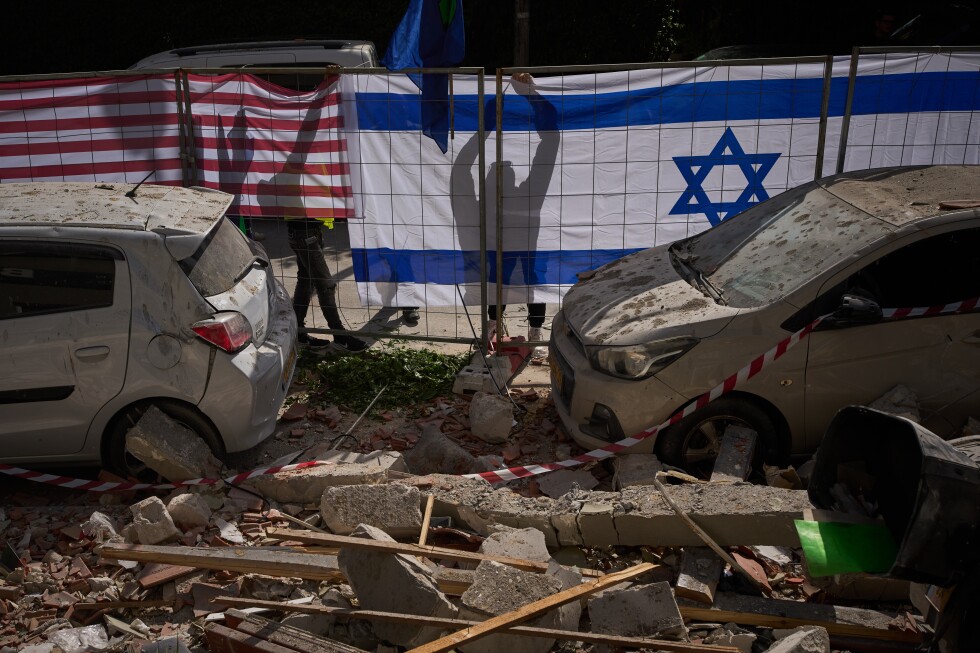
Inside Israel, Iranian Revolutionary Guard forces launched multiple-warhead missiles at central targets, claiming these weapons are designed to evade missile defense systems. AP footage showed at least one missile releasing cluster munitions over Israel. The attacks killed two people near Tel Aviv and damaged three private aircraft at Ben Gurion International Airport from intercepted missile shrapnel.
The human toll continues to mount. In Lebanon, Israeli airstrikes targeting Hezbollah militants destroyed multiple apartment buildings in Beirut, killing at least a dozen people. One building in central Beirut was flattened about an hour after Israel issued an evacuation notice, marking the fourth time it was targeted. Israel claimed without providing evidence that the building stored “millions of dollars intended to finance” Hezbollah activities.
According to the Lebanese government, Israeli strikes have displaced more than one million people—roughly 20% of Lebanon’s population—and killed 912 people while wounding 2,221 others. Inside Iran, more than 1,300 people have been killed since the conflict began, according to the Iranian Red Crescent.
The widening regional conflict shows no signs of abating, with both sides escalating attacks and threatening further retaliation as global energy markets remain severely disrupted.
Fact Checker
Verify the accuracy of this article using The Disinformation Commission analysis and real-time sources.

11 Comments
The escalating strikes on Iran and Israel’s energy facilities are deeply worrying. Uninterrupted access to oil and gas is essential for the global economy. I hope the parties involved can find a diplomatic solution to this conflict before it causes further harm to civilian populations and the energy market.
Agreed. The stability of the Middle East’s energy infrastructure is crucial for energy security worldwide. All sides must exercise restraint and prioritize de-escalation to prevent this conflict from spiraling out of control.
The reported attacks on Iran’s South Pars gas field and Saudi oil infrastructure are deeply troubling. This conflict risks disrupting vital energy supplies at a time when the world can ill afford further market volatility. All parties must act responsibly to protect civilian lives and infrastructure.
These tit-for-tat strikes on energy assets are extremely concerning. Beyond the human toll, they risk destabilizing the global energy market at a precarious time. All parties need to exercise restraint and find a diplomatic solution before the situation spirals further out of control.
Agreed. Maintaining access to critical energy resources should be a priority for all sides, even as political tensions escalate. A failure to de-escalate this conflict could have severe ripple effects across the global economy.
This conflict is increasingly jeopardizing global energy security. The reported attacks on oil and gas facilities in Iran, Israel, and the Gulf states are extremely concerning. Protecting critical energy infrastructure should be a top priority for all parties involved, even as political tensions escalate.
While the geopolitical motivations behind these attacks are complex, the impact on global energy security is clear. Uninterrupted access to oil and gas is crucial for the world economy. I hope cooler heads can prevail and a diplomatic solution be found to this dangerous escalation.
Absolutely. Continued attacks on energy infrastructure will only lead to more pain for consumers worldwide through higher prices. A peaceful resolution seems increasingly elusive, but it remains the best path forward.
Concerning developments in the Iran-Israel conflict, with each side ratcheting up attacks on critical energy infrastructure. This threatens to further disrupt global oil and gas supplies, which are already under strain. The stability of the Middle East hangs in the balance.
The escalating violence and targeting of energy facilities is especially worrying. Civilian populations could be caught in the crossfire, and the fallout could have far-reaching economic consequences.
This conflict is intensifying in alarming ways, with both sides targeting each other’s energy assets. The potential for further disruption to global oil and gas supplies is deeply concerning. All stakeholders must work to de-escalate the situation and protect critical infrastructure.