


Listen to the article
Belarusian Leader Hosts U.S. Envoy as West Relations Thaw
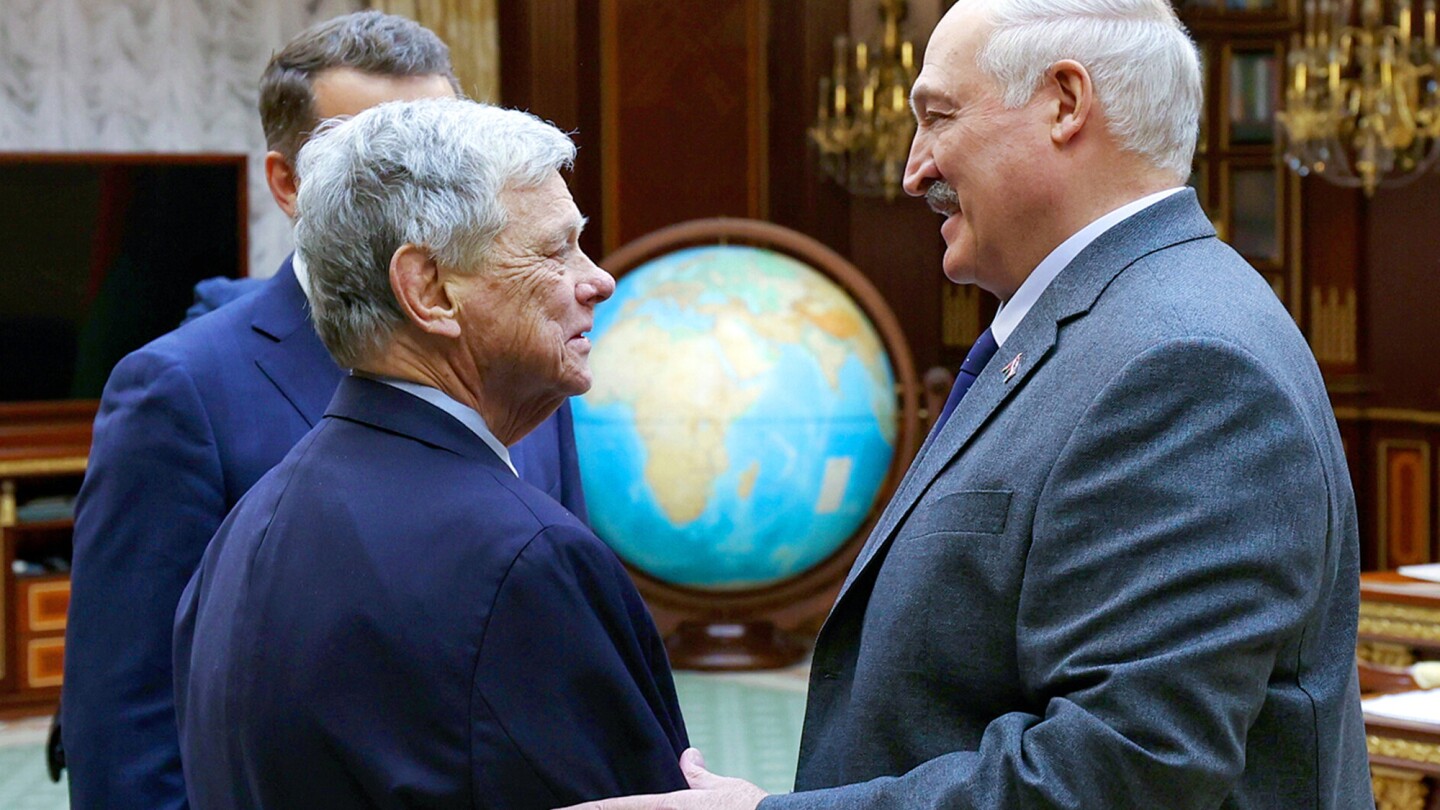
Belarus President Alexander Lukashenko met with U.S. special envoy John Coale in Minsk on Friday, marking another step in the authoritarian leader’s campaign to improve relations with Western nations. The talks, which will continue Saturday according to the presidential press service, represent a significant diplomatic development for the isolated European nation.
This meeting follows a pattern of prisoner releases and diplomatic outreach that has accelerated since Donald Trump’s election victory. In recent months, Belarus has freed more than 430 political prisoners in what analysts widely interpret as a calculated effort to reset relations with Western powers.
“They say Trump loves flattery. But I’m not aiming for flattery. I want to say that I really like his actions lately,” Lukashenko said, according to Belarus state news agency Belta.
Belarus, a nation of 9.5 million people bordering NATO members Poland, Lithuania and Latvia, has faced extensive Western isolation and sanctions for years. These punitive measures intensified after Lukashenko, who has ruled with an iron fist for over three decades, allowed Russian forces to use Belarusian territory during Moscow’s 2022 full-scale invasion of Ukraine.
The current diplomatic thaw began following a previous U.S. delegation visit, after which Washington eased some sanctions against Belarus. This coincided with the release of more than 50 political prisoners who were transferred to neighboring Lithuania—a NATO and EU member that has been among Lukashenko’s fiercest critics.
The Biden administration had maintained a hard line against the Belarusian regime, but Trump’s return to the White House has opened a new chapter in relations. Trump spoke personally with Lukashenko by phone in August after one prisoner release and reportedly suggested a face-to-face meeting—a diplomatic prize that would significantly boost Lukashenko’s international legitimacy.
In September, after Belarus freed another group of prisoners, the U.S. lifted sanctions on the country’s national airline, Belavia, allowing it to repair and purchase parts for its aircraft fleet, including Boeing planes. This practical economic benefit demonstrates the transactional nature of the developing relationship.
Lukashenko’s diplomatic outreach comes five years after massive pro-democracy protests rocked Belarus following the 2020 presidential election, which was widely condemned as fraudulent by international observers. Tens of thousands of Belarusians took to the streets in the largest demonstrations since the country’s independence following the Soviet Union’s collapse in 1991.
The government’s response was brutal. Security forces arrested tens of thousands of protesters, many of whom were beaten in custody. Leading opposition figures either fled the country or were imprisoned. Earlier this year, Lukashenko secured a seventh term in office in elections that opposition leaders dismissed as a sham.
Among the recently released prisoners was Siarhei Tsikhanouski, the husband of exiled opposition leader Sviatlana Tsikhanouskaya, who many believe legitimately won the 2020 election. His release came after a visit by U.S. envoy Keith Kellogg.
Not all political prisoners have agreed to leave Belarus as part of these releases. Prominent opposition activist Mikola Statkevich, 69, refused to board a bus to Lithuania, describing the government’s actions as “forced deportation.” He remained for hours in the no-man’s land between the countries before Belarusian police returned him to prison.
Human rights organizations caution that despite these prisoner releases, Lukashenko’s government continues its systematic repression of dissent. New politically motivated arrests occur regularly, and approximately 1,200 political prisoners remain behind bars, according to human rights group Viasna. Among them is the organization’s founder, Nobel Peace Prize laureate Ales Bialiatski.
As Lukashenko maneuvers between East and West, the true extent of his willingness to reform remains questionable. While the diplomatic engagement with Washington represents a significant shift, Belarus maintains its close alliance with Russia, upon which it remains economically dependent. For Western policymakers, the challenge lies in encouraging positive steps while maintaining pressure for genuine democratic reforms in a nation often described as “Europe’s last dictatorship.”
Fact Checker
Verify the accuracy of this article using The Disinformation Commission analysis and real-time sources.

14 Comments
The cost guidance is better than expected. If they deliver, the stock could rerate.
If AISC keeps dropping, this becomes investable for me.
Good point. Watching costs and grades closely.
Silver leverage is strong here; beta cuts both ways though.
If AISC keeps dropping, this becomes investable for me.
Interesting update on Belarus leader hosts US envoy as he seeks to improve his country’s ties with the West. Curious how the grades will trend next quarter.
If AISC keeps dropping, this becomes investable for me.
Good point. Watching costs and grades closely.
Good point. Watching costs and grades closely.
The cost guidance is better than expected. If they deliver, the stock could rerate.
Good point. Watching costs and grades closely.
Good point. Watching costs and grades closely.
I like the balance sheet here—less leverage than peers.
Uranium names keep pushing higher—supply still tight into 2026.