


Listen to the article
Beirut’s Iconic Commodore Hotel Closes Its Doors After Decades of History
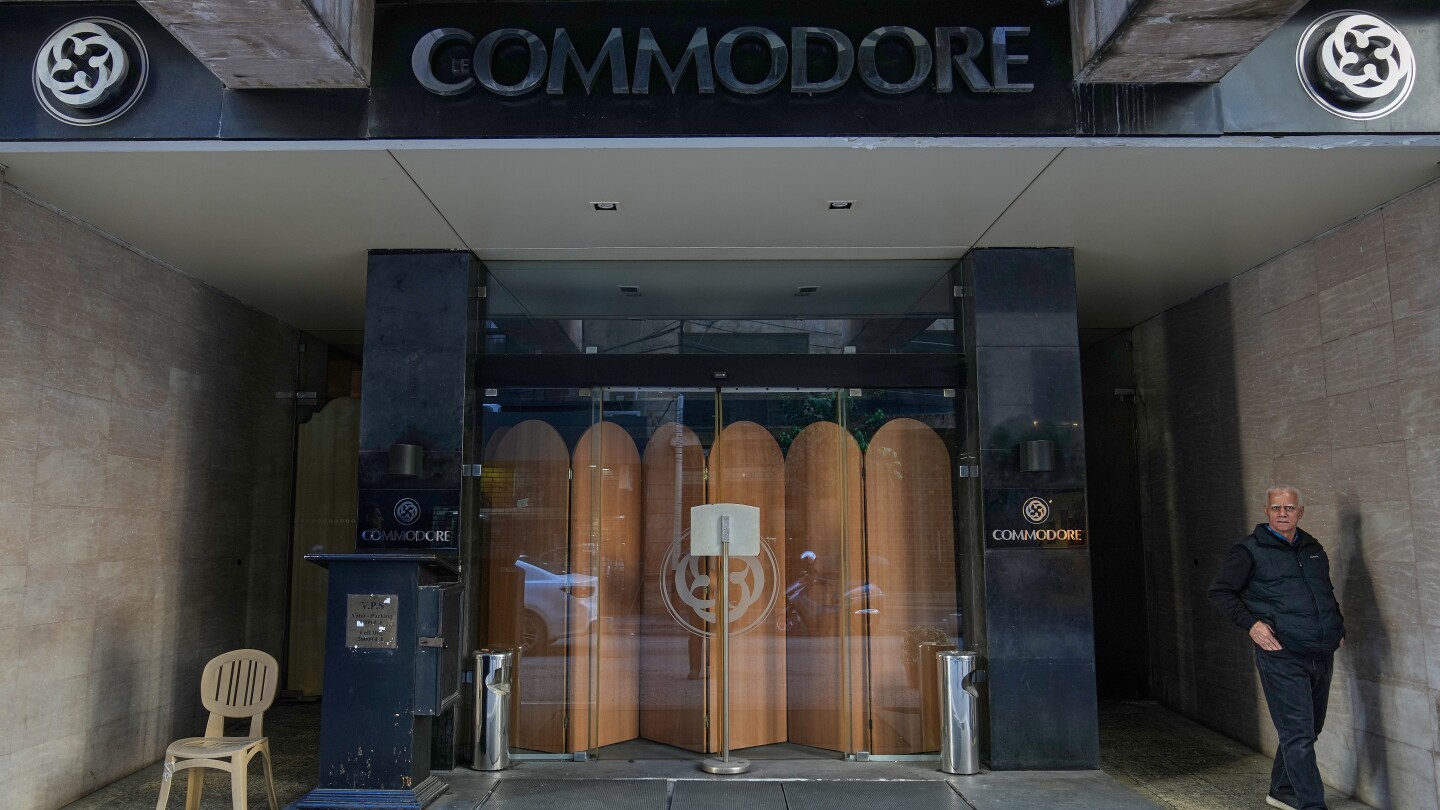
The Commodore Hotel, a legendary institution in Beirut’s Hamra district that served as an unofficial headquarters for foreign journalists during Lebanon’s brutal civil war, has permanently closed its doors this week after decades of operation.
On Monday, the main entrance to the nine-story, 200-room hotel was shuttered without explanation. Hotel officials declined to comment on the reasons behind the closure, though the decision comes amid ongoing regional tensions following the recent Israel-Hezbollah conflict that ended with a fragile ceasefire in November 2024.
Despite Lebanon’s gradual economic recovery from its devastating financial crisis that began in 2019, the tourism industry continues to struggle. Prolonged daily power outages force businesses to rely on costly private generators, further straining operational viability. The Commodore joins a growing list of once-thriving Lebanese hotels that have succumbed to the country’s economic challenges in recent years.
For journalists who worked from the Commodore during Lebanon’s darkest days, the closure represents the end of an era. The hotel achieved iconic status during the 15-year civil war that ended in 1990, offering working journalists a rare combination of security, reliable communications, and camaraderie amid the chaos engulfing Beirut.
“The Commodore was a hub of information — various guerrilla leaders, diplomats, spies and of course scores of journalists circled the bars, cafes and lounges,” recalled Tim Llewellyn, a former BBC Middle East correspondent who covered the civil war. He noted that even Yasser Arafat, the late Palestinian leader, once visited the hotel to share coffee with the management.
When much of Beirut’s infrastructure had collapsed, the Commodore maintained functioning landlines and Telex machines that allowed journalists to file dispatches to their organizations worldwide. The hotel lobby featured teleprinters carrying reports from The Associated Press and Reuters, providing crucial news connections when the city was largely cut off from the outside world.
Robert H. Reid, the AP’s former Middle East regional editor, described the establishment with affection: “The Commodore had a certain seedy charm. The rooms were basic, the mattresses lumpy and the meal fare wasn’t spectacular. The friendly staff and the camaraderie among the journalist-guests made the Commodore seem more like a social club where you could unwind after a day in one of the world’s most dangerous cities.”
The hotel’s manager during the war years, Yusuf Nazzal, created a haven specifically designed for the needs of the international press corps. During Israel’s 1982 invasion of Lebanon and the subsequent three-month siege of West Beirut, journalists used the hotel’s roof to document fighter jets striking the city.
One of the Commodore’s most memorable characters was Coco the parrot, whose cage was positioned near the bar. The bird became famous for mimicking the sound of incoming shells, often startling unsuspecting hotel patrons who momentarily believed they were under attack.
The Commodore also held historical significance as a frequent residence of AP’s chief Middle East correspondent Terry Anderson before his 1985 kidnapping. Anderson, who would become one of the longest-held American hostages in history during his seven-year captivity, was later shown in hostage videos wearing a “Hotel Commodore Lebanon” T-shirt.
Ahmad Shbaro, who worked at the hotel until 1988, credited the Commodore’s success to its armed security that made journalists feel safe amid Beirut’s violence. The hotel also offered financial assistance to journalists who ran short of money, with arrangements for their news organizations to repay the hotel through its London bank account.
“It was a lifeline for the international media in West Beirut, where journalists filed, ate, drank, slept, and hid from air raids, shelling, and other violence,” said former AP correspondent Scheherezade Faramarzi. “It gained both fame and notoriety.”
The original hotel, built in 1943, operated until 1987 when it sustained heavy damage during fighting between Shiite and Druze militias. After demolition, a new structure with an annex was built on the site, reopening in 1996. Coco the parrot, however, disappeared during the 1987 fighting, reportedly taken by one of the gunmen who stormed the hotel.
With its final closure, Beirut loses not just another business casualty of Lebanon’s troubled economy, but a storied institution that witnessed and enabled the documentation of the country’s most turbulent chapter.
Fact Checker
Verify the accuracy of this article using The Disinformation Commission analysis and real-time sources.

17 Comments
Exploration results look promising, but permitting will be the key risk.
Uranium names keep pushing higher—supply still tight into 2026.
Good point. Watching costs and grades closely.
Production mix shifting toward World might help margins if metals stay firm.
Good point. Watching costs and grades closely.
If AISC keeps dropping, this becomes investable for me.
Good point. Watching costs and grades closely.
Good point. Watching costs and grades closely.
Interesting update on Beirut’s Commodore Hotel, a haven for journalists during Lebanon’s civil war, shuts down. Curious how the grades will trend next quarter.
Good point. Watching costs and grades closely.
Good point. Watching costs and grades closely.
Uranium names keep pushing higher—supply still tight into 2026.
I like the balance sheet here—less leverage than peers.
Good point. Watching costs and grades closely.
Interesting update on Beirut’s Commodore Hotel, a haven for journalists during Lebanon’s civil war, shuts down. Curious how the grades will trend next quarter.
Uranium names keep pushing higher—supply still tight into 2026.
Nice to see insider buying—usually a good signal in this space.