


Listen to the article
Ancient Mega-Shark Fossil Discovery Pushes Back Timeline of Ocean Predators
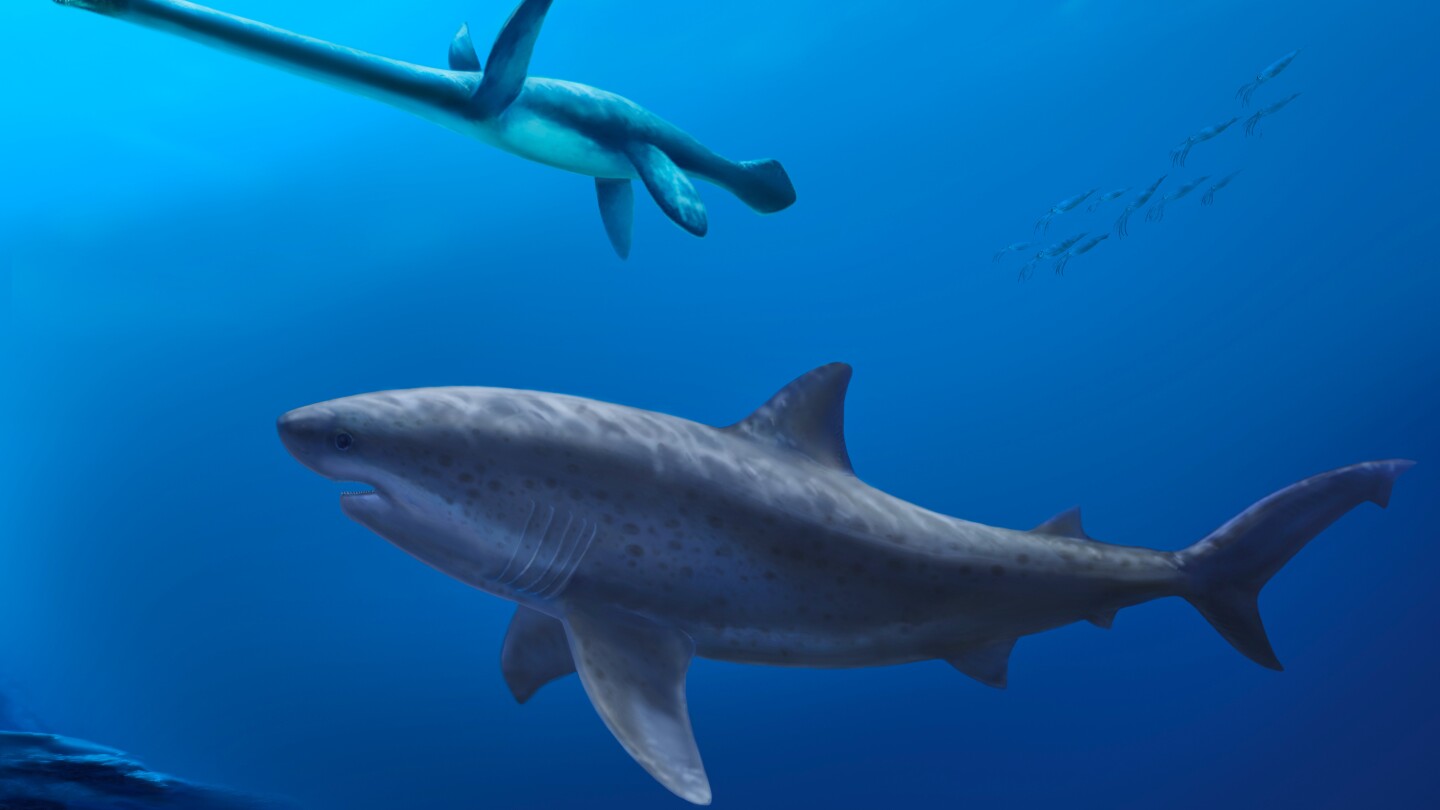
Scientists have identified the remains of a massive prehistoric shark that prowled the waters off northern Australia 115 million years ago, making it the earliest known mega-predator of the modern shark lineage. The discovery pushes back the timeline of gigantic sharks by 15 million years, surprising researchers who study the evolution of these ancient ocean predators.
The creature, belonging to the cardabiodontid family, is estimated to have measured approximately 8 meters (26 feet) in length—significantly larger than today’s great white sharks, which typically reach about 6 meters (20 feet). The finding challenges previous understanding of when sharks evolved to become apex predators.
“Cardabiodontids were ancient, mega-predatory sharks that are very common from the later part of the Cretaceous, after 100 million years ago,” explained Benjamin Kear, senior curator in paleobiology at the Swedish Museum of Natural History and one of the study’s authors. “But this has pushed the time envelope back of when we’re going to find absolutely enormous cardabiodontids.”
The breakthrough came from analyzing five vertebrae measuring 12 centimeters (4.7 inches) across that were discovered on a beach near Darwin in Australia’s Northern Territory during the late 1980s and 1990s. These specimens had been stored in a museum for decades before their significance was fully recognized.
The vertebrae originated from what was once the floor of an ancient ocean that stretched between the supercontinents of Gondwana (now Australia) and Laurasia (now Europe). This region has previously yielded other marine reptile fossils, including long-necked plesiosaurs and ichthyosaurs, making it a treasure trove for paleontologists studying Cretaceous marine ecosystems.
Vertebrae are particularly valuable discoveries for scientists studying ancient sharks. Unlike other vertebrates, sharks have skeletons made of cartilage rather than bone, which rarely fossilizes. The fossil record of sharks typically consists of teeth, which sharks continuously shed throughout their lives.
“The importance of vertebrae is they give us hints about size,” Kear noted. “If you’re trying to scale it from teeth, it’s difficult. Are the teeth big and the bodies small? Are they big teeth with big bodies?”
To determine the size of the Darwin cardabiodontids, researchers employed multiple methodologies including fisheries data, CT scans, and mathematical models. After years of testing different approaches, the team concluded that these prehistoric predators resembled modern sharks in their overall body shape.
“It would’ve looked for all the world like a modern, gigantic shark, because this is the beauty of it,” said Kear. “This is a body model that has worked for 115 million years, like an evolutionary success story.”
The findings, published in the journal Communications Biology, suggest that modern sharks rose to dominance in marine food chains much earlier than previously thought. While lamniform sharks—ancestors of today’s great whites—first appear in the fossil record around 135 million years ago, they were believed to be much smaller, typically reaching only about one meter in length.
This discovery indicates that sharks evolved to become mega-predators relatively quickly in their evolutionary history. By comparison, the infamous megalodon, which may have reached lengths of 17 meters (56 feet), appeared much later in the fossil record.
The research opens new avenues for paleontologists to explore similar environments worldwide for evidence of even earlier giant sharks. “They must have been around before,” Kear suggested. “This thing had ancestors.”
Beyond satisfying scientific curiosity about prehistoric ocean ecosystems, studying these ancient predators could provide insights into how modern marine species might respond to environmental changes. As Kear emphasized, “This is where our modern world begins. By looking at what happened during past shifts in climate and biodiversity, we can get a better sense of what might come next.”
The discovery underscores Australia’s significance as a repository of prehistoric marine life and highlights how even long-stored museum specimens can yield groundbreaking scientific insights when examined with new perspectives and technologies.
Fact Checker
Verify the accuracy of this article using The Disinformation Commission analysis and real-time sources.

13 Comments
Incredible that we’re still making groundbreaking paleontological discoveries like this. Reveals how much we have yet to learn about the ancient history of life on our planet. Can’t wait to see what else is uncovered.
This is such a remarkable finding. The scale and power of this ancient shark is truly mind-boggling. Kudos to the researchers for pushing the boundaries of what we know about prehistoric life.
Absolutely, it’s incredible how much new information can still be uncovered about the distant past. Discoveries like this really expand our horizons and challenge our preconceptions.
Fascinating discovery! This ancient mega-shark from Australia’s ancient seas is truly remarkable. Pushes back the timeline of when these massive predators ruled the oceans.
Absolutely, the 8-meter length is staggering compared to today’s great whites. Gives us a whole new perspective on the evolution of apex marine predators.
As an investor in mining and energy, I’m always fascinated by new scientific discoveries that could impact commodity markets. Curious to see if this ancient shark find leads to any commercial applications down the line.
Good point. While primarily of scientific interest, who knows if further research on this species could unlock insights relevant to modern industries like mining or energy. Always interesting to consider the potential downstream impacts.
Fascinating that this ancient shark was even larger than the legendary megalodon. Gives a glimpse into the incredible diversity of prehistoric marine life. Can’t wait to see what other mysteries get uncovered.
Wow, a true prehistoric giant! Really puts the megalodon in perspective. Excited to see how this discovery shapes our understanding of ancient marine ecosystems and the evolution of apex predators.
This is such an exciting discovery for researchers studying the evolution of ocean predators. A true apex predator from the Cretaceous period – amazing to think about the ecosystems it would have dominated.
Definitely, it’s mind-blowing to consider the scale and power of this ancient shark compared to today’s sharks. Really changes our perspective on the prehistoric oceans.
I’m curious to learn more about the cardabiodontid family and how this discovery changes what we know about shark evolution. Seems like a game-changer in the field of paleobiology.
Agreed, this find pushes back the timeline by 15 million years. Really makes you wonder what other ancient megafauna may be uncovered as research continues in this region.