


Listen to the article
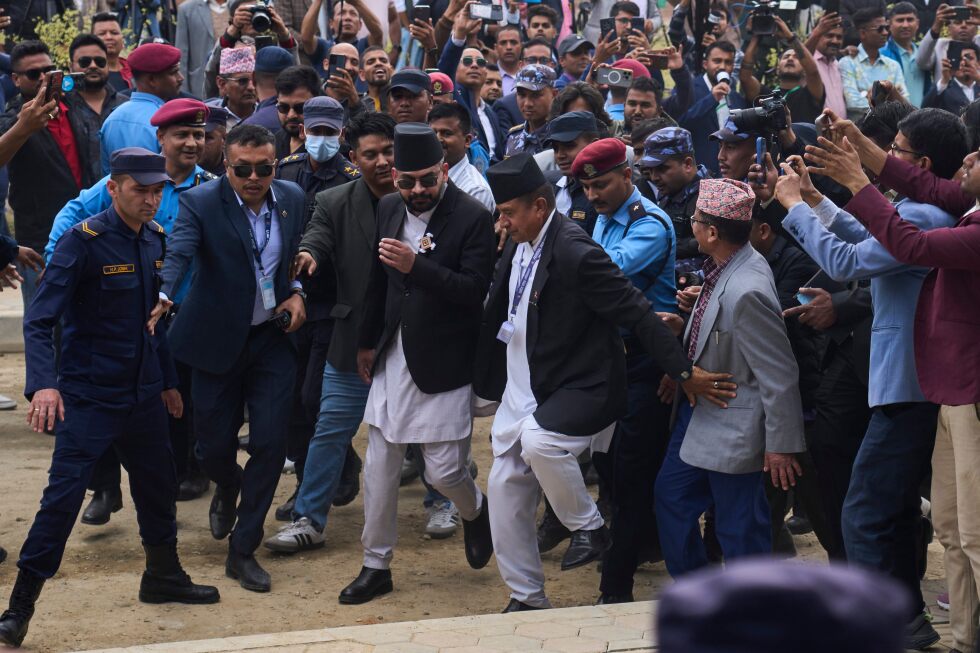
Nepal’s youngest prime minister, 35-year-old Balendra Shah, took the oath of office on Friday following his party’s landslide victory in elections earlier this month. The swearing-in ceremony marks a significant political shift in the Himalayan nation, coming in the wake of September’s youth-led uprising that toppled the previous government.
Shah, widely known as Balen, was appointed by President Ram Chandra Paudel after his Rastriya Swatantra Party secured nearly two-thirds of the seats in the House of Representatives during the March 5 polls. The political newcomer now faces the challenge of addressing deep public frustration with Nepal’s established political class, widely criticized for corruption and instability.
The elaborate swearing-in ceremony incorporated traditional Hindu rituals, including the “shankhnaad” (blowing of conches) and religious chanting by Hindu priests and Buddhist lamas. Army bands performed as officials and diplomats gathered to greet the new leader, while hundreds of supporters celebrated outside the presidential residence and prime minister’s office in central Kathmandu.
In a country where religious traditions hold significant importance, the timing of Shah’s oath-taking was carefully arranged. The ceremony took place at precisely 12:34 p.m. on Ram Navami, a major Hindu festival, a time deemed auspicious by Hindu priests based on astrological calculations. Following the numerological pattern of “1-2-3-4,” Shah later entered his new office at 14:15 p.m., maintaining another considered-favorable “14-15” pattern.
Such attention to religious timing reflects Nepal’s cultural fabric, where more than 80% of the population identifies as Hindu, and astrological considerations routinely influence important life events from marriages to business ventures.
Though born in Kathmandu, Shah’s family roots trace to Nepal’s Terai region along the Indian border, an area with strong Hindu traditions. His unconventional path to power began far from politics – initially gaining recognition as a structural engineer and rapper before winning election as Kathmandu’s mayor.
Shah emerged as an influential figure during September’s protests, which represented a watershed moment in Nepal’s recent political history. The demonstrations, predominantly led by Generation Z activists, turned bloody and resulted in dozens of fatalities. While not directly participating in the protests, Shah publicly supported the movement, aligning himself with the youth-driven push for change.
The election results reflect Nepali voters’ fatigue with established political parties and their track record of governance. Shah’s Rastriya Swatantra Party’s commanding parliamentary majority indicates a strong public mandate for fresh leadership and reform in a country that has struggled with political instability since transitioning to democracy.
Indian Prime Minister Narendra Modi was among the first international leaders to congratulate Shah. “Your appointment reflects the trust reposed in your leadership by the people of Nepal,” Modi wrote on social media platform X, adding that he looked forward to strengthening bilateral relations between the neighboring nations.
Shah’s administration faces substantial challenges, including addressing economic development in one of Asia’s poorest countries, stabilizing governance after years of political turmoil, and managing Nepal’s delicate geopolitical position between India and China, both of which seek influence in the strategically located Himalayan nation.
Political analysts note that Shah’s victory represents a generational shift in Nepali politics, potentially opening a new chapter for a country that has cycled through numerous governments since abolishing its monarchy in 2008. His administration’s ability to translate popular support into effective governance will be closely watched both domestically and by regional powers with strategic interests in Nepal.
Fact Checker
Verify the accuracy of this article using The Disinformation Commission analysis and real-time sources.

16 Comments
Interesting update on Balendra Shah sworn in as Nepal’s youngest prime minister. Curious how the grades will trend next quarter.
Exploration results look promising, but permitting will be the key risk.
Good point. Watching costs and grades closely.
Good point. Watching costs and grades closely.
Production mix shifting toward World might help margins if metals stay firm.
I like the balance sheet here—less leverage than peers.
Silver leverage is strong here; beta cuts both ways though.
If AISC keeps dropping, this becomes investable for me.
Good point. Watching costs and grades closely.
The cost guidance is better than expected. If they deliver, the stock could rerate.
Good point. Watching costs and grades closely.
Good point. Watching costs and grades closely.
Exploration results look promising, but permitting will be the key risk.
Uranium names keep pushing higher—supply still tight into 2026.
Good point. Watching costs and grades closely.
Good point. Watching costs and grades closely.