


Listen to the article
Asian Markets Rebound on Hopes of US-Iran Diplomatic Progress
Asian stock markets largely recovered Tuesday, mirroring the cautious optimism that spread through Wall Street after President Donald Trump suggested potential diplomatic progress with Iran regarding their ongoing conflict.
Japan’s Nikkei 225 gained 1.1% in afternoon trading, reaching 52,102.08 and recouping some of the previous day’s losses. Toyota Motor Corp. saw its stock rise 0.9% following its announcement of a $1 billion investment in its Kentucky and Indiana manufacturing facilities. This investment is part of Toyota’s broader November commitment to invest up to $10 billion in the United States over the next five years, highlighting Japanese manufacturers’ efforts to demonstrate their contributions to American employment and economic growth.
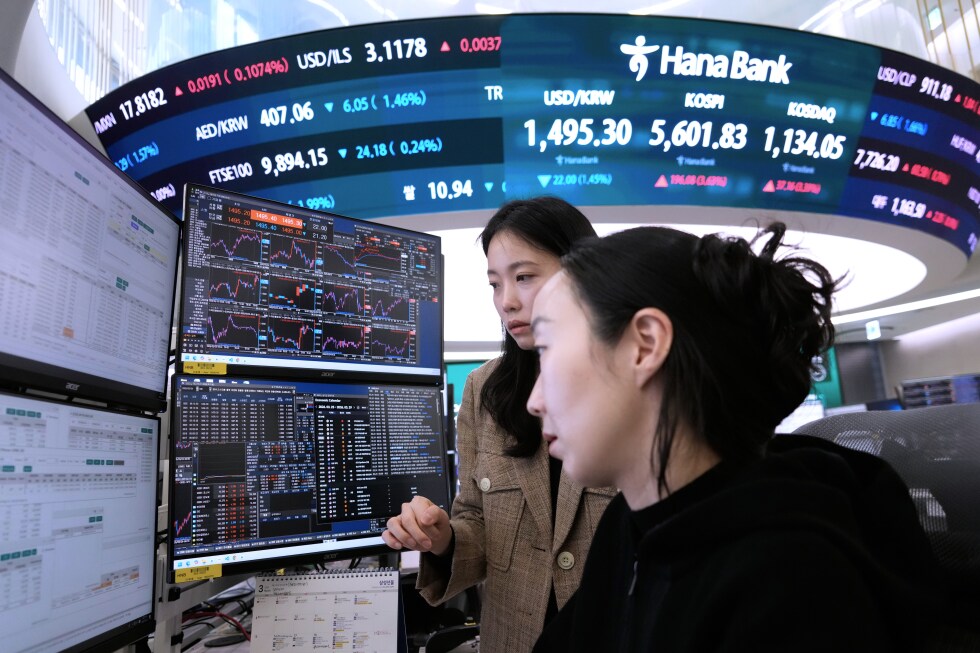
Elsewhere in Asia, Australia’s S&P/ASX 200 edged up 0.2% to 8,379.40, while South Korea’s Kospi showed stronger gains of 2.7%, climbing to 5,550.95. Hong Kong’s Hang Seng jumped 2.2% to 24,908.00, and China’s Shanghai Composite added 1.3% to reach 3,862.39.
Global financial markets have experienced significant volatility due to concerns about the Iran conflict that began in late February. Asian nations have been particularly vulnerable to these tensions, as many rely heavily on energy shipments through the Strait of Hormuz, a critical maritime passage for Middle Eastern oil exports.
Energy markets reflected the shifting sentiment, with benchmark U.S. crude rising $3.16 to $91.29 per barrel. Brent crude, the international standard, added $2.90 to reach $102.84 per barrel. This reversal came after Trump claimed the United States and Iran had engaged in “productive talks” over the previous two days “regarding a complete and total resolution of our hostilities in the Middle East.”
However, Iranian officials disputed Trump’s assertion. Mohammad Bagher Qalibaf, Iran’s parliament speaker, suggested on social media platform X that “fakenews is used to manipulate the financial and oil markets.”
Despite the contradictory statements, market analysts see potential for diplomatic progress. “While there’s clearly a long way to go until some sort of ceasefire is agreed, and peace restored, we do at least seem to have taken the first step towards those ends,” noted Michael Brown, senior research strategist at Pepperstone.
The diplomatic tensions escalated over the weekend when Trump threatened to “obliterate” Iran’s power plants if it failed to reopen the Strait of Hormuz within 48 hours. The narrow waterway has become increasingly significant for global oil markets as reduced traffic has prevented tankers from departing the Persian Gulf to supply global customers.
The potential for diplomatic resolution triggered a significant rally on Wall Street Monday. The S&P 500 rose 74.52 points to 6,581.00, while the Dow Jones Industrial Average experienced dramatic swings, initially surging nearly 1,135 points before settling with a gain of 631 points, or 1.4%, to close at 46,208.47. The Nasdaq composite jumped 299.15 points, or 1.4%, to 21,946.76.
Smaller companies demonstrated particular strength, with the Russell 2000 index of small-cap stocks leading markets with a 2.3% gain.
The bond market also reflected the more optimistic sentiment, with yields on the 10-year Treasury falling to 4.35% Monday from 4.39% the previous Friday. However, this yield remains significantly above its pre-conflict level of 3.97%.
In currency markets, the U.S. dollar strengthened slightly against the Japanese yen, trading at 158.66 yen early Tuesday compared to 158.35 yen previously. The euro weakened to $1.1581 from $1.1610.
The market developments underscore how geopolitical tensions in the Middle East continue to influence global financial markets, with particular implications for energy-dependent Asian economies. Investors remain cautiously optimistic about potential diplomatic progress, though uncertainty persists about the actual state of US-Iran communications and the prospects for de-escalation in the region.
Fact Checker
Verify the accuracy of this article using The Disinformation Commission analysis and real-time sources.

10 Comments
The rebound in Asian equities is a welcome sign, but I wonder if the optimism is premature. Underlying economic factors like trade tensions and slowing growth may still weigh on sentiment in the long run.
That’s a fair point. The market reaction could be overly reactive to short-term political signals rather than reflecting the broader economic landscape. Caution may still be warranted.
Interesting to see Asian markets rebound after the Trump-Iran rhetoric. Seems the potential for diplomatic progress has calmed some investor jitters. I wonder if this will be a sustained recovery or just a temporary bounce back.
Agreed, the markets are quite sensitive to geopolitical developments these days. It will be important to see if there are concrete steps towards de-escalation between the US and Iran.
The investment by Toyota in US manufacturing facilities is a positive sign of Japanese firms doubling down on their commitment to the American market. This could help offset any trade tensions between the two countries.
Yes, it’s good to see major international companies continuing to invest in the US despite the broader political uncertainty. This type of foreign direct investment is important for the economy.
I’m curious to see how the situation with Iran plays out and what impact it could have on the energy and commodity markets. Volatility seems inevitable, but a diplomatic solution would be ideal for global stability.
Absolutely. The geopolitical risk premium in energy and commodity prices is a major factor these days. Resolving the US-Iran tensions would help bring more predictability to those markets.
It will be interesting to see if the easing of US-Iran tensions leads to any changes in commodity prices, especially for energy and metals. Those sectors tend to be quite sensitive to geopolitical developments.
Absolutely. Commodity markets will be closely watching for signs of de-escalation between the US and Iran. Any reduction in supply disruption risk could have a significant impact on prices.