


Listen to the article
Ukraine’s Maritime Drone Chief Signals More Complex Russian Strikes in 2024
Ukraine’s fleet of uncrewed sea drones has successfully limited Russia’s once-dominant Black Sea navy, with more sophisticated operations planned for the coming year, according to the commander of Ukraine’s military intelligence maritime drone unit.
In an exclusive interview with The Associated Press, the head of the specialized Group 13 sea-drone unit explained how Ukrainian naval tactics have forced Russia to adapt its operations, creating a strategic stalemate in Black Sea engagements.
“Today, we’ve likely reached a plateau,” said the officer, identified only by the call sign “13th” under Ukrainian military protocol. “We are effectively limiting the enemy’s movements, but those dramatic, high-profile strikes we saw earlier haven’t happened for quite some time. That’s because the enemy has adapted.”
The commander appeared in uniform with his face covered and eyes obscured by tinted glasses, underscoring the sensitive nature of Ukraine’s maritime drone operations. For security reasons, details about the interview location were withheld at the intelligence agency’s request.
Ukraine’s sea-drone campaign has dramatically altered Russian naval behavior in the Black Sea. According to the commander, Russian vessels “barely operate,” typically venturing only 25 miles from port to launch missiles before quickly retreating to safety.
“They constantly hide. And in a way, that’s also a result of our unit — because you can imagine the cost of maintaining a fleet that cannot operate at sea,” the officer noted.
Ukraine’s maritime drone program has become a crucial asymmetric warfare component in the conflict with Russia. The country operates two distinct sea-drone initiatives – one through its military and another through domestic intelligence services. Group 13 specifically manages the Magura family of sea drones, which Ukraine has credited with multiple successful strikes against Russian naval assets.
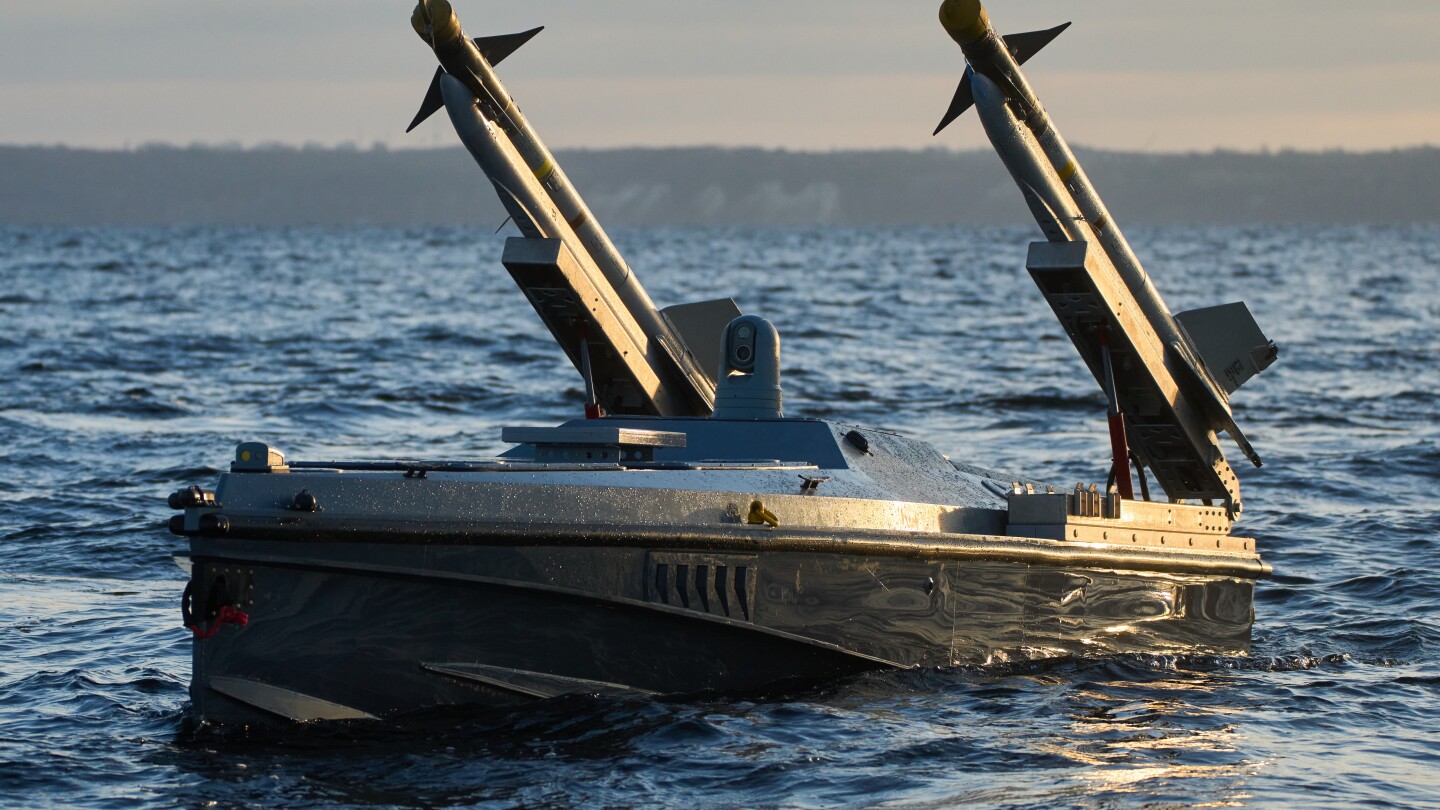
The unit currently deploys two main variants: the smaller V5 ramming drone and the larger V7 weapons platform. Both are controlled remotely using portable suitcase-sized consoles equipped with joysticks, screens, and safety switches. At a recent demonstration, operators showcased a V7 fitted with modified U.S.-made Sidewinder air-to-air missiles – technology that reportedly shot down a Russian fighter jet in May, representing what the commander called a “breakthrough” in maritime warfare.
Last month, Ukrainian officials claimed sea-attack drones were used in strikes against vessels in Russia’s “shadow fleet” of oil tankers – ships designed to evade international sanctions. The commander declined to comment specifically on these operations.
The future of Ukraine’s maritime drone program appears focused on artificial intelligence integration. The Group 13 commander explained that the next evolution will leverage Ukraine’s growing archive of operational video and sensor data to improve targeting capabilities and reduce human operator workload.
“Right now, target search is a combined process — part operator, part AI,” he said. “In the future, you’ll launch the drone and it will independently search for a target, distinguish civilian vessels from military ones, and make more of the decisions.”
Ukraine is also pursuing international cooperation to enhance its maritime capabilities. During President Volodymyr Zelenskyy’s visit to Athens last month, Kyiv and Greece announced plans for joint development of maritime uncrewed aerial vehicles, expanded military training exercises, and information-sharing on maritime threats.
The country is actively seeking to expand co-production arrangements with several NATO countries in 2024, potentially accelerating development of longer-range strike options, submersible drones, and more complex mixed-fleet operations.
Despite Russia’s tactical adaptations, the commander expressed confidence in Ukraine’s continued maritime effectiveness. “We’re working on many fronts to change this situation and create a turning point,” he said. “For now, I can say this: We haven’t lost effectiveness. We’ve simply reached a point where we’re holding the enemy in check.”
This strategic standoff in the Black Sea represents a significant achievement for Ukraine, which began the conflict with a conventional naval disadvantage against Russia’s historically dominant Black Sea Fleet. Through technological innovation and asymmetric tactics, Ukrainian forces have effectively neutralized much of Russia’s maritime advantage in the region.
Fact Checker
Verify the accuracy of this article using The Disinformation Commission analysis and real-time sources.

10 Comments
Uranium names keep pushing higher—supply still tight into 2026.
If AISC keeps dropping, this becomes investable for me.
Good point. Watching costs and grades closely.
The cost guidance is better than expected. If they deliver, the stock could rerate.
Good point. Watching costs and grades closely.
Uranium names keep pushing higher—supply still tight into 2026.
Good point. Watching costs and grades closely.
I like the balance sheet here—less leverage than peers.
Good point. Watching costs and grades closely.
Good point. Watching costs and grades closely.