


Listen to the article
Ukrainian Artist Preserves War’s Reality Through Battlefield Relics Collection
In a dimly lit basement near Kyiv’s Maidan Square, Ukrainian street artist Maxim Kilderov has created an extraordinary repository of war artifacts that tells the unfiltered story of Russia’s invasion of Ukraine.
The collection, which Kilderov plans to transform into a public museum, contains thousands of objects recovered from battlefields across Ukraine: scorched rocket launch tubes, captured Russian military uniforms, personal diaries of enemy soldiers, and countless unit patches displaying the dark humor and resilience of those fighting on the frontlines.
“I want one hall that concentrates everything — so people feel emotion when they suddenly find themselves surrounded by these items,” Kilderov explains, describing his vision for a space that conveys the raw reality of the conflict that has engulfed Ukraine since February 2022.
For Kilderov, this collection represents more than historical artifacts. Having endured 55 days under Russian occupation in Nova Kakhovka, a city in southern Ukraine, he sees these objects as essential evidence of a war that must be documented beyond official narratives.
During those harrowing weeks under occupation, Kilderov risked his life organizing underground aid networks, livestreaming conditions under Russian control, and even spray-painting abandoned Russian military vehicles with his distinctive symbols of resistance.
“From day one, we began sharing information with people inside the city and with the outside world,” he recounts. “By the 55th day, I managed to escape.”
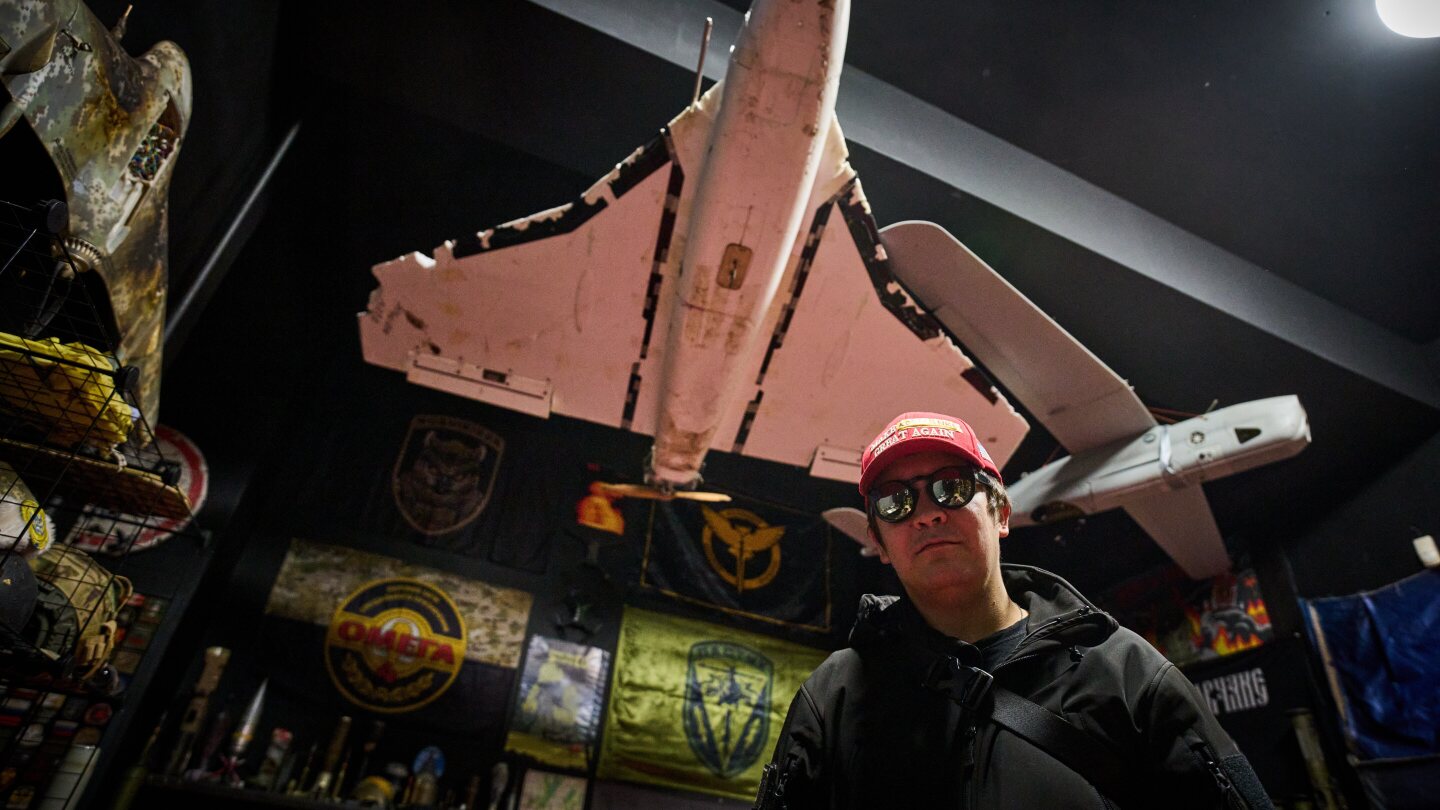
The collection began modestly in Kilderov’s home but has since expanded dramatically. Through military contacts, trades, and personal recovery efforts following air attacks on Ukrainian cities, he has amassed an impressive array of battlefield relics. Russian documents and passports sit alongside helmets, weapons fragments, knives, grenades, and night-vision equipment. A Shahed decoy drone made of Styrofoam hangs from the ceiling.
Some items carry profound personal significance. A smartphone pierced by shrapnel that saved a soldier’s life. Military unit flags commemorating Black Sea operations. Soldiers’ drawings and half-consumed cigarette packs abandoned in haste. Each item represents a human story within the larger conflict.
Throughout the space, Kilderov’s distinctive artistic style is evident — doodle-like calligraphy concealing symbols and messages of resistance. A massive 5-meter painting titled “55” dominates one wall, its maze of colored lines symbolizing the days he spent under occupation.
Since fleeing to western Ukraine, Kilderov has channeled his experiences into various artistic endeavors. He designs military patches and creates art on battlefield debris. He even converts rocket tubes into Bluetooth speakers, donating most proceeds to Ukrainian military units.
The basement has become more than a collection space. It serves as a gathering point for soldiers who bring new artifacts and share their stories, expanding a collection that Kilderov views as an authentic record of Ukraine’s wartime experience.
As Ukraine enters its fourth winter of war, Kilderov expresses concern about the fading sense of unity that characterized the early days of the invasion. He notes a troubling return to inequality and division in a society that was once bound by urgency and shared purpose.
During his interview, Kilderov wore a red MAGA hat, which he described as a deliberately ironic gesture reflecting Ukraine’s vulnerability as a nation dependent on foreign aid that can be suspended without warning — a reality highlighted by recent delays in U.S. assistance packages.
“When Russia attacked Kyiv, people picked up rifles and went to fight,” he reflects. “I hope we return to that unity.”
The collection stands as both a testament to Ukraine’s resilience and a warning about the fragility of solidarity in protracted conflict. Through these salvaged objects, Kilderov ensures that the human dimensions of the war — beyond strategic assessments and political declarations — remain visible and undeniable.
As international attention shifts and war fatigue sets in globally, Kilderov’s growing museum offers a stark reminder of the continuing human cost of Europe’s largest military conflict since World War II.
Fact Checker
Verify the accuracy of this article using The Disinformation Commission analysis and real-time sources.

5 Comments
The collection sounds incredibly moving and impactful. Having these tangible reminders of the conflict, from the frontlines, will make the war’s realities visceral and undeniable for visitors. This museum is an important project.
I’m glad to see this artist’s dedication to documenting the true lived experiences of Ukrainians resisting the invasion. Capturing these personal stories and perspectives is so important, beyond just the official narratives.
It’s heartbreaking to think of the personal tragedies and struggles represented by these artifacts. But I’m glad this artist is preserving them to honor the resilience and courage of the Ukrainian people in the face of this brutal invasion.
This is such an important and powerful initiative. Preserving the raw, human experience of this war is critical for understanding the reality on the ground. These artifacts will be invaluable historical records.
Kilderov’s vision for a space that conveys the raw emotional reality of the war is really powerful. Immersing visitors in these artifacts could be a profound and transformative experience. This museum will be an important memorial.