


Listen to the article
The Artemis II crew has captured breathtaking new imagery that draws powerful parallels to one of NASA’s most iconic moments from the Apollo era.
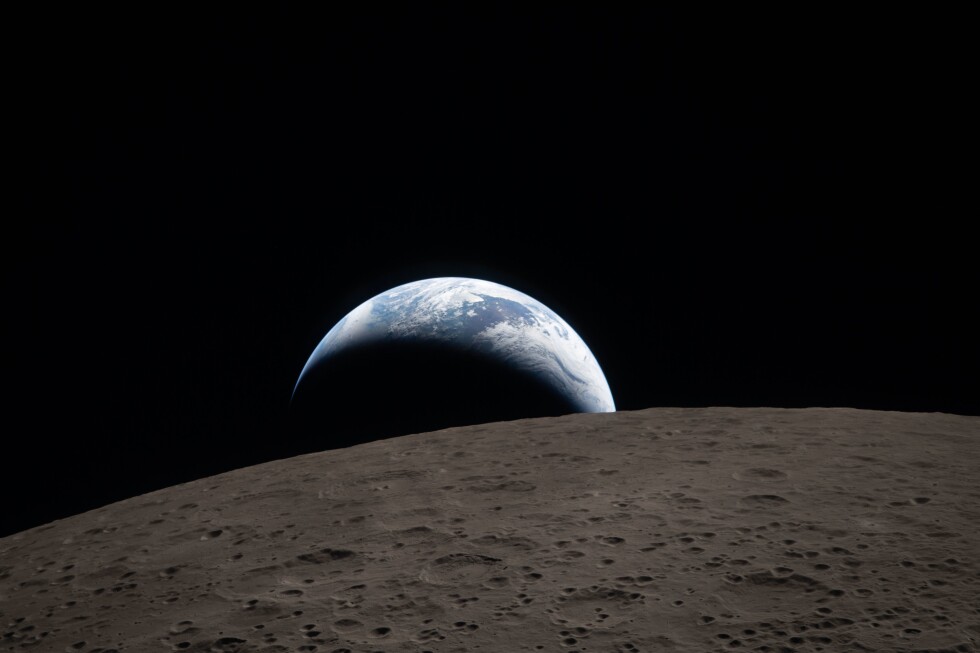
NASA released remarkable photographs Tuesday taken by the four-member U.S.-Canadian crew, just one day after their historic lunar flyaround mission. The images showcase Earth from a perspective seen by only a handful of humans throughout history.
In a deliberate homage to Apollo 8’s groundbreaking “Earthrise” photograph from 1968, the Artemis II astronauts captured their own version: an “Earthset” showing our blue planet descending behind the moon’s crater-marked gray surface. The juxtaposition of Earth’s vibrant colors against the desolate lunar landscape offers a striking visual reminder of our planet’s unique place in space.
Among the released images was also a stunning capture of a total solar eclipse as seen from the crew’s unique vantage point, with the moon completely blocking the sun from their perspective. These images represent the first photographs of Earth and the moon taken by astronauts since the Apollo program ended over five decades ago.
The crew, consisting of three Americans and one Canadian, is now on their return journey to Earth with a Pacific Ocean splashdown scheduled for Friday. Meanwhile, scientists at Houston’s Mission Control are meticulously analyzing the continuous stream of lunar photographs being transmitted back to Earth.
The Artemis II mission marks NASA’s first crewed return to lunar orbit since Apollo 17 in 1972. It serves as a crucial stepping stone toward NASA’s ambitious goal of returning humans to the lunar surface. If all proceeds as planned, another crew will attempt a moon landing in approximately two years as part of the Artemis III mission.
The historical significance of these new photographs cannot be overstated. The original Earthrise image captured by Apollo 8 astronauts Frank Borman, Jim Lovell, and Bill Anders on Christmas Eve 1968 became one of the most influential photographs ever taken. That image, showing a partially illuminated Earth rising above the lunar horizon, is widely credited with galvanizing the environmental movement by presenting a fragile Earth suspended in the vastness of space.
“We came all this way to explore the moon, and the most important thing is that we discovered the Earth,” said Apollo 8 astronaut Bill Anders regarding the original Earthrise photograph.
The Artemis II mission represents a significant revival of human deep space exploration after decades focused primarily on low Earth orbit operations like the International Space Station. The program, named after Apollo’s mythological twin sister, aims to establish a sustainable human presence on and around the moon as preparation for eventual human missions to Mars.
The mission carries additional historical significance as it includes Canadian Space Agency astronaut Jeremy Hansen alongside NASA astronauts Reid Wiseman, Victor Glover, and Christina Koch. This makes it the first lunar mission with international crew participation and includes both the first woman and the first person of color to travel beyond Earth orbit.
These new images serve as powerful visual documentation of humanity’s return to deep space exploration and provide a fresh perspective on our home planet from a cosmic vantage point. The photographs are expected to inspire a new generation of space enthusiasts, just as the original Earthrise image captivated the world over half a century ago.
As the Artemis II crew prepares for their return to Earth, their mission has already succeeded in reconnecting humanity with the profound experience of viewing our planet from the vicinity of its nearest celestial neighbor.
Fact Checker
Verify the accuracy of this article using The Disinformation Commission analysis and real-time sources.

10 Comments
These photos are a testament to the incredible progress in space technology and exploration since the Apollo era. I’m particularly intrigued by the total solar eclipse image – what an extraordinary sight that must have been for the crew.
These photos from Artemis II are a powerful reminder of the progress we’ve made in space exploration since the Apollo era. I’m curious to see how the scientific data and imagery from this mission will contribute to our understanding of the moon and Earth’s relationship.
The total solar eclipse image is simply stunning. What an incredible vantage point for witnessing this celestial event. I’m excited to see how the Artemis program continues to push the boundaries of human space exploration.
Absolutely, the total solar eclipse must have been an awe-inspiring sight from the crew’s perspective. I can only imagine the sense of wonder and discovery they are experiencing.
The Artemis II Earthset photo is a powerful visual statement about our planet’s place in the cosmos. I’m curious to learn more about the scientific and technical advancements that made these stunning images possible, compared to the original Apollo Earthrise shot.
Excellent point. The advancements in imaging technology and spacecraft capabilities since Apollo must have played a big role in capturing these breathtaking views. It will be fascinating to learn more about the technical details.
The Earthset image is a beautiful homage to the iconic Earthrise photo from Apollo 8. It’s remarkable that we can now capture these views again with modern technology. I wonder how the Artemis crew’s perspective and experiences compare to the original Apollo astronauts.
That’s a great point. It would be fascinating to hear the Artemis crew’s reflections on seeing Earth from the moon, and how it compares to the pioneering experiences of the Apollo astronauts.
Seeing Earth from the moon’s perspective is truly awe-inspiring. The Artemis II ‘Earthset’ photo is a powerful reminder of our planet’s fragility and beauty. I can’t wait to see what other breathtaking images the crew captures during their mission.
Agreed, the juxtaposition of Earth and the desolate lunar landscape is striking. It’s wonderful that we can now witness these views again after the long gap since Apollo.