


Listen to the article
Gunfire echoed through Tehran on Tuesday as heavily armed militias deployed across the Iranian capital, transforming districts into fortified zones under intense security measures. Video footage captured bursts of automatic weapons fire after dark, with government buildings, state media facilities, and major intersections placed under guard.
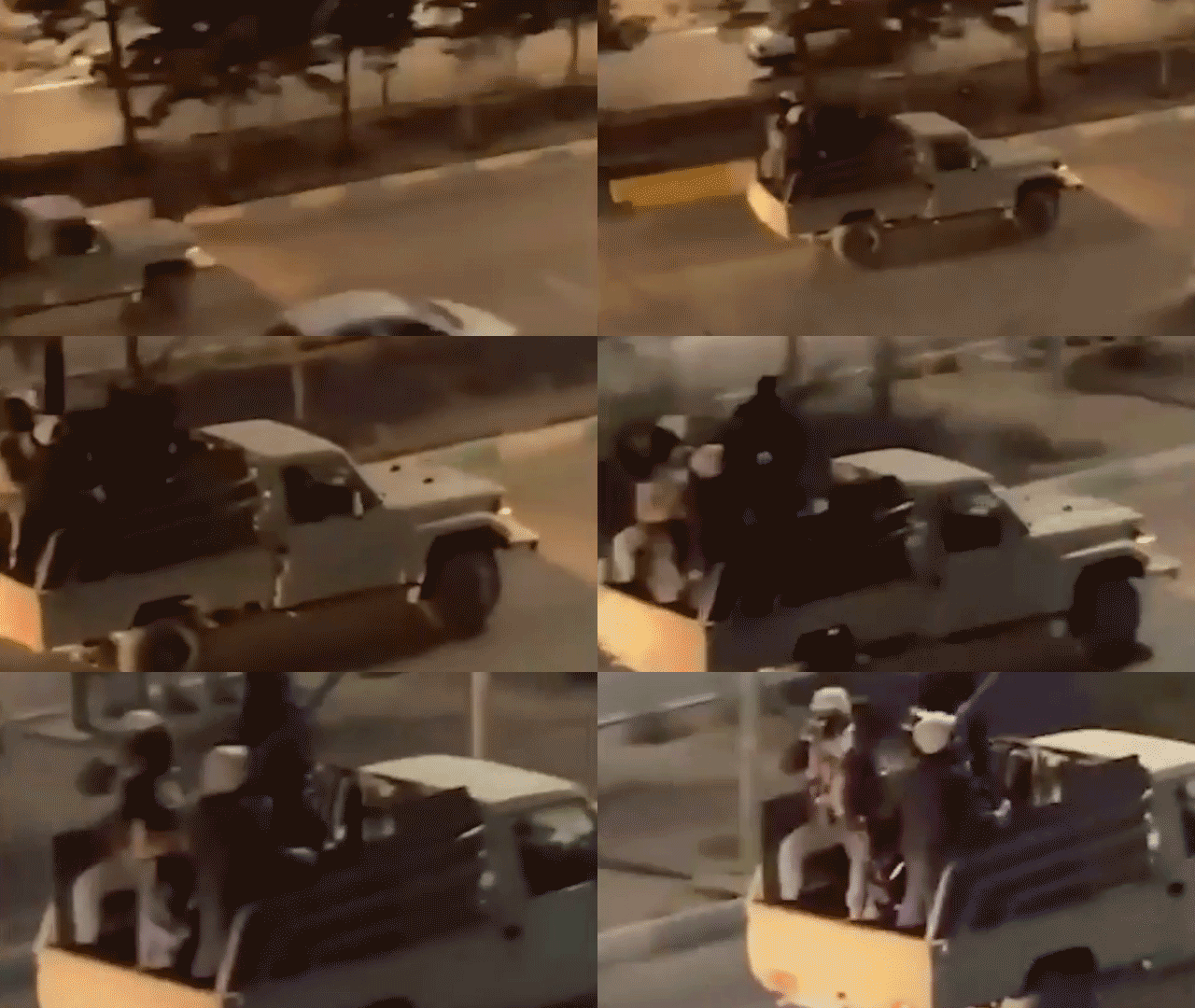
Armored Toyota pickups mounted with heavy machine guns patrolled the streets in convoys, with masked fighters firing weapons as they moved through urban areas. Large-caliber guns could be heard rattling through the darkness as armed men shouted commands in Farsi.
“There has been a deployment of dozens of Toyotas mounted with heavy machine guns and other heavy weapons in Tehran,” said Ali Safavi, a senior official with the National Council of Resistance of Iran (NCRI). According to Safavi, these forces are reportedly linked to Lebanese Hezbollah and Iraq’s Popular Mobilization Forces (PMF).
The footage shows what appears to be Iraqi Hashd al-Sha’bi fighters and Hezbollah militants under the command of Iran’s Islamic Revolutionary Guard Corps (IRGC). Their commanders can be heard issuing orders in Farsi as the convoys navigate through the capital.
Safavi claims the Iranian regime has increasingly relied on foreign proxy forces to maintain control. “The regime has brought in at least 5,000 foreign elements now from Iraq and Hezbollah to control Tehran,” he explained. “They are guarding government buildings and state radio and TV using Russian-made 50-caliber heavy machine guns.”
These security measures coincide with Day 24 of nationwide protests, according to the Human Rights Activists News Agency (HRANA), which also reported a continued communications blackout across the country. The death toll has reached alarming levels, with HRANA stating that 4,519 deaths have been confirmed, while an additional 9,049 reported deaths remain under investigation. At least 5,811 people have been seriously injured and 26,314 arrested.
The agency described an overwhelming security presence throughout the capital, particularly after nightfall, with law enforcement, IRGC, Basij paramilitary units, and plainclothes agents creating what HRANA called “an atmosphere of deterrence and fear.”
The protests began on December 28, initially sparked by economic grievances before rapidly spreading nationwide as opposition to clerical rule intensified. Despite the regime’s harsh crackdown involving mass arrests, lethal force, and internet restrictions, demonstrations have persisted across the country.
“Sometimes the protesters hold their ground despite gunfire, ammunition and volleys of tear gas,” Safavi noted. He further alleged that IRGC units attacked a hospital in Gorgan, killing wounded patients, placing snipers on rooftops, and firing into surrounding areas. “They took around 76 bodies to a warehouse and are refusing to hand them over to families because the forces want to bury them in secret,” he claimed.
Throughout the unrest, Supreme Leader Ayatollah Ali Khamenei has consistently blamed “foreign enemies” for the protests while supporting the IRGC’s forceful response to demonstrators.
The situation has drawn international attention, with U.S. President Trump warning Iran on Tuesday that continued assassination threats from Tehran would trigger overwhelming retaliation. “Anything ever happens, we’re going to blow the whole — the whole country’s going to get blown up,” Trump told NewsNation.
However, NCRI President-elect Maryam Rajavi has rejected the notion that external military action could topple the regime. “A foreign war cannot bring down this regime,” she stated. “What is required is an organized nationwide resistance rooted in active, combat-ready forces inside Iran’s cities to defeat one of the most brutal and repressive apparatuses in the world today — the IRGC.”
The ongoing unrest represents one of the most significant challenges to the Islamic Republic since its establishment in 1979. The regime’s decision to deploy foreign militias in the capital signals growing concern about its ability to control the situation using domestic security forces alone. As international pressure mounts and protests continue despite the brutal crackdown, Iran’s leadership faces an increasingly difficult path forward in containing public dissent.
Fact Checker
Verify the accuracy of this article using The Disinformation Commission analysis and real-time sources.

9 Comments
As an energy analyst, I’m wondering how this unrest could impact Iran’s oil and gas production and exports. Disruptions to their energy sector would have significant global implications, especially given the tight supply conditions in global energy markets right now.
The use of heavy machine guns and armored vehicles by these militias is extremely concerning. This level of firepower suggests they are well-equipped and organized, posing a serious threat to public safety. I hope the authorities can swiftly de-escalate the violence.
I’m curious to learn more about the specific militia groups involved and their links to Hezbollah, the PMF, and the IRGC. What are their grievances and demands? Understanding the underlying drivers of this unrest is crucial.
Agreed, the involvement of those regional militias raises a lot of questions about the geopolitical dynamics at play. Unpacking the complex web of alliances and rivalries will be key to analyzing this situation.
Wow, the images of these heavily armed convoys patrolling Tehran are really striking. I wonder what the motivations and goals of these militia groups are. This seems like a very dangerous and volatile situation.
These militia attacks seem to be targeting government buildings and state media facilities, which suggests a more coordinated and politically-motivated agenda beyond just random acts of violence. I wonder if this is part of a broader power struggle within Iran.
As an investor in mining and energy companies, I’m worried about how this unrest in Iran could impact global commodity markets and supply chains. Geopolitical instability is always a risk factor to consider.
That’s a good point. Disruptions to Iranian production and exports of key resources like oil, copper, and uranium could certainly roil global markets. Prudent investors will be closely monitoring the situation.
This is a very concerning development. Armed militias unleashing deadly force on the streets of Tehran is a deeply troubling escalation of violence. I hope the authorities can quickly restore order and protect innocent civilians.