


Listen to the article
Tennis Stars Call for Privacy Amid Growing Camera Surveillance at Major Tournaments
Top-ranked tennis players Iga Swiatek and Coco Gauff have voiced concerns about the increasing camera presence in players’ private spaces at major tournaments, highlighting a growing tension between content creation and athlete privacy at the Australian Open.
The issue gained prominence when footage of Gauff smashing her racket in what she thought was a private area after her quarterfinal loss to Elina Svitolina went viral online. The 21-year-old American had deliberately moved away from center court to vent her frustration.
“I tried to go somewhere where I thought there wasn’t a camera because I don’t necessarily like breaking rackets,” Gauff explained in her post-match press conference. “Maybe some conversations can be had because I feel like at this tournament the only private place we have is the locker room.”
World No. 1 Swiatek echoed these sentiments after her 7-5, 6-1 quarterfinal loss to fifth-seeded Elena Rybakina, questioning the boundaries of player surveillance.
“Are we tennis players, or are we like animals in the zoo where they are observed even when they poop?” the 24-year-old Polish star asked bluntly, before apologizing for the exaggeration. “It would be nice to have some privacy.”
Swiatek, who has won four French Open titles along with Wimbledon and the U.S. Open championships, pointed out that she often needs space to practice specific techniques immediately before walking onto the court—something difficult to do with cameras constantly rolling.
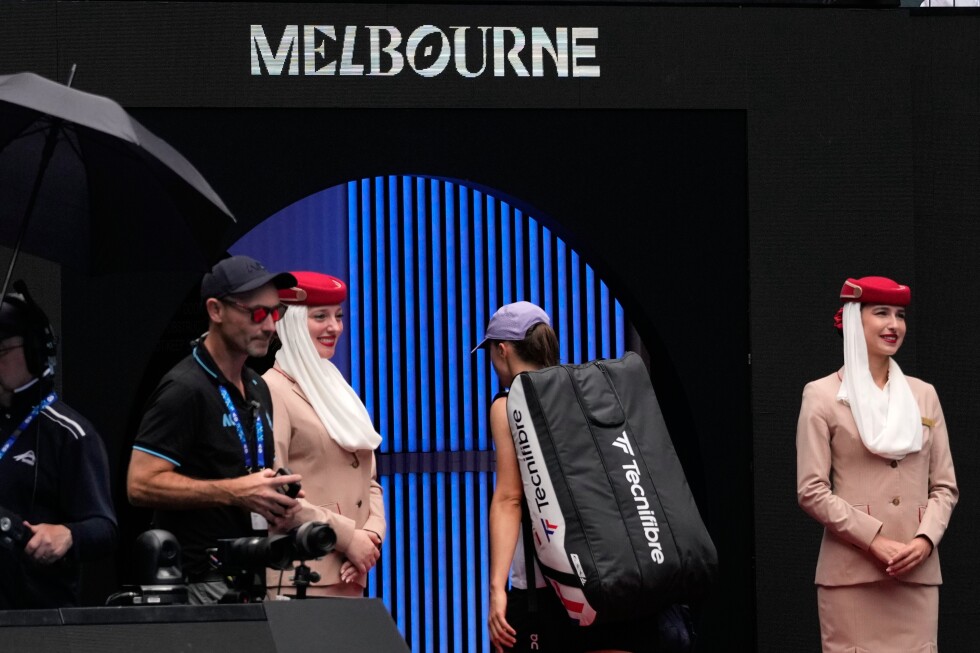
The extensive camera coverage is part of a broader strategy by tournament organizers, particularly at the Australian Open, to enhance fan engagement by providing behind-the-scenes content. Cameras track players from locker rooms to courts and throughout stadium areas, with footage often appearing on broadcasts and social media platforms.
Amanda Anisimova, who lost her quarterfinal match to fellow American Jessica Pegula, expressed sympathy for Gauff’s situation. “There are good moments, obviously, that people see, and that’s fun. Then, when you lose, there are probably not-so-good moments,” she said. “The fact that the video of Coco that was posted, it’s tough, because she didn’t have a say in that.”
The Women’s Tennis Association (WTA) has acknowledged these concerns. WTA Chair Valerie Camillo issued a statement affirming that the organization “stands with our players and takes their concerns about privacy and cameras at the Australian Open seriously.”
“Players deserve spaces away from competition where they can recover in private,” Camillo added. “We have already taken steps to reduce camera presence in off-court player areas to ensure players have appropriate private spaces.”
The WTA has called for tournament organizers and broadcast partners to review the issue and ensure “clear, respectful boundaries in off-court areas.”
This isn’t the first time player reactions have been captured and shared widely. After losing to Gauff in the U.S. Open final, Aryna Sabalenka had a similar private moment of frustration broadcast to audiences, underscoring that this issue extends beyond the Australian Open.
Following Gauff’s incident, 23-time Grand Slam champion Serena Williams offered support on social media, posting that there’s “nothing wrong with hating to lose” and playfully offering to teach Gauff how to demolish a racket in “one swipe — Serena style.”
Novak Djokovic, who has witnessed the evolution of media coverage throughout his career, sympathized with the younger players while expressing skepticism about the possibility of change.
“I saw what happened with Coco after her match. I empathize with her,” the 24-time Grand Slam champion said. “It’s really sad that you can’t basically move away anywhere and hide and fume out your frustration in a way that won’t be captured by a camera.”
Djokovic added a sobering perspective on the current media landscape: “We live in a society and in times where content is everything, so it’s a deeper discussion. It’s really hard for me to see that that’s going backward. It’s just something that I guess we have to accept.”
With a touch of dark humor, Djokovic even suggested the next frontier might be even more invasive: “I’m surprised that we have no cameras while we are taking a shower! I mean, that’s probably the next step.”
As tournaments continue to balance content creation with player welfare, this debate highlights the evolving challenges facing professional athletes in an era of constant digital surveillance and content consumption.
Fact Checker
Verify the accuracy of this article using The Disinformation Commission analysis and real-time sources.

9 Comments
I can understand the players’ frustrations. The constant surveillance, even in supposedly private areas, must be incredibly stifling and demoralizing. This needs to be addressed to ensure their wellbeing.
Agreed. Athlete privacy and mental health should be the top priority, not maximizing content and coverage. The authorities need to find a way to protect the players’ dignity.
This is a concerning trend that risks dehumanizing the players. While media coverage is important, there has to be a line drawn to protect their right to privacy, especially in emotionally fraught moments.
Absolutely. The players are human beings, not zoo animals for our entertainment. Striking the right balance is crucial to preserve the integrity of the sport.
Iga Swiatek raises a valid point – are athletes being treated more like performers than people? The quest for content and coverage shouldn’t come at the expense of basic dignity and privacy.
It’s a complex issue without easy answers. Fans want access, but the players’ wellbeing has to be the priority. Perhaps there could be designated ‘off-limits’ areas to give them some respite.
This is a concerning development that risks turning tennis into a spectacle rather than a sport. The players are not just performers – they deserve the same basic privacy and respect as any other person.
This is an interesting issue that highlights the tension between public interest and athlete privacy. There’s certainly a balance to be struck between fans’ desires for content and players’ need for personal space.
I agree, the increasing camera surveillance does seem excessive and intrusive. Players should have some private areas where they can decompress without being constantly observed.