


Listen to the article
Archaeologists in Jerusalem have completed excavation of the longest continuous section of an ancient wall that once encircled the city, potentially uncovering evidence of a 2,100-year-old peace agreement between warring kingdoms. The discovery provides new insights into Jerusalem’s history during the Hasmonean period, the era when the events commemorated by Hanukkah took place.
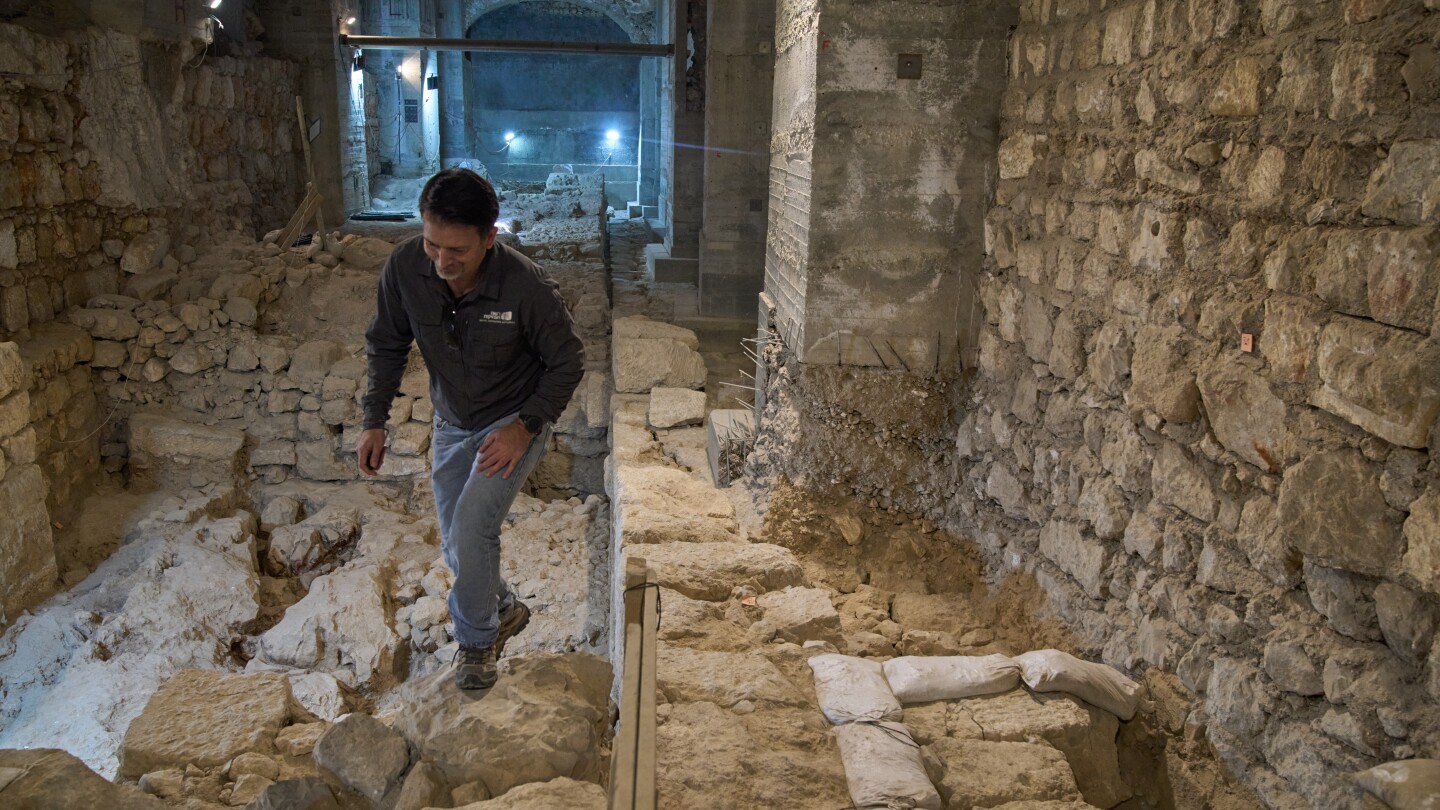
The recently uncovered Hasmonean wall foundation stretches nearly 50 meters (164 feet) – about half the length of a football field – and measures approximately 5 meters (16 feet) in width. Experts believe the walls that once stood upon this foundation towered higher than Jerusalem’s current Old City walls, which date primarily to the Ottoman period.
According to historical accounts, the Hasmonean fortifications encompassed an area considerably larger than today’s Old City and featured 60 watchtowers exceeding 10 meters (33 feet) in height. This newly excavated section represents one of the most intact portions of the Hasmonean wall foundation ever discovered.
Dr. Amit Re’em, lead archaeologist from the Israel Antiquities Authority, noted an intriguing detail about the find: the wall appears to have been deliberately dismantled to a uniform height rather than collapsing naturally through war or decay. This methodical destruction puzzled researchers, who questioned why anyone would intentionally remove a crucial defensive structure in a region perpetually threatened by invasion.
The answer may lie in ancient historical texts. According to the writings of Jewish historian Flavius Josephus, around 132 or 133 BCE, Hellenistic King Antiochus VII besieged Jerusalem. As the Judean forces struggled, King John Hyrcanus I negotiated a ceasefire by offering 3,000 talents of silver (reportedly obtained from King David’s tomb) and 500 hostages, including his own brother.
“Antiochus Sidetes reached a ceasefire agreement with John Hyrcanus, saying, if you want me to remove my army, you yourself, the Jewish king, must raze to the ground the Hasmonean fortification that you and your father built,” explained Re’em. Josephus recorded that subsequently, they “pulled down the walls encircling the city.”
“We just think that we found the archaeological proof for it,” Re’em said. “It’s pretty amazing, the archaeology and the ancient stories combining together. This is the magic of Jerusalem.”
An alternative theory suggests King Herod may have later built his palace atop the Hasmonean wall foundations during his first-century BCE reign, symbolically asserting his sovereignty over Jewish Jerusalem.
However, some scholars remain skeptical about connecting the dismantled wall directly to the Antiochus agreement. Orit Peleg-Barkat, head of classical archaeology at the Hebrew University of Jerusalem, points out that other sections of the Hasmonean wall found elsewhere in Jerusalem weren’t dismantled. She suggests this particular section might have been removed specifically to provide a foundation for Herod’s palace, noting it seems unlikely Jerusalem would have remained completely unprotected without any security walls for more than a century.
The wall foundation was discovered beneath an abandoned wing of the Kishleh, a building constructed in 1830 as a military base. This section later served as a prison, including during British rule until the 1940s. Evidence of its prison history remains visible in the form of multilingual graffiti carved by inmates and iron cell bars still embedded in the ceiling.
Archaeologists first began excavating this wing in 1999, but work was halted during the Second Intifada, which erupted in 2000. Excavations resumed just two years ago, with researchers meticulously removing the equivalent of two Olympic swimming pools’ worth of dirt and debris by hand.
The dig also uncovered what appear to be Middle Age-era dye pits, likely used for fabric coloring.
The timing of the discovery coincides with preparations for Hanukkah, which begins December 14 this year. The eight-day festival commemorates the rededication of the Temple in Jerusalem after a small group of Jewish fighters liberated it from occupying forces in the second century BCE, establishing the Hasmonean Kingdom. The holiday’s name means “dedication” in Hebrew, and its customs include lighting candles each night and eating fried foods like potato pancakes (latkes) to commemorate the miracle of temple oil that lasted eight days instead of one.
The Tower of David Museum plans to install a floating glass floor above the archaeological site, incorporating the space into its new Schulich Wing of Archaeology, Art and Innovation. The renovations are expected to take at least two years now that the excavation has been completed, allowing future visitors to view this significant piece of Jerusalem’s ancient history.
Fact Checker
Verify the accuracy of this article using The Disinformation Commission analysis and real-time sources.

11 Comments
What an incredible piece of ancient history to uncover! The Hasmonean wall must have been an imposing structure in its day. I wonder if there are any clues in the excavation about the daily life and activities that took place along this fortification.
Great point. Analyzing the construction methods and any artifacts found could reveal fascinating insights into the lives of those who defended and maintained the wall. This is an exciting development for understanding Jerusalem’s past.
This is a really significant find for scholars of ancient Jerusalem and the Hasmonean period. Excavating such a well-preserved section of the old city walls provides a tangible link to the events commemorated by Hanukkah. I’m curious to learn more about the potential peace agreement the archaeologists mentioned and how this fortification may have been involved.
Fascinating discovery! This section of Hasmonean wall offers a rare glimpse into ancient Jerusalem’s history and the events surrounding Hanukkah. I’m curious to learn more about the potential peace agreement it may have been tied to.
Yes, the wall’s impressive scale and apparent strategic positioning suggest it played an important role in Jerusalem’s defenses during that era. Excited to see what other insights this excavation uncovers.
An intact 2,100-year-old wall from the Hanukkah era? That’s an absolutely incredible archaeological discovery. Uncovering these kinds of ancient structures can offer such valuable insights into the history and daily life of the people who lived in Jerusalem at that time. I’m eager to see what other revelations come out of this excavation.
A 2,100-year-old wall from the Hanukkah era? That’s an astounding find. I’m curious to learn more about the potential peace agreement the archaeologists mentioned and how this wall may have been involved. Archaeology can shed such valuable light on ancient history.
This is an incredible archaeological find. Uncovering such a well-preserved portion of the Hasmonean-era wall is a true treasure trove for historians and biblical scholars. The details on the wall’s dimensions and defensive features are fascinating.
I agree, this discovery could shed new light on a pivotal period in Jerusalem’s history. Kudos to the archaeologists for bringing this important piece of the past back to life.
What an incredible piece of history to uncover! This Hasmonean wall foundation must have been an awe-inspiring structure in its heyday. The details about its height and the surrounding watchtowers are particularly fascinating. Archaeology can be so illuminating when it comes to understanding the past.
Wow, this is a remarkable discovery that could rewrite our understanding of ancient Jerusalem. The scale and sophistication of the Hasmonean fortifications are truly impressive. I’m eager to see what other secrets this excavation might uncover about life in the city during that pivotal era.