


Listen to the article
Archaeologists in Turkey have unearthed a rare fresco depicting Jesus as the “Good Shepherd,” a discovery experts are calling one of the most significant finds from Anatolia’s early Christian era.
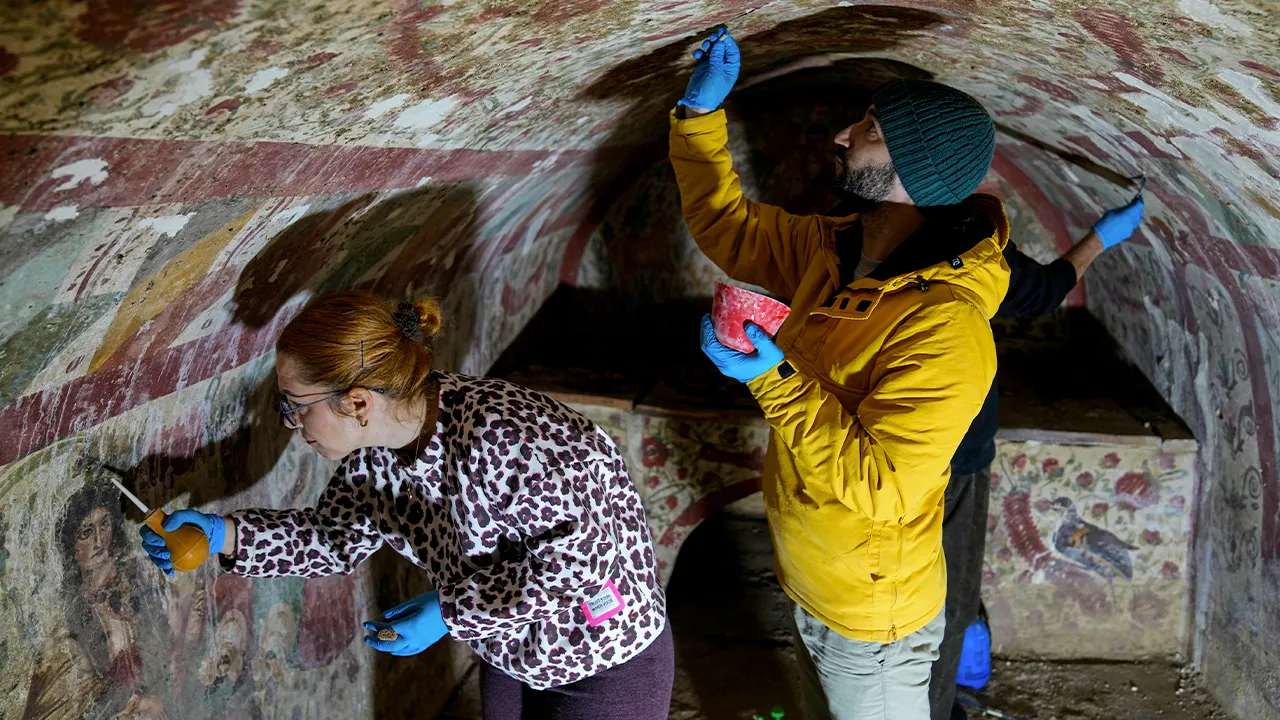
The artwork was discovered in August inside an underground tomb near Iznik, the historic city where the Nicene Creed—a cornerstone statement of Christian belief—was established in 325 AD. The tomb itself is believed to date back to the third century when the region was under Roman rule and Christianity faced widespread persecution.
According to researchers who granted The Associated Press first access to the site, the fresco portrays a youthful, beardless Jesus dressed in a Roman toga while carrying a goat across his shoulders. This Roman-influenced depiction of Christ represents an unusual artistic choice for the region at that time.
The lead archaeologist heading the excavation believes this particular portrayal may be the “only example of its kind in Anatolia,” underscoring its exceptional historical and religious significance. The fresco’s preservation quality has astonished experts, who note that such intact early Christian imagery rarely survives in the region.
The discovery coincides with Pope Leo XIV’s recent visit to Turkey—his first international trip since assuming leadership of the Vatican. While in Iznik, the Pope commemorated the 1,700th anniversary of the Council of Nicaea, the ecclesiastical gathering that formulated the Nicene Creed still recited by millions of Christians worldwide.
During the papal visit, Turkish President Recep Tayyip Erdoğan presented Pope Leo XIV with a tile painting replicating the “Good Shepherd” fresco, highlighting the archaeological find’s diplomatic and cultural importance. Turkey, while predominantly Muslim today, contains numerous historically significant Christian sites dating back to the religion’s earliest centuries.
Iznik, formerly known as Nicaea, holds particular importance in Christian history as the location where Eastern and Western church leaders gathered in 325 AD to address theological disputes and establish doctrinal unity. The Council of Nicaea, convened by Roman Emperor Constantine I, produced the foundational creed that defined orthodox Christian beliefs about the nature of Christ and the Trinity.
While in Turkey, Pope Leo XIV joined Eastern Orthodox and Western Christian leaders in a symbolic prayer service at the historic site where the council was held. Together they recited the Nicene Creed, with the Pope emphasizing its role as “of fundamental importance in the journey that Christians are making toward full communion”—a reference to ongoing efforts to bridge divisions between various Christian denominations.
The discovery of the fresco provides a tangible connection to Christianity’s formative period when the religion was transitioning from a persecuted minority faith to an officially recognized institution within the Roman Empire. The artwork’s Roman artistic elements reflect this transitional period when Christian imagery was still evolving, often borrowing from existing Greco-Roman visual traditions.
Archaeological work continues at the tomb site as researchers carefully document and preserve the fresco and surrounding structures. Experts anticipate that further analysis of the artwork and tomb may yield additional insights into early Christian communities in Anatolia during a crucial period of religious development.
The “Good Shepherd” motif itself carries particular theological significance in Christian tradition, referencing biblical passages where Jesus describes himself as the shepherd who cares for his flock—a metaphor for his relationship with followers. The discovery adds a valuable piece to scholars’ understanding of how early Christians visualized their faith through art during periods of persecution and transition.
Fact Checker
Verify the accuracy of this article using The Disinformation Commission analysis and real-time sources.

8 Comments
I’m curious to learn more about the artistic influences and symbolism behind this depiction of Christ as the “Good Shepherd.” The Roman toga is an intriguing stylistic choice that seems to blend local and imperial traditions.
This is a remarkable archaeological find, shedding light on early Christian art and worship in Anatolia. The fresco’s unique depiction of a youthful, toga-clad Jesus is quite intriguing and likely reflects the cultural influences of the region at the time.
The timing of this discovery, coinciding with a recent papal visit to the area, is quite intriguing. I wonder if there will be any official statements or reactions from the Vatican regarding this rare and significant find.
This discovery adds another fascinating chapter to the complex history of Christianity’s spread and evolution across Anatolia. It will be exciting to see what further analysis of the fresco and its context can reveal.
While the religious significance of this fresco is undoubtedly important, I’m also struck by its potential historical value. Insights into early Christian art and practices could shed light on the region’s social and cultural dynamics at the time.
The exceptional preservation of this 3rd-century artwork is truly astounding. It’s exciting to think of the insights it could provide into the religious and artistic practices of Anatolia’s early Christian communities.
Agreed, the level of detail and color in the fresco is quite remarkable given its age. Archaeologists must be thrilled to have uncovered such a significant piece of early Christian history.
As an art historian, I’m eager to see how scholars interpret the artistic merits and symbolic meaning of this fresco. The blend of Roman and early Christian elements is quite fascinating.