


Listen to the article
Inside a Massive Scam Compound: Thai Military Reveals Scale of Cross-Border Operation
O’SMACH, Cambodia — The industrial-scale scam compound seized by Thailand’s military last December sprawls across nearly 200 acres of Cambodian border territory, a facility so vast it equals 150 American football fields in size.
During a media tour on Tuesday, Thai military officials guided journalists through the O’Smach Resort complex, offering a rare glimpse into one of Southeast Asia’s largest fraudulent operations centers. The sheer magnitude of the facility dwarfs any previously documented scam compound in the region.
“Every country of the world has to join together to solve this problem, (we) cannot do it alone with Cambodia and Thailand,” said Air Chief Marshal Prapas Sornchaidee, who led the media tour.
The complex contains 157 buildings, including 29 dedicated to housing scam operations, alongside massive dormitories and luxury accommodations ranging from apartments to three-story villas. Military officials estimate at least 10,000 people lived and worked at the facility before Thai forces took control during a border conflict with Cambodia in December.
Thai authorities say they seized the area after Cambodian forces used it as a base for launching attacks across the border. The compound’s ownership is tied to Cambodian politician Ly Yong Phat, who faces U.S. sanctions for human rights abuses within this same complex. However, officials could not confirm whether Ly owns the newer construction evident throughout the site, where piles of bricks and idle construction cranes suggest an operation that was still expanding.
Throughout the grounds, evidence of daily life remains frozen in time. A variety of Chinese restaurants catering to regional tastes — from spicy Hunan cuisine to southern Shaxian specialties and Sichuanese hot and sour rice noodles — suggests the diverse origins of the compound’s former occupants.
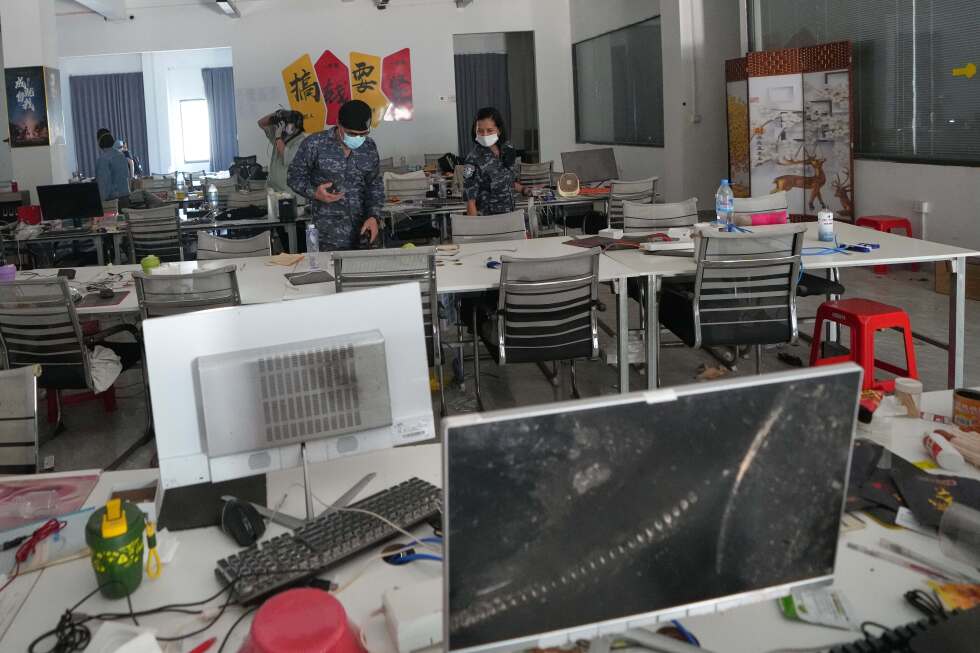
Inside a four-story office building, desks remain littered with scripts, Chinese-language notes, American SIM cards, and partially consumed snacks — all abandoned when the occupants fled. One particularly elaborate script stretched 24 pages, detailing the fictional life story of “Mila,” a character designed to manipulate American victims.
The Mila persona included an intricate backstory: a widow who lost her husband to leukemia, leaving her to raise their daughter alone, with additional details about childhood bullying and being sent to live with an uncle in South Africa. Such elaborate character development demonstrates the sophisticated psychological manipulation tactics employed to gain victims’ trust.
The O’Smach compound represents just one node in a vast criminal network that has proliferated across Southeast Asia since the COVID-19 pandemic. According to recent United Nations estimates, approximately 300,000 workers are involved in these fraudulent operations throughout the region.
The timing of this media tour coincides with the FBI’s release of troubling data showing Americans lost nearly $21 billion to scams in 2023 alone. Many of these losses can be traced back to operations like those found at O’Smach, where workers systematically targeted U.S. citizens using elaborate social engineering techniques and investment fraud schemes.
These scam compounds have mushroomed across Cambodia, Myanmar, and Laos in recent years, often operating in special economic zones or border areas where jurisdiction is complex and enforcement challenging. Many workers within these facilities are themselves victims of human trafficking, lured by false promises of legitimate employment only to be forced into scamming operations under threat of violence.
While both Thailand and Cambodia have publicly committed to addressing these criminal enterprises, the cross-border nature of the operations makes enforcement difficult without coordinated international action. The scale of the O’Smach complex alone demonstrates how these operations have evolved from small-scale fraud into industrial-level criminal enterprises with infrastructure rivaling small towns.
As construction materials sit waiting throughout the complex, the question remains whether this raid represents a significant blow to regional scam operations or merely a temporary disruption to an adaptive criminal industry that continues to evolve and relocate across Southeast Asia’s porous borders.
Fact Checker
Verify the accuracy of this article using The Disinformation Commission analysis and real-time sources.

12 Comments
Wow, the scale of this scam compound is truly mind-boggling. It’s alarming to see the level of organization and investment required to establish such a massive fraudulent operation. This is a wake-up call for the need to strengthen cross-border cooperation and information sharing to combat these criminal enterprises.
Absolutely. The fact that tens of thousands of people were involved in these scams is a sobering reminder of the pervasiveness of these criminal networks. Effective dismantling of such operations will require a sustained, coordinated global effort.
This is a sobering reminder of the need for enhanced border security and international coordination to combat transnational organized crime. The fact that such a massive scam operation could be established right on the border is concerning.
Absolutely. The ability of these criminal groups to operate across borders with such impunity highlights the vulnerabilities in the region that need to be addressed through increased cooperation and information sharing between law enforcement agencies.
This report really underscores the need for greater regional cooperation and information sharing to tackle these complex, transnational scams. The fact that such a massive operation could be established right on the border is deeply concerning.
Agreed. The ability of these criminal groups to operate across borders with seeming impunity highlights the urgent need for coordinated, multinational efforts to disrupt and dismantle their activities.
Fascinating look into the scale and complexity of these cross-border scam operations. It’s alarming to see how many people were involved and the sheer size of the facilities. Clearly a massive coordinated effort that will require international cooperation to address effectively.
You’re right, the scope of this scam network is staggering. Tackling such large-scale fraud will take a concerted global effort to shut down these criminal enterprises.
This report on the massive scam compound on the Thailand-Cambodia border is deeply concerning. The sheer scale of the operation, with hundreds of buildings and thousands of people involved, underscores the need for enhanced regional cooperation and information sharing to combat these transnational criminal enterprises.
You’re right, the level of organization and investment required to establish such a sprawling fraudulent operation is staggering. Tackling these complex, cross-border scams will require a concerted, multinational approach to be successful.
The sheer scale of this scam compound is mind-boggling. It’s alarming to think that tens of thousands of people were involved in these fraudulent activities. Clearly these criminal enterprises have become highly sophisticated and entrenched in the region.
You’re right, the level of organization and investment required to build such a massive operation is staggering. It’s going to take a major, sustained effort to dismantle these cross-border scam networks.