


Listen to the article
Ancient Egyptian Pharaoh’s Boat Being Assembled at Grand Egyptian Museum
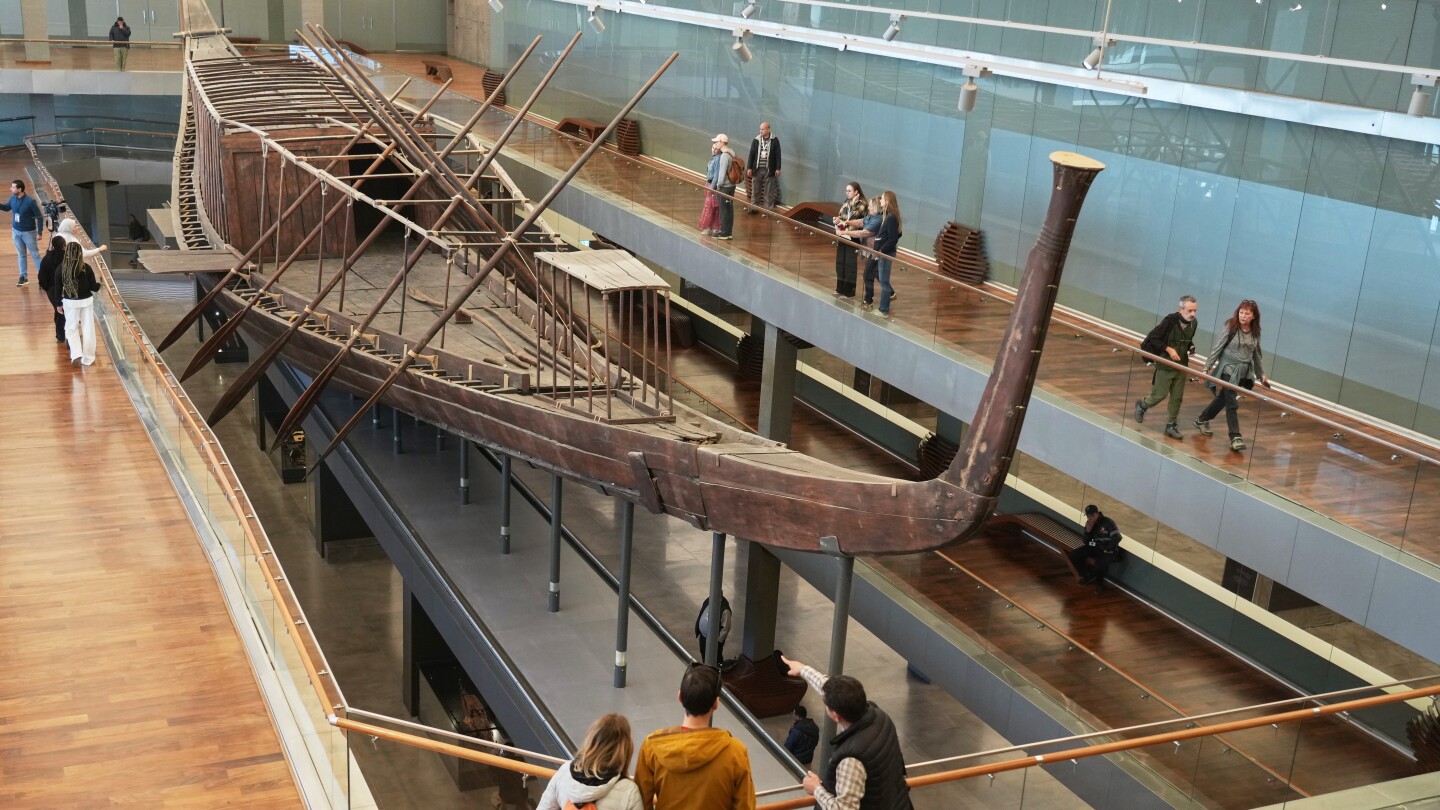
Museum visitors in Cairo are witnessing history unfold as restoration experts begin the painstaking process of assembling an ancient Egyptian pharaoh’s boat in the exhibition hall of the Grand Egyptian Museum.
The 42-meter (137-foot) cedarwood vessel, one of two boats belonging to King Khufu who ruled Egypt more than 4,500 years ago, is being pieced together in full public view. The assembly process began Tuesday morning as dozens of onlookers watched the first stages of what officials say will be a four-year project.
“You’re witnessing today one of the most important restoration projects in the 21st century,” declared Tourism and Antiquities Minister Sherif Fathy, who attended the launch event. The boat contains 1,650 wooden pieces that must be carefully fitted together to reconstruct the ancient vessel.
The boat will eventually sit alongside its already-assembled twin, which has been on public display. Both vessels were discovered in 1954 on the southern side of the Great Pyramid at Giza, which Khufu commissioned during his reign. Excavation of the second boat’s wooden components only began in 2014, according to museum documentation.
Archaeologists remain uncertain about the vessels’ exact purpose. Most experts believe they were either used to transport Khufu’s body during his funeral procession or were intended for his spiritual journey in the afterlife, possibly to accompany the sun god Ra.
Issa Zeidan, head of restoration at the Grand Egyptian Museum, emphasized the complexity of the project, which involves specialized techniques to preserve the millennia-old wood while ensuring structural integrity. The public assembly represents a rare opportunity for visitors to witness archaeological conservation work that typically occurs behind closed doors.
The restoration project takes place within the $1 billion Grand Egyptian Museum, which was inaugurated last month with considerable fanfare. Billed as the world’s largest archaeological museum, the GEM houses nearly 50,000 artifacts spanning thousands of years of Egyptian history. Its crown jewel is the collection of treasures from King Tutankhamun’s tomb, discovered by British archaeologist Howard Carter in 1922.
The museum’s location near the pyramids at Giza positions it as a centerpiece in Egypt’s strategy to revitalize its tourism sector, which has struggled in recent years due to regional instability, the COVID-19 pandemic, and economic challenges. Tourism officials hope the museum will help boost visitor numbers and foreign currency revenue, providing much-needed support for Egypt’s ailing economy.
Egypt’s tourism industry, which accounts for approximately 12 percent of GDP and employs nearly three million people directly and indirectly, has been gradually recovering. The government has invested heavily in archaeological projects and museum development to diversify its tourism offerings beyond beach resorts.
The public assembly of Khufu’s boat represents a new approach to museum exhibitions, combining traditional displays with live conservation work. This interactive element offers visitors insight into the meticulous processes involved in preserving ancient artifacts.
Khufu, also known by the Hellenized name Cheops, was the second pharaoh of the Fourth Dynasty during the Old Kingdom period. His Great Pyramid at Giza is the oldest and largest of the three pyramids in the Giza complex and the oldest of the Seven Wonders of the Ancient World.
As visitors observe the gradual reconstruction of this ancient vessel, they witness not only a remarkable feat of archaeological restoration but also a tangible connection to one of history’s most powerful rulers and the civilization he commanded more than four millennia ago.
Fact Checker
Verify the accuracy of this article using The Disinformation Commission analysis and real-time sources.

13 Comments
This is a truly remarkable project. Preserving and showcasing Egypt’s incredible ancient heritage is so important. I’m glad the public can witness this painstaking restoration process firsthand.
Agreed, it’s a unique opportunity to see history being brought back to life. The Grand Egyptian Museum is doing a wonderful job showcasing the country’s remarkable archaeological treasures.
Reassembling a 4,500-year-old pharaoh’s boat in public view is an incredible feat of engineering and historical preservation. It must be awe-inspiring for visitors to watch this unfold.
I can only imagine how captivating it must be to witness this process in person. Egypt has such an incredible cultural legacy, and projects like this help bring the past to life.
The Grand Egyptian Museum is doing an amazing job bringing this piece of history back to life. Reassembling a 4,500-year-old pharaoh’s boat in full public view is a truly remarkable feat. I commend the restoration experts for their dedication to preserving Egypt’s cultural legacy.
Incredible to see this ancient Egyptian pharaoh’s boat being reassembled in public. It’s a testament to the skill and craftsmanship of the restoration experts. I can’t wait to see the finished product alongside its twin.
Seeing an ancient Egyptian pharaoh’s boat being reassembled in public is a once-in-a-lifetime opportunity. I hope the Grand Egyptian Museum’s efforts to engage the public in this process inspire greater interest and appreciation for archaeology.
Reassembling a 4,500-year-old pharaoh’s boat in public view is a remarkable achievement. The level of skill and attention to detail required must be immense. I’m eager to learn more about the specific techniques and challenges involved in preserving this ancient artifact.
What an incredible opportunity to see history being brought back to life. Witnessing the restoration of this ancient Egyptian pharaoh’s boat must be a truly awe-inspiring experience. I commend the Grand Egyptian Museum for their dedication to showcasing Egypt’s remarkable archaeological treasures.
What an incredible undertaking to restore and display this ancient Egyptian artifact. The level of craftsmanship and attention to detail required must be immense. I’m eager to see the final result when the boat is fully assembled.
This is a remarkable project that showcases Egypt’s commitment to preserving its ancient heritage. I’m curious to learn more about the specific restoration techniques being used to carefully piece together this ancient vessel.
The reassembly of this ancient Egyptian pharaoh’s boat is a remarkable example of the importance of historical preservation. It’s wonderful that the public can engage with this process and gain a deeper appreciation for Egypt’s rich cultural heritage.
This is a captivating project that will undoubtedly capture the imagination of visitors to the Grand Egyptian Museum. Witnessing the painstaking process of reassembling an ancient Egyptian pharaoh’s boat must be a humbling experience. I’m curious to learn more about the challenges involved in preserving such an invaluable artifact.