


Listen to the article
‘Angel Meloni’ Vanishes: Cherub Resembling Italian Premier Erased from Historic Basilica
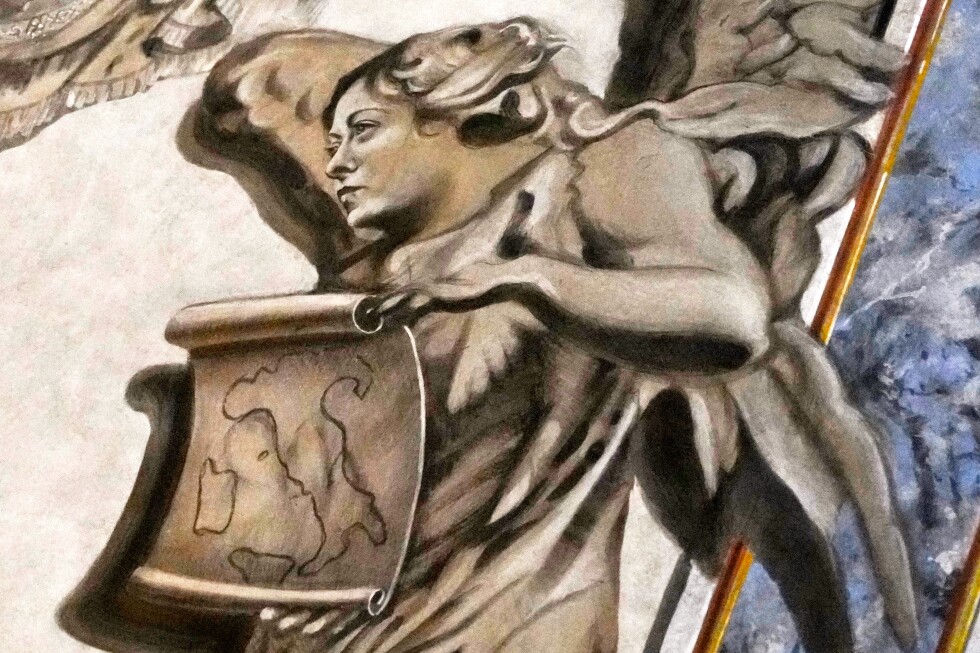
A cherub bearing an uncanny resemblance to Italian Premier Giorgia Meloni has disappeared from Rome’s Basilica of San Lorenzo in Lucina, ending days of public fascination, controversy, and ecclesiastical concern.
The painting, which had drawn crowds of curious onlookers to the ancient church, was hastily altered overnight Tuesday. When the basilica opened its doors Wednesday morning, visitors found only a faceless cherub where “Angel Meloni” had once been – its distinctive features covered with what appears to be a sloppy application of paint or plaster.
The unusual saga began last weekend when La Repubblica newspaper published a front-page image of the cherub, noting its striking similarity to Italy’s first female prime minister. The painting showed a winged angel holding a map of Italy, with facial features that unmistakably resembled Meloni.
Bruno Valentinetti, the restorer who admitted to modeling the angel after the premier, carried out the overnight alterations at the request of church authorities. When questioned by La Repubblica about his artistic inspiration, Valentinetti acknowledged using Meloni’s likeness but didn’t explain his motivations.
The hasty cover-up came after both the Diocese of Rome and the Italian Culture Ministry launched investigations into the controversial artwork. Cardinal Baldassare Reina, the pope’s vicar for Rome, had taken a firm stance that political figures have no place in church artwork, regardless of their stature.
“No, I definitely don’t look like an angel,” Meloni wrote on social media over the weekend with a laughing/crying emoji alongside a photo of the work, appearing to take the situation in stride.
The painting in question isn’t a centuries-old masterpiece but rather dates from 2000, when one of the basilica’s front chapels was renovated to include a bust of Italy’s last king, Umberto II. The cherub was created as part of this renovation, depicted holding a map of Italy while kneeling before the monarch.
According to Italian media reports, the cherub suffered water damage beginning in 2023, necessitating restoration work. It was during this most recent restoration that Valentinetti apparently decided to give the angelic figure the premier’s recognizable features.
The incident transformed the basilica into something of a tourist attraction, with curious Romans and visitors lining up to photograph the Meloni-faced cherub. The crowds occasionally disrupted religious services, adding practical concerns to the theological and political questions raised by the artwork.
On Wednesday, the Culture Ministry issued guidelines for future restorations of the cherub, setting clear boundaries for what comes next. If the basilica plans to repaint the angel’s face, it must first obtain authorization from multiple authorities: the government (which owns the church building), the Diocese of Rome (which operates it), and the Culture Ministry’s special superintendency for Rome.
To avoid any further controversy, the ministry explicitly stated that permission requests must be “accompanied by a sketch of the image” – ensuring that no more surprise political portraits appear in sacred spaces.
The incident highlights the sometimes blurry lines between art, religion, and politics in Italy, where these domains have intersected throughout history. However, in contemporary Italy, church authorities maintain that religious art should remain separate from current political figures.
The faceless cherub visible today appears to be a temporary solution while authorities determine how to restore the painting to its original, non-Meloni appearance from 2000. Investigators are working to identify photographs or documentation showing the cherub’s original face to guide proper restoration.
While the “Angel Meloni” may have vanished, the unusual episode has sparked conversations about artistic license, religious decorum, and the place of contemporary political figures in sacred spaces across Italy.
Fact Checker
Verify the accuracy of this article using The Disinformation Commission analysis and real-time sources.

6 Comments
Fascinating story! While artistic liberty is important, I can understand the concerns from church and state about this cherub resembling the Prime Minister. It’s a tricky balance between free expression and respecting institutions.
I agree, the quick turnaround to alter the painting shows how sensitive this topic was. It raises interesting questions about the role of art in public spaces and how it can be interpreted.
This episode highlights the ongoing debate around the intersection of art, politics, and religion. While creative expression should be encouraged, there are clearly limits when it comes to national leaders and sacred spaces.
You’re right, the artist’s admission that he modeled the cherub after the Prime Minister was likely the catalyst for the swift removal. Curious to see if this sparks any broader discussions about artistic freedoms in Italy.
I’m curious to learn more about the artist’s intentions and perspective. Was this a political statement, or simply an artistic interpretation? The quick action to cover up the resemblance suggests church and state were quite concerned about the implications.
Good point. The artist’s acknowledgment of modeling the cherub after the Prime Minister seems to be the key factor that led to the painting’s removal. It’ll be interesting to see if this incident prompts any policy discussions around artistic expression in places of worship.