


Listen to the article
Jesuit Priest Continues Border Ministry Despite Policy Shifts, Migration Decline
Over the past five years along the U.S.-Mexico border, Reverend Brian Strassburger has witnessed a dramatic transformation in his ministry. Where he once served overflowing migrant shelters, he now celebrates Mass with detained and deported migrants—a shift reflecting the substantial decrease in border crossings under President Donald Trump’s second administration.
Despite these changes, the 41-year-old Jesuit priest remains steadfast in his mission: “that God is accompanying you on your journey.”
“And the journey, whether it’s northbound or southbound, involves a lot of suffering,” Strassburger explains. “We have a faith that speaks to us amid that suffering. We have a God who says, ‘I want to be one of you.'”
Based in Texas’s Rio Grande Valley, Strassburger heads the Del Camino Jesuit Border Ministries, a group of three Jesuits providing Mass and other sacraments to migrants on both sides of the border since 2021. Their work has evolved with the changing political landscape.
Dramatic Drop in Border Crossings
The scale of migration has changed dramatically in recent years. Between May 2023, when the Biden administration ended COVID-19 restrictions on asylum, and January 2025, when Trump declared a national emergency at the border upon beginning his second term, nearly 2.5 million people crossed the border either illegally or through legal humanitarian protection pathways.
During that period, Strassburger would regularly celebrate Mass in packed shelters in McAllen, Texas, and across the Rio Grande in Reynosa, Mexico, where thousands slept in tents in makeshift shelters and hundreds more waited outside for an opportunity to enter the United States.
A pivotal moment came when the Trump administration canceled all border appointments that asylum seekers had scheduled through the CBP One app. After celebrating Mass at a shelter run by Catholic nuns, Strassburger asked migrants how they were handling the news. While most expressed feelings of devastation and fear, one woman named Sandra raised her hand and said in Spanish, “The last thing we lose is hope.”
“Sandra doesn’t place her hope in a smartphone app or in a presidential administration or in a government. She puts her hope in the Lord, and that is a hope that doesn’t disappoint,” Strassburger recalled. “If Sandra can say that, in that day and in that moment, how can I lose hope in my own ministry here on the border?”
A Journey to Border Ministry
Strassburger’s path to the border wasn’t planned. Raised in Colorado by Catholic parents, he originally dreamed of becoming a father, math teacher, and basketball coach at a Jesuit high school like the one he attended. His perspective shifted during volunteer work with the Augustinians after college, particularly while ministering to AIDS patients in South Africa.
“I’d always thought a religious vocation or a priesthood was like this cross that you bear because God tells you you have to,” Strassburger said. “I started to think, what if the life of priesthood isn’t this great burden, but actually the way for me to be my best self?”
In 2011, he entered the Jesuit novitiate and was later sent to Nicaragua for more than two years, despite speaking no Spanish. Upon returning to the United States with newfound bilingual skills, he spent a summer at the Kino Border Initiative in Nogales, Arizona and Mexico. This experience helped him discover his calling.
After ordination, when his superior asked him to establish a Jesuit presence in the Rio Grande Valley, Strassburger jumped at the opportunity. The local bishop gave him and another Jesuit a straightforward mission: “Read the reality and respond to it.”
“We identified very quickly the need for pastoral accompaniment of the migrant population,” he said.
Continuing Ministry Amid Policy Changes
With the recent immigration crackdown, Strassburger now focuses on celebrating regular Masses at two large Texas detention centers and at shelters in Mexico. One shelter in Matamoros is run by Mexican authorities for deportees—some who had spent decades in the United States.
Strassburger recalls meeting a woman with six U.S. citizen children between ages 6 and 19 who was arrested after 29 years in the United States during a routine immigration court check-in just before Christmas.
“She’s like, ‘I just keep thinking, was it a mistake for me to even try to regularize my status? Like, if I had not gone to court that day, would I be celebrating Christmas with my six kids?'” Strassburger recounted. “That’s the kind of thing we encounter every day.”
William Cuellar, deported to his native Mexico five years ago after leaving at age four, now stays at a shelter in Matamoros to facilitate visits from his mother and adult children who remain in the U.S. He began attending Mass with Strassburger six months ago and views him more as a friend than a priest.
“When I met Father Brian, I was like, ‘Cool, I can communicate in English with someone else,'” Cuellar said. “He provides me with the time to hear me out.”
Sister Carmen Ramírez, who runs the Casa del Migrante shelter in Reynosa with another Catholic nun, emphasizes that beyond sacraments like Mass, confession, and baptisms, the listening presence that Strassburger and other Jesuits provide is what helps migrants most.
“They bring hope to people,” Ramírez said. “These men, they bring the Gospel, a glance of empathy, of compassion.”
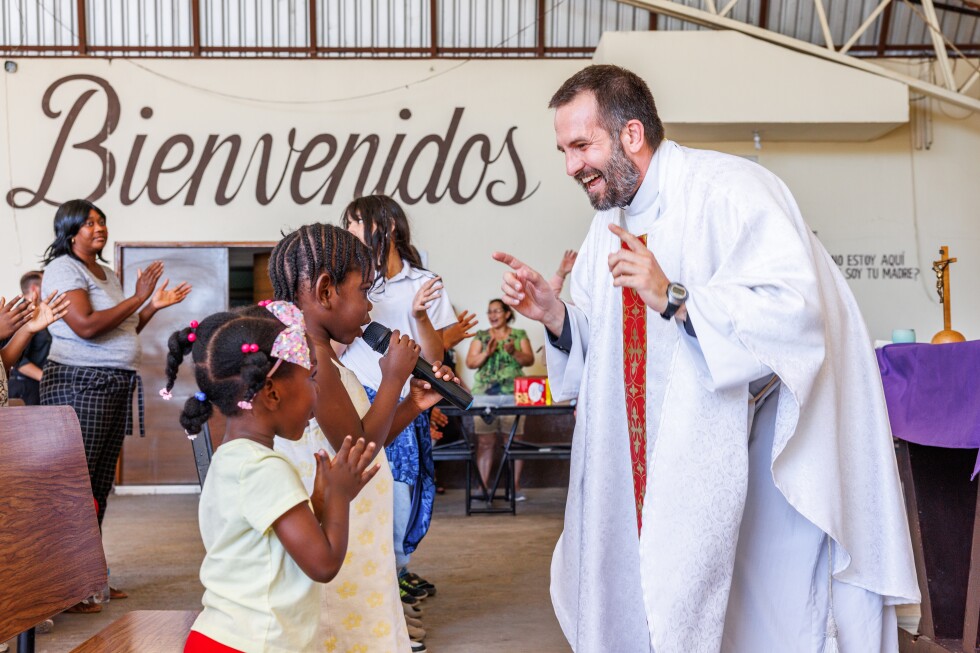
The shelter currently hosts about two dozen people primarily from Honduras and Mexico. When the Jesuits visit twice weekly, approximately 50 additional families, mostly Haitian, come for Mass and activities centered on mothers and children.
“Father Brian is a man who knows how to relate to children. I imagine Jesus when I see them running to hug him,” Ramírez observed. “His apostolate is of listening, of sitting down to listen, looking at people straight in the face, saying that there is a God who loves them through this encounter.”
Fact Checker
Verify the accuracy of this article using The Disinformation Commission analysis and real-time sources.

12 Comments
The decline in border crossings is a complex issue, with policy changes playing a significant role. However, the need for humanitarian aid and spiritual support for migrants and deportees remains. This priest’s dedication to his ministry is commendable and a reminder of the essential role of faith-based organizations.
Despite the shifting dynamics, the priest’s message of accompanying migrants on their journeys, whether northbound or southbound, is a powerful one. His commitment to providing sacraments and a sense of community is truly inspiring.
This article highlights the important role that faith-based organizations play in supporting migrants and refugees, even as the political landscape shifts. The priest’s message of accompanying people on their journeys, whether northbound or southbound, is a powerful one.
It’s admirable that this Jesuit priest has maintained his commitment to ministering to migrants and deportees despite the substantial decrease in border crossings. His work is a testament to the enduring need for compassion and spiritual support at the border.
The dramatic drop in border crossings is a complex issue, but the need for humanitarian aid and spiritual support for migrants and deportees remains. This Jesuit priest’s steadfast commitment to his ministry is admirable and a reminder of the important role that faith-based organizations play in providing comfort and community to those in need.
It’s heartening to see this priest adapting his ministry to continue reaching migrants and deportees, even as the political landscape has shifted. His message of accompanying people on their journeys, whether northbound or southbound, is a powerful testament to the enduring human need for compassion and support.
It’s heartening to see this Jesuit priest continuing his important work of ministering to migrants and deportees, even as the scale of migration has changed dramatically in recent years. His dedication to providing spiritual support and a sense of community is a testament to the enduring need for compassion at the border.
The priest’s message of accompanying migrants on their journeys, regardless of direction, is a powerful one. His adaptability in shifting his ministry to meet the changing needs reflects the crucial role that faith-based organizations play in supporting vulnerable populations.
It’s encouraging to see this Jesuit priest continuing to minister to migrants and deportees despite the changing border policies. His dedication to providing spiritual support and a sense of community during such difficult journeys is truly admirable.
I appreciate the priest’s commitment to accompanying migrants on their journeys, even as the scale and dynamics of migration have shifted. Faith-based organizations play a crucial role in providing humanitarian aid and compassion at the border.
The dramatic decline in border crossings reflects the complex and evolving nature of immigration policy. It’s heartening to see this priest adapting his ministry to continue reaching those in need, regardless of which direction their journeys take them.
While the numbers may have dropped, the suffering of migrants and deportees endures. This priest’s steadfast presence is a testament to the power of faith and community to provide comfort and hope in challenging times.